The Betty and Barney Hill Abduction: The Case That Created a Genre
A frightened couple drove home through the White Mountains in 1961 and, without meaning to, wrote the template every abduction has followed since.
Contents
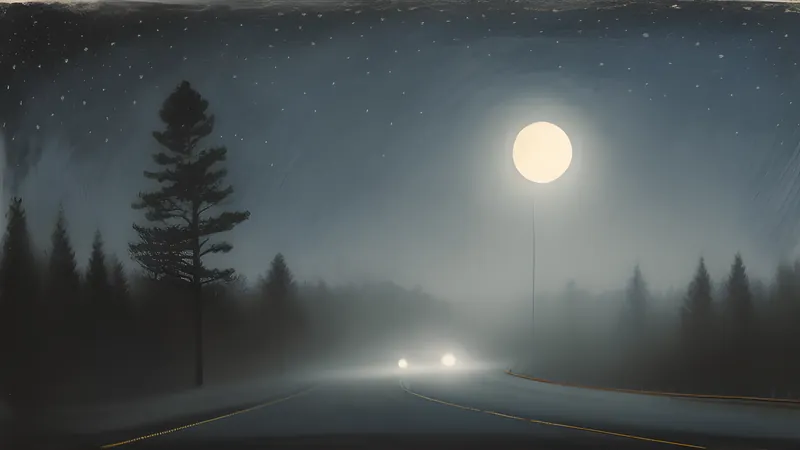
On the night of 19 September 1961, Betty and Barney Hill were driving home to Portsmouth, New Hampshire, along Route 3 through the White Mountains, coming back from a short holiday in Canada. They were an unusual couple for small-town New England at the time — she white, he Black, both active in the civil-rights movement, both members of their local Unitarian church and the NAACP. Somewhere south of Lancaster, Betty noticed a bright point of light that seemed to move against the stars. They stopped the car. Barney got out with a pair of binoculars, looked up at what he later described as a large craft with figures visible at its windows, and got back in badly shaken, telling Betty to drive because they were about to be captured.
They reached home near dawn, roughly two hours later than the distance should have taken, with a stretch of the drive they could not clearly account for. Out of that gap grew the first widely publicised, fully realised alien abduction narrative in modern history — the grey figures, the examination table, the needle in the navel, the lost time recovered under hypnosis. Nearly everything the word “abduction” now conjures traces back to a nervous couple on a mountain road who never asked to become the founders of anything. The case is worth taking seriously, and taking seriously does not mean deciding whether a spacecraft landed. It means asking how an experience this specific took hold and why it became the mould into which thousands of later experiences were poured.
Two hours no one could account for
The bare facts of the night are not really in dispute, because the Hills reported them almost at once and stuck to them. They saw a light behaving oddly. Barney observed it through binoculars and was frightened. They drove home rattled, arrived later than they expected, and both felt a lingering unease they could not name. Betty’s dress, she later noticed, was torn and stained; Barney’s shoes were oddly scuffed. Within days Betty reported the sighting to Pease Air Force Base, where it was logged, and the official explanation offered at the time leaned towards the couple having seen the planet Jupiter or a misidentified aircraft.
What they did not initially report was any abduction. In the first days and weeks the story was a frightening UFO sighting and a puzzling patch of missing time, nothing more. Betty began having vivid, recurring nightmares of being taken aboard a craft and examined. She read a book by the retired Marine Corps major Donald Keyhoe, a prominent UFO writer, and wrote to his organisation. The couple’s anxiety did not fade, and after nearly two years of it they sought help — which is where the case, and the genre, were truly born.
The doctor, the hypnosis, and the story that emerged
In late 1963 the Hills were referred to Dr Benjamin Simon, a respected Boston psychiatrist and neurologist who used hypnosis to treat trauma, work he had done with soldiers during the Second World War. Over months of sessions through 1964 he regressed Betty and Barney separately, and under hypnosis each described being taken from the car by short humanoid beings, led aboard a disc-shaped craft, and subjected to a medical examination. Betty described a long needle inserted into her navel, which she was told was a pregnancy test. Barney described eyes that seemed to wrap around the beings’ heads. Betty described being shown a “star map” of trade and exploration routes, which she later reproduced from memory.
The detail is what makes the case magnetic, and also what makes Dr Simon’s own conclusion so important, because it is usually left out of the retellings. Simon did not believe his patients had been aboard a spacecraft. His clinical judgement was that the abduction narrative was a fantasy — most likely originating in Betty’s dreams, which she had discussed at length with Barney, and which had become a shared story the couple absorbed and then relived under hypnosis. He regarded hypnosis as a route to what a patient believed and felt, not a lie detector or a video recording of past events. His own view, from the doctor who spent more hours inside this case than anyone, was that the terror was real and the abduction was not literally so.
What hypnosis actually does
Here is the fork, and it is a clinical one rather than a question of honesty, because the Hills were plainly sincere. The decades since 1961 have taught investigators a great deal about what happens under hypnotic regression, and almost none of it supports the idea that hypnosis unlocks buried true memories. The psychologist Elizabeth Loftus and many others have shown, in careful experimental work, that memory is reconstructive and highly suggestible — that confidently held, emotionally vivid, richly detailed recollections can be generated for events that never occurred, and that leading questions and expectation shape what a subject “remembers.” Hypnosis, far from bypassing this, tends to amplify it, increasing both the vividness of recall and the subject’s certainty while doing nothing to improve accuracy.
A person regressed while looking for the source of a two-year fear, primed by nightmares, popular UFO books and a culture already full of flying-saucer imagery, is in close to ideal conditions for constructing a detailed narrative that feels utterly real. This is not deception and not stupidity; it is how ordinary human memory behaves under those specific pressures. The Hills came out of hypnosis genuinely believing they had lived what they described, because in every sense that memory can be lived, they had.
The timing and the imagery offer their own quiet clues. Betty’s nightmares began before the hypnosis and were detailed and recurring; she recounted them to Barney over the two years between the sighting and the sessions with Dr Simon. When the couple were regressed, the abduction narrative that emerged closely tracked the content of those dreams — the same beings, the same examination, the same needle. A sceptic and a believer can look at that sequence and read it in opposite directions: as a memory finally surfacing, or as a dream, told and retold, hardening over two years into something the mind came to file as an event. What is not in doubt is that the frightening material existed in Betty’s dream life well before hypnosis claimed to recover it as history.
The star map has become the case’s evidentiary crown jewel, and it repays the same careful handling. In 1968 an amateur astronomer and schoolteacher named Marjorie Fish built three-dimensional models of nearby star systems and concluded that Betty’s sketch matched a view from the vicinity of the double star Zeta Reticuli. It is a striking claim and it electrified believers. Later analysts, including the astronomer and science writer Carl Sagan and the sceptic Robert Sheaffer, argued that the “match” was the kind of pattern the human eye will find in almost any field of dots if it is motivated to, and that shifting stellar-distance data undercut Fish’s specific fit. A pattern recovered from a hypnotically enhanced memory, then matched against stars by a determined interpreter, is a chain in which each link invites the next reading — the same pull towards meaningful shape that keeps people finding predictions in old Simpsons episodes and messages in misremembered brand logos.
The journey from one couple to a whole genre
The Hills’ story reached the public in 1966, when the journalist John G. Fuller published The Interrupted Journey, drawing on Dr Simon’s session tapes with the couple’s cooperation. A 1975 television film, The UFO Incident, with James Earl Jones as Barney, carried it to a vast audience. And from there the specific furniture of the Hill account — the missing time, the grey humanoids with enormous eyes, the medical examination, the recovery of the whole event through hypnotic regression — became the standard script. Later abduction reports, and later abduction researchers such as Budd Hopkins and the Harvard psychiatrist John Mack, worked almost entirely within the template the Hills had unknowingly laid down, very often using the same hypnotic-regression method that produced it in the first place.
This is the folklorist’s central observation about the case. Before 1961 there was no fixed idea of what an alien abduction was supposed to look like; afterwards there was a genre with a grammar, and thousands of people’s genuine, frightening experiences flowed into that grammar and took its shape. The Hills did not merely report an event. They supplied a vocabulary, and once a vocabulary exists, human experience organises itself around it. That is how modern folklore propagates — through a shared script that tells frightened people what their fear must have meant. It sits in the same lineage as the pines of Rendlesham Forest and the balloon that became a Roswell spaceship, each supplying later witnesses with a ready-made shape for the unexplained.
What the encounter was really about
There is a reading of the Hills’ experience that treats them with the seriousness they deserve, and it starts from who they actually were. Betty and Barney were an interracial couple in 1961, an activist Black man and white woman driving alone at night through the white, rural North of a country in which their marriage was still illegal in many states and their safety on a dark road was a real and reasonable fear. Barney, in particular, carried the constant vigilance that being a Black man in mid-century America demanded. Some who have studied the case gently suggest that the encounter’s imagery — of being watched, stopped, seized, subjected to an intimate physical examination by powerful figures who regarded him as a specimen — reads as a near-perfect distillation of anxieties the Hills lived with in waking life.
That is not a claim that they “really” experienced a metaphor rather than a spacecraft; it is an observation that terror finds images to inhabit, and the images it finds are drawn from what already frightens us. Whatever the Hills saw in the sky that night was real enough to shake two grounded, credible people badly. What their minds built from it over the following years, under nightmare and hypnosis and the pull of a culture ready to supply the parts, was a story that carried far more than one drive through the mountains.
The Hills went to their deaths — Barney in 1969, Betty in 2004 — believing something extraordinary had happened to them, and there is no honest reason to doubt that they believed it or to sneer at them for doing so. What they left behind is stranger and, in a way, larger than an abduction: a demonstration of how a single frightened account, given a vocabulary and a method, can become the frame through which countless later people understand their own missing hours. The lights over Route 3 have never been explained. The genre they gave birth to explains itself perfectly, which is exactly the thing worth being curious about.
Related Content