The Berners Street Hoax: The Prank That Besieged a London Address
In 1810 a single letter-writer turned a quiet address into the busiest door in London
Contents
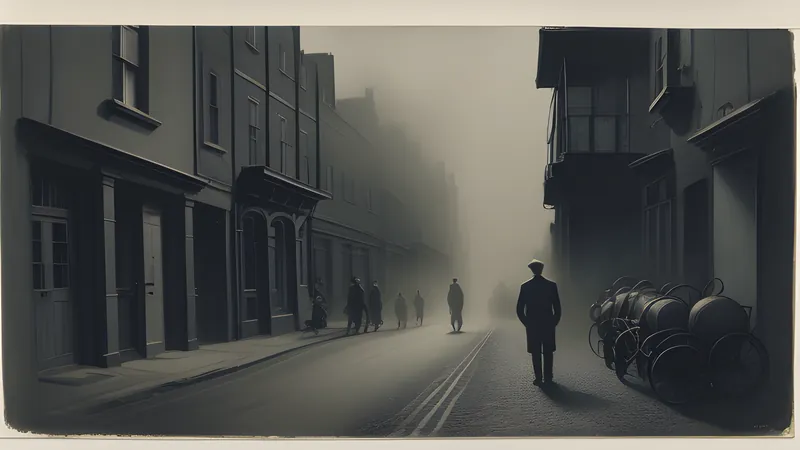
On the morning of 27 November 1810, a chimney sweep knocked at 54 Berners Street, in the Marylebone district of London, and told the servant who answered that he had been engaged to clean the chimneys. He was informed, not for the last time that day, that no one in the house had sent for him. He had barely been turned away when a second sweep arrived on the same errand, then a third, then a small procession of them, each holding the same conviction and the same address. Behind the sweeps came coal wagons. Behind the coal came cakes, ordered by the dozen from every confectioner in the district, and behind the cakes came the whole apparatus of Georgian commerce, converging on a single quiet house occupied by a widow named Mrs Tottenham, who had done nothing at all to deserve it.
The day a street stopped working
The volume of it is what the contemporary accounts dwell on, and what makes the episode more than an anecdote. Over the course of the day, by the estimates that survive, something on the order of a thousand tradespeople and callers arrived at the door, each summoned by a letter written in a fine hand, each certain of an appointment that did not exist. Fishmongers came with barrows of fish. Wine merchants delivered dozens they had never been sent for. Wig-makers, opticians, jewellers, bootmakers, upholsterers turned up with samples and invoices. Coffin-makers arrived to measure a body, having been told the lady of the house had died. Midwives came for a birth. A brewer sent a dray. Furniture, pianos, an organ, wedding cakes and coal all fought for the same stretch of pavement outside a single front door.
Then the letters climbed the social ladder. The Governor of the Bank of England was persuaded to call, on the understanding that his presence was urgently required. The chairman of the East India Company came. The Lord Mayor of London himself, Sir James Shaw, arrived in his carriage, having received a letter that appeared to summon him on official business, and had to extricate himself and his carriage from a crush of tradesmen’s carts. The Duke of Gloucester and the Archbishop of Canterbury were among those said to have been drawn in. By afternoon the street was impassable. Carts locked wheels, crowds gathered to watch the crowds, and the parish constables who were called to clear it could do very little, because nobody present had committed any crime. Each person had simply answered a letter in good faith and arrived where they were asked to arrive.
The man behind the window
Across the road, at a lodging he had taken specifically for the purpose, a young man named Theodore Edward Hook sat at a window with a friend and watched the whole thing unfold. Hook was twenty-two, a playwright and celebrated wit, and the machinery below him was entirely his own. The engine of the hoax was correspondence. In the weeks before, Hook and a small circle of accomplices had written — by the traditional count, though the number is impossible to verify exactly — something like a thousand letters, each in the confident hand of a genuine commission, each requesting that a particular tradesman or dignitary attend at 54 Berners Street at a stated hour on that stated day. There was no machinery, no accomplice on the ground, no ongoing manipulation once the post had gone out. Hook had simply loaded the ordinary infrastructure of the city — the penny post, the honest habit of keeping an appointment — and let it fire itself.
Why he did it is the part most often repeated, and the part hardest to pin down. The story that has come down is that Hook made a wager with his friend Samuel Beazley that he could transform any house in London into the most talked-about address in the city within a week, and that he chose Mrs Tottenham’s door more or less at random to win the bet. Whether the wager is literal fact or a tidy explanation attached afterwards, it captures something true about Hook’s temperament. He was a man who lived for the practical joke and the improvised song, a fixture of Regency drawing rooms famous for his nerve, and the Berners Street affair was less a crime of malice than an experiment in how much chaos one clever person could conjure from paper and other people’s good manners.
What the hoax actually exploited
It is worth being precise about what Hook did and did not do, because the mechanism is the interesting part. He deceived no one about anything, in the ordinary sense. He made no false object, forged no artefact, told no lie that any individual recipient could have caught. Each letter, taken alone, was an unremarkable request that a tradesman had every reason to honour. The deception existed only in aggregate, in the collision of a thousand honest responses at a single point in space and time. The victims were not gullible; they were reliable. The chimney sweep who came to sweep a chimney, the coffin-maker who came to measure the dead, the Lord Mayor who answered what looked like an official summons — every one of them was behaving exactly as a functioning society requires its members to behave, and that dependability was the raw material Hook worked with.
This is why the Berners Street hoax has kept its place in the folklore of pranks for two centuries, when countless nastier and more elaborate schemes have been forgotten. It is a demonstration, almost a proof, of a principle that the modern world would rediscover again and again: that a system built on trust can be turned into a weapon simply by pointing all of its inputs at one target. There was nothing to disbelieve. The genius, if that is the word, lay in understanding that individual scepticism offers no defence against a threat that is only visible from above.
The escape and the legend
Hook was never charged. Suspicion fell on him quickly — he was a known wit with a known appetite for exactly this kind of stunt — but there was no proof, and Hook prudently left London for a time, retreating to the country until the heat cooled. The absence of a trial has meant that almost everything we think we know about the mechanics comes secondhand, refined and rounded by retelling, and the historian’s honest position is that the famous numbers should be held loosely. The core of the affair is solidly attested in the contemporary press, which reported the siege of Berners Street as fact; the precise figure of a thousand letters, the exact roster of dignitaries, the neat wager with Beazley — these have the polish of a story that has been told well many times, and some of that polish may be later addition.
Much of what later hardened into settled fact traces to a single source. Richard Harris Barham — a clergyman and satirist better remembered today as the author of the Ingoldsby Legends — was a friend of Hook’s, and his 1849 memoir The Life and Remains of Theodore Edward Hook, written eight years after Hook’s death, is where the tidiest version of the story, wager and all, first appears in print in the form still repeated now. Barham was working from drawing-room anecdote and his own long acquaintance with the man, not from a court record or a diary Hook kept at the time, and a modern reader should treat his account the way any biography written by an admiring friend deserves to be treated: broadly reliable on the shape of events, generous on the details that flatter its subject’s wit.
What is not in doubt is the shape of it, and the shape is what matters. Hook went on to a considerable career as a novelist and editor, and to a reputation as one of the great improvisers of his age, but nothing else he did outlived the morning he spent at a rented window watching London deliver itself to a stranger’s door.
The man who could not resist a stage
Theodore Hook is worth lingering on, because the hoax fits the life exactly. He was a prodigy of the Regency stage and salon — a composer of comic operas in his teens, a professional wit whose party trick was to improvise entire songs, verse after verse, on subjects the guests threw at him, weaving the names of everyone present into the rhymes. He lived by performance and audience reaction, and he treated the whole city as a potential room to work. In 1812, two years after Berners Street, his talents earned him an appointment as accountant-general and treasurer of Mauritius, a lucrative colonial post; it ended in disaster when a large shortfall was found in the accounts and Hook was brought home under a cloud, later spending time confined for the debt. He turned to writing, founded and edited the fiercely Tory paper John Bull, produced a stream of popular novels, and died in 1841, exhausted and in debt, having burned through an enormous natural gift.
Seen against that arc, Berners Street reads less like an isolated cruelty than like the purest expression of a temperament that needed an audience and could not always tell the difference between wit and harm. The same nerve that let him improvise a song for a drawing room let him orchestrate a siege for a street, and the same restlessness that made him magnetic company made him incapable of leaving a good idea unexecuted, whatever the cost to a blameless widow in Marylebone.
The pleasure of watching a system fail
The reason people still tell this story is not really the inconvenience to Mrs Tottenham, who by every account was frightened and exhausted and entirely blameless. It is the vision of a whole city’s orderly machinery seizing up at once, glimpsed from a safe distance. There is a particular delight, apparently durable across centuries, in watching the confident structures of daily life — commerce, hierarchy, the reliable keeping of appointments — turn briefly absurd, and in knowing that the absurdity was set in motion by nothing more than a man with good handwriting and too much time. The prank is funny because it is bloodless and because it reveals something we half-suspect anyway: that the whole edifice runs on trust, and that trust, pointed the wrong way, becomes the mechanism of its own collapse.
The phrase itself outlived the specifics of who did what to whom. Newspapers were still reaching for “a Berners Street hoax” as generic shorthand for a letter-borne prank when interest in this exact kind of engineered inconvenience resurfaced a century later: in 1910, Virginia Woolf and a handful of Bloomsbury friends, disguised as an Abyssinian royal delegation, talked their way aboard HMS Dreadnought for an official tour, in a stunt that the press of the day reached for older vocabulary to describe. Hook’s afternoon had already given English the template a hundred years before anyone needed it again.
That insight has aged unnervingly well. Every era since has found its own way to aim a crowd of honest actors at a single undeserving target — the phone tree, the mailing list, the viral post that summons ten thousand strangers to one person’s door. Hook did it with a quill and the penny post, and the fact that it still works, in principle, is the reason his afternoon at the window is remembered.
For kindred studies in spectacle and the crowd’s role in it, see the Balloon Boy hoax, a modern staged emergency that turned a live audience into unwitting participants, and the Cardiff Giant, where a whole nation queued up to be fooled and then queued up again to enjoy having been.
Related Content