The Beast of Busco: Indiana's Giant-Turtle Hunt
In 1949 a small Indiana town drained a lake chasing a monster turtle — and got a festival that outlived the search
Contents
In the spring of 1949, a farmer named Gale Harris looked out across the seven-acre pond on his land near Churubusco, Indiana, and saw something break the surface that he swore was the size of a dining-room table. He was not the first. A local man had reported a monstrous turtle in the same water back in 1898, and the pond had carried the name Fulk Lake and a quiet reputation for decades. But it was Harris who chased it, and it was Harris who turned a farm pond into a national news story, because he decided he was going to catch the thing — and the whole country came to watch him fail.
The Beast of Busco is one of the gentlest monster stories America has, and one of the most instructive. There is almost certainly a real animal at the bottom of it. There is definitely a real town that reorganised its entire identity around the hunt. And there is a clean, documented record of exactly how a plausible large turtle became “Oscar,” a fifteen-stone reptile the size of a car, without anyone quite lying.
The pond and the farmer
Fulk Lake sat on land that had passed to Gale Harris, and the turtle stories attached to it were genuinely old — the 1898 sighting by a man named Oscar Fulk is why the creature was eventually nicknamed Oscar. When Harris and a couple of companions reported seeing an enormous turtle in March 1949, the local paper picked it up, and from there the wire services did what wire services did: a strange, harmless, visual story out of small-town Indiana was exactly the sort of thing to run in papers from Fort Wayne to the coasts. Reporters started arriving. So did the curious, in numbers the town of about a thousand people had never seen.
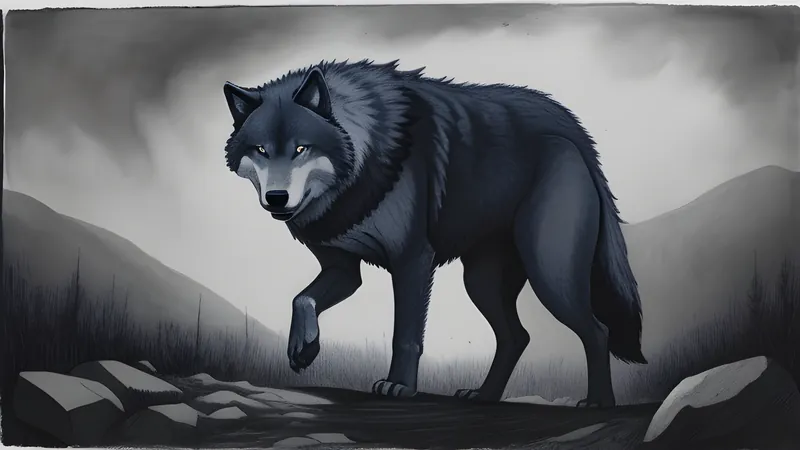
Harris gave the estimates that made the legend. He described a turtle he put at something like five hundred pounds, with a shell four feet across — a snapping turtle, if it was one, scaled up to the dimensions of folklore. Those numbers matter, because they are the load-bearing fiction of the whole affair, and they came from a frightened, excited man looking at a dark shape in murky water and doing what human beings reliably do with dark shapes in murky water: rounding up. No scale was ever involved.
The hunt that drained a lake
What followed over 1949 was not a rumour that faded. It was a months-long, escalating, physical campaign to lay hands on the animal, and its very seriousness is what fixed the legend in place. Harris and volunteers tried nets. They tried baited hooks. At one point a diver went down into the cold, silty water to feel for the creature by hand and came up having found nothing he could hold. They brought in the idea of using a female sea turtle as a lure. The efforts grew more elaborate and more desperate as the crowds and the newspaper attention swelled through the spring and summer.
The climax was the draining. Harris resolved to pump Fulk Lake dry and simply expose whatever was living in it. The pumping went on for days; the mud at the bottom became a hazard in its own right; the operation was plagued by breakdowns and, by some accounts, by Harris’s own deteriorating finances and health as the obsession consumed the season he should have been farming. And when the water was low enough to see what the lake held, the answer was: no monster. Oscar was not there, or was never there, or had slipped away through the mud, depending on who was telling it. The most expensive turtle hunt in Indiana history ended with an empty, ruined pond and a man who had spent himself chasing a shape.
What was probably actually in the water
Here is the part a folklorist should concede without flinching, because conceding it is what makes the rest honest. Indiana ponds really do contain large snapping turtles, and the common snapping turtle, Chelydra serpentina, is a genuinely alarming animal to meet at close range — a spiked, algae-crusted, prehistoric-looking thing with a strike quick enough to take a finger. The much larger alligator snapping turtle, Macrochelys temminckii, native to more southern river systems, can exceed a hundred pounds and looks, frankly, like a myth that forgot to stay in the swamp. A very large old snapper in Fulk Lake, glimpsed surfacing and gone, is not merely possible. It is the likeliest single explanation for the sightings that started the whole thing in 1898 and recurred in 1949.
So the kernel is real and it is zoological: a big turtle, in a pond known for big turtles, in a state where big turtles live. The fork — the exact place the record and the legend part company — is not the existence of the animal. It is the size. A forty-pound snapper is a startling thing to haul out of a farm pond and a completely ordinary fact of Indiana wildlife. A five-hundred-pound one is a creature that does not exist, has never been documented anywhere on earth, and would rewrite herpetology if it did. The legend lives entirely in the gap between those two numbers, and that gap was filled by estimation under excitement rather than by evidence — the same over-scaling that turns a big stray dog into a black panther, or a floating log into a lake monster. The pattern of a real, mundane animal inflated into a marvel is the same one that runs under Champ, Lake Champlain’s home-grown Nessie.
How the town kept the monster
Most failed monster hunts simply fade, and the community that hosted one grows quietly embarrassed. Churubusco did the opposite, and this is the genuinely interesting turn. Rather than let Oscar drain away with the lake, the town adopted him. In 1950, the year after the hunt collapsed, Churubusco held its first Turtle Days festival — a civic celebration built directly on the monster it had failed to catch. Turtle Days is still running more than seventy years later, an annual summer event with a parade, a queen, food stalls and turtle races, and the town has cheerfully rebranded itself “Turtle Town, U.S.A.” Oscar failed to appear in the mud in 1949 and has been the mascot of the place ever since.
That is a revealing decision, and worth taking seriously rather than smiling past. The town did not need Oscar to be real to keep him. What it needed was for Oscar to be theirs — a story that put a specific dot on the map named Churubusco, in a flat stretch of northeastern Indiana that had no other reason to be famous. A monster you have failed to catch is, in a sense, a better civic asset than one you have caught, because it can never be disproved by being produced. Oscar’s permanent absence is exactly what makes him permanently available. The legend is load-bearing for the town’s identity, and everyone involved knows it and enjoys it, which is a healthier relationship with a monster than most communities manage.
The cost of the certainty
It is worth staying a moment with what the hunt did to Gale Harris, because the human wreckage is the part the festival cheerfully forgets. The 1949 campaign consumed a farming season Harris could not spare. The pumping to drain the lake dragged on for a fortnight and more, machinery failing repeatedly, and by several accounts Harris injured himself badly during the operation and let his farm work slide while the crowds and reporters watched him pursue the thing in the mud. The estimates of what it cost him vary, but the shape is consistent: a man who spent money, health and a growing season he did not have on the compulsion to drag a single certainty up out of the water. When the drained lakebed produced no monster, it also produced no vindication, and Harris was left with a ruined pond and a story the town would enjoy far more than he had.
The monster itself had a longer pedigree than 1949. The pond had carried its reputation since at least 1898, when a local man named Oscar Fulk reported an enormous turtle in the same water — the sighting that eventually gave the creature its nickname. Half a century of quiet local talk sat behind Harris’s fright, which is exactly why his sighting caught: he was not inventing a monster, he was confirming one the neighbourhood had half-believed since before he was born. The “drain the lake and settle it” impulse is itself an old American folk-motif, the frontier conviction that any mystery will yield to enough labour and machinery. Harris tested that conviction to its limit and found its floor. Some questions do not resolve, however hard you pump, and a lakebed of mud is what stubbornness looks like when it finally runs out of water.
What the giant turtle was really about
Strip the story back and the Beast of Busco is not really about a reptile at all. It is about Gale Harris, a farmer who saw something he could not name and could not let go of, and who spent a season and a small fortune trying to drag a certainty up out of the mud so he could hold it in his hands. There is something almost unbearably human in the image of a man pumping a lake dry, day after day, machinery failing around him, neighbours and reporters watching, because he could not stand to leave the question open. He wanted the shape in the water to resolve into a fact. It never did, and it cost him.
The town’s answer to that unresolved question was wiser than the hunt that produced it. Churubusco stopped trying to catch Oscar and started celebrating him — turned an unanswerable question into an annual party. That is, in miniature, what a great deal of folklore is for. A community takes a genuinely strange event it cannot fully explain, declines to be tormented by the not-knowing the way poor Harris was, and instead builds something warm and repeatable around the mystery. The Loch Ness shoreline does the same thing on a grander scale, and for the same reason: an uncatchable monster is a renewable resource, and a good story is more use to a place than a dead specimen would ever be.
Somewhere in Fulk Lake, or wherever its waters drained to, there may genuinely have been an unusually large old snapping turtle — a real animal, minding its own prehistoric business, briefly the most hunted creature in America and entirely uninterested in the fact. It was never five hundred pounds. It never needed to be. Churubusco caught the only version of Oscar that was ever going to matter: the one they get to keep.
Related Content