The Beast of Bray Road: Wisconsin's Roadside Werewolf
How a rural stretch of asphalt outside Elkhorn became America's most-quoted dogman sighting

Contents
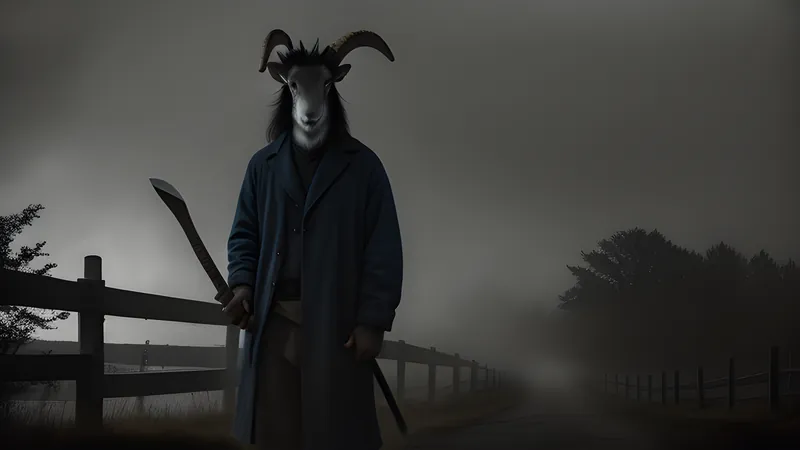
Bray Road runs about two miles of unremarkable blacktop through farmland outside Elkhorn, Wisconsin, the kind of road that shows up on a county map and nowhere else. In the autumn of 1991 a young woman named Doris Gipson was driving it after dark when her headlights caught something crouched over a shape in the gravel at the roadside. It rose onto two legs. Covered in dark fur, roughly the height of a person, with a long muzzle and pointed ears, it turned toward her car, and for a few seconds before it dropped back to all fours and loped into the ditch, she had a clear look at something she had no name for. She reported it to the local sheriff’s department, mostly, she said later, because she wanted someone in authority to know what was on that road.
Several other Walworth County residents came forward over the following months with similar accounts along the same rural corridor: a wolf-like animal that stood upright, walked like a person for short stretches, and showed no fear of headlights. The reports reached a young reporter at the local weekly, the Week Times, whose job was covering township meetings and county fairs. Her name was Linda Godfrey, and what she found when she started asking around was a genuine pattern — independent witnesses, unconnected to each other, describing the same creature on the same few miles of road within the same season.
The kernel: a reporter’s notebook, not a campfire
What makes Bray Road different from most cryptid cases is how well documented its origin actually is. Godfrey did not set out to create a legend. She was doing local journalism, the unglamorous kind, and she treated the sightings the way she would treat any story with multiple corroborating sources: she wrote down names, dates, and details, and she published what people told her without editorial embellishment. Her first article ran in the Week Times in early 1992, describing the Gipson sighting and two others from the same stretch of road, and it named the location plainly enough that curious readers started driving out to Bray Road themselves, some of them reporting sightings of their own.
Godfrey later found an older account that predated her reporting by more than fifty years. In 1936, a farmer named Mark Schackleman was plowing a field near a Native American effigy mound in neighboring Jefferson County when he claimed to see a large, upright, wolf-like creature crouched at the mound’s edge, digging. He described it in terms strikingly similar to what Gipson and the others would report decades later: powerful shoulders, a doglike face, and a gait that shifted between two legs and four. Whether Schackleman’s account reached the 1991 witnesses before they made their own reports, or whether the two events are simply parallel descriptions of the same rural half-glimpsed animal, is impossible to establish. What is established is that both accounts exist as dated, sourced records rather than undated campfire retellings, which is rarer than it sounds in cryptozoology.
Godfrey’s method mattered as much as her material. She interviewed witnesses individually rather than in a group, cross-checked timelines against when each person could plausibly have heard about earlier reports, and printed the accounts with names attached wherever witnesses allowed it — a level of sourcing closer to small-town courthouse reporting than to the anonymous “a local man claims” style that most monster stories rely on. That rigor is exactly why the case has held up as a reference point for cryptozoologists and folklorists alike: whatever the creature turns out to have been, the documentary trail around the sightings themselves is unusually solid.
Where the road forks from the record
The documented part of the story is a stretch of Wisconsin road, a handful of named witnesses, and a reporter who wrote their accounts down responsibly. The fork happens in what came after. Once the story left Walworth County, it stopped being a local pattern of sightings and became raw material for a national genre. A 1992 episode of Unsolved Mysteries brought the Bray Road reports to a television audience many times larger than the Week Times’s circulation, and the tabloid press followed, reshaping “a large upright canid seen near a rural road” into “Wisconsin Werewolf,” a headline built for shock rather than accuracy. Godfrey herself, to her credit, resisted the werewolf framing in her own writing — she never claimed lycanthropy, only that witnesses had seen something they couldn’t identify — but the label stuck to the case regardless of what she’d actually written.
The bigger fork came with the word “dogman” itself, which did not exist as a cryptozoological category before the 1990s. Once Bray Road had national visibility, older and geographically scattered reports of bipedal canine creatures from Michigan, Ohio, and elsewhere in the upper Midwest were retroactively folded into the same label, as though they’d always belonged to one continuous tradition. Some of that borrowed material was itself openly manufactured: the Michigan Dogman traces to a 1987 novelty radio song, written by a local DJ as an April Fools’ joke, that inspired a wave of copycat sighting reports once listeners realized the “1938” date buried in the lyrics sounded plausible enough to check. By the time dogman conventions and cable documentaries arrived, Bray Road had become the flagship case in a genre partly built from a joke and partly from Godfrey’s careful local reporting, with most audiences given no way to tell which parts were which.
The label also absorbed folklore that long predates any of it. Algonquian-speaking peoples across the Great Lakes region had their own tradition of a dangerous, human-adjacent figure of the deep woods, a story that colonial settlers later flattened and repurposed into something closer to a generic monster; the Wendigo’s journey from a sacred warning to a horror trope followed the same basic mechanism that pulled scattered Midwestern canid sightings under the “dogman” umbrella — a specific, culturally rooted story losing its original context as it’s repackaged for outside audiences hungry for a new monster rather than an old warning.
How the story travelled and changed shape
Godfrey went on to write The Beast of Bray Road: Tailing Wisconsin’s Werewolf in 2003, then several follow-up books collecting dogman reports from across the country. Each book widened the net a little further, and each retelling smoothed the specific, dated, geographically anchored Walworth County reports into something closer to archetype: a single roaming “beast” rather than a cluster of local sightings that happened to share a description. Local businesses in Elkhorn leaned into the association, and Bray Road itself became a minor tourist curiosity, visited by monster-hunting road-trippers the way the-jersey-devil-how-a-colonial-grudge-grew-wings turned a stretch of the Pine Barrens into pilgrimage territory. Wisconsin, it turned out, had its own hometown monster market, and less than an hour’s drive from Bray Road, the city of Rhinelander had already discovered exactly how profitable a good local cryptid could be with its own carved and celebrated Hodag.
Wildlife biologists offer a mundane explanation that fits the physical descriptions reasonably well without requiring any of the witnesses to be lying. Coyote-wolf hybrids, increasingly common across the upper Midwest as coyote range has expanded into former wolf territory, are larger and more heavily built than a standard coyote, and an animal suffering from sarcoptic mange — a parasitic mite infestation that causes severe hair loss and skin thickening — can look startlingly unfamiliar at night, its silhouette reading as something closer to human than canine. A large, mangy hybrid canid rising briefly onto its hind legs to sniff the air, a common behavior when an animal is startled, would produce exactly the kind of half-second upright glimpse that several Bray Road witnesses described.
None of the witnesses had any obvious reason to fabricate an encounter. Gipson was driving home from a routine errand, not seeking out a story, and the other Walworth County residents who came forward were mostly farmers and long-time locals with no prior interest in cryptozoology and no financial stake in what they’d seen. That ordinariness is part of what convinced Godfrey the reports deserved careful documentation rather than dismissal, and it’s also what makes the biological explanation and the folklore explanation compatible rather than competing: a genuinely strange-looking animal, seen briefly in poor light by people primed by generations of inherited monster stories, produces exactly this kind of account.
What the road was really carrying
None of that makes the witnesses careless or foolish. A driver alone on an unlit rural road at night, catching a large animal in her headlights for two or three seconds, is working with genuinely poor information, and the brain’s instinct to fill gaps with the most alarming plausible shape is not a character flaw, it’s how human vision works under stress. What the Bray Road case really carries is the older tradition that produced werewolf folklore across Northern Europe for centuries, brought to Wisconsin’s dairy country by German and Scandinavian settlers who arrived with their own upright-wolf stories already fully formed, and layered onto a landscape where genuinely uncanny nocturnal animal encounters were common enough that the folklore had somewhere to land. Godfrey, when asked directly whether she believed the creature was supernatural, tended to deflect the question entirely, saying only that she trusted the witnesses to know what they had seen even if science couldn’t yet supply the label for it.
That refusal to force a verdict is, in its way, the most honest position available. The people who stood on Bray Road at night and watched something they couldn’t name share something with the farmer at the effigy mound in 1936, and with anyone who has ever driven an unlit road and caught a shape at the treeline that resolved, on a second look, into something both stranger and more ordinary than what the mind offered first. A sincere witness and a manufactured legend can grow from the very same road without contradicting each other: Gipson’s account was hers alone, unplanned and unrehearsed, while the national “Bray Road Beast” that followed was assembled afterward, piece by piece, out of her testimony, Schackleman’s decades-old memory, a Michigan DJ’s prank song, and a publishing industry that had discovered dogman books sold well.
The road itself is still there, still unremarkable in daylight, carrying dairy trucks between fields the way it always did before 1991. What changed is that a local reporter did her job carefully enough that a scattering of frightened, sincere accounts became durable enough to survive fifty years, several books, and an entire cable-television subgenre built largely on borrowing its name. Elkhorn’s tourism office still fields the occasional question about where exactly to find the road, and answers it plainly, because by now the honest response to “was it real” was never really the point. The story that survived is the one about how a handful of ordinary people, on an ordinary road, described the same impossible thing closely enough that a good reporter believed they deserved to be taken seriously — and refused to tidy their accounts into either a hoax or a confirmed monster just to give the rest of us a cleaner ending.
Related Content