The Backrooms and Folklore Born From an Image
How one blurry photo of an empty office spawned a mythology built by thousands of strangers
Contents
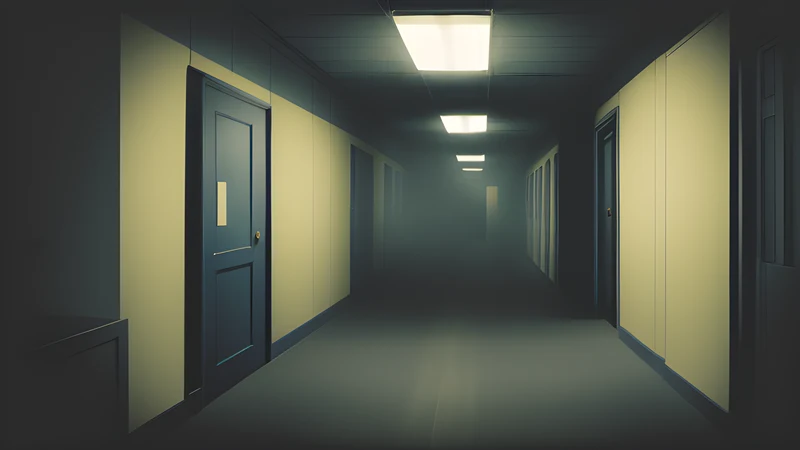
There is a photograph you may have seen without knowing its name. A room, or the corner of one, papered in a sickly mustard yellow. Damp beige carpet. A grid of fluorescent ceiling panels, one of them slightly out of true. No furniture, no windows, no people, no obvious exit. The picture is faintly out of focus, as though taken in a hurry or by a camera that could not decide where to rest. It looks like nowhere in particular, which is precisely why it looks like somewhere you have been. That single image, posted to an anonymous message board in the spring of 2019, is the seed crystal of one of the most elaborate pieces of folklore the internet has yet produced.
The Backrooms began on 4chan’s paranormal board, /x/, in May 2019. A thread invited people to post images that felt “off,” unsettling in a way they could not quite explain. Among the replies came the yellow room, and beneath it an anonymous user wrote a caption that did the real work. If you are not careful and you “noclip” out of reality in the wrong areas, it said, you will end up here: some six hundred million square miles of randomly segmented empty rooms, the smell of moist carpet, the buzz of fluorescent lights at maximum hum, and the endless background noise of the yellow. “God save you,” it finished, “if you hear something wandering around nearby, because it sure as hell has heard you.” In a few dozen words, an ordinary snapshot became a place with rules, a threat, and a door.
What the image actually was
The photograph itself has a mundane provenance, which is part of what makes the story worth telling. For years its origin was unknown, adding to its aura; the picture seemed to come from nowhere, a fitting birthplace for a realm that is nowhere. In 2024 an internet archivist tracked it to its source: it was a genuine snapshot taken in a business in Oshkosh, Wisconsin, a shop mid-renovation, the yellow walls freshly painted and the space emptied of stock. An entirely real room in an entirely real American town, caught at the one moment when it looked like a wound in the world. There was no darkroom trickery and no artist’s intent. The uncanny quality was an accident of renovation and a cheap camera, and the caption supplied everything else.
This matters because it locates the whole edifice precisely. The Backrooms are not built on a hoax in the ordinary sense; nobody was trying to deceive anyone about a real place. They are built on a feeling, the specific dread of a familiar space made empty and wrong, and on the collective decision of thousands of people to take that feeling seriously enough to elaborate it. The raw material was a documentary fact, a photograph of a shop. The mythology was volunteered.
The aesthetic that was waiting
The Backrooms landed in soil already prepared. In the late 2010s a sensibility had been spreading online under the name “liminal spaces,” a fascination with transitional, in-between places emptied of their usual function: deserted shopping malls at night, hotel corridors, school hallways in the summer holidays, motorway service stations at three in the morning. A liminal space is one you are meant to pass through rather than stay in, and photographing it empty produces a particular unease, a sense that time has stopped and that you have been left behind. Subreddits and image accounts devoted to these pictures had built an audience primed to feel exactly the emotion the yellow room delivered.
There was a nostalgic undertow to it as well. Many of the images that thrived in this genre resembled the spaces of a 1980s or 1990s childhood, the carpeted play areas and strip-lit corridors and municipal swimming pools of a generation now grown up. The Backrooms tapped a grief that had no name, the feeling of a familiar place you can never return to because it existed only in memory, or perhaps never quite as you remember it. The genre that grew up around this feeling, sometimes called dreamcore or weirdcore, dealt in exactly this sense of a childhood half-remembered and subtly corrupted. The yellow room felt like a place you had been as a small child and had somehow always known was waiting.
How the legend grew
What happened next is the part a folklorist watches with real fascination, because it is the ancient process of collaborative mythmaking running at internet speed and in full public view. The original post described one place. Within months, contributors had built a cosmology around it.
The single yellow expanse became “Level 0,” the first of an ever-expanding catalogue of levels, each with its own environment, its own hazards, its own lore. There were levels of endless flooded corridors, levels of vast dark warehouses, levels that were pleasant and safe, documented on a collaborative wiki in the deadpan register of a technical manual or a survival guide. Entities were catalogued and given clinical designations. Rules of navigation were codified. The whole thing acquired the texture of a shared world, maintained by hundreds of contributors who argued over canon, wrote entries, and policed consistency with the seriousness of monks copying scripture. No single author owns it. It is a genuine folk creation, authored by a crowd and belonging to no one.
The Backrooms found their most powerful storyteller in a teenager. In 2022 a young American filmmaker named Kane Parsons, posting as Kane Pixels, released a short found-footage film titled simply The Backrooms on YouTube. It imagined a person falling into the yellow rooms and being pursued by something unseen, rendered with a low-fidelity home-video realism that made it feel discovered rather than made. It was watched tens of millions of times, spawned a series, and drew the attention of the film studio A24, which announced a feature adaptation. A schoolboy’s short film had become the most authoritative telling of a myth that a few years earlier had been a single anonymous caption.
The register that made it convincing
One detail of how the Backrooms are written deserves its own attention, because it explains a great deal of the myth’s power. The wiki entries and survival guides are composed in a flat, bureaucratic, deadpan voice, the register of a maintenance manual or an internal report. Levels are numbered. Entities are given catalogue codes and threat classifications. Survival advice is offered in the calm, itemised tone of a health-and-safety notice: how much of the almond water is safe to drink, which corridors to avoid, what to do if the lights begin to flicker. This documentary flatness is the single most important stylistic choice in the whole enterprise.
The reason is that horror delivered in the language of officialdom borrows the authority of officialdom. When a phenomenon is described in the same measured tone a government agency would use to describe a chemical hazard, the reader’s guard drops; the form implies that somewhere a serious body has studied the thing and is managing it. This is the same mechanism, transposed to fiction, that lets a hoax dressed in the trappings of a trusted broadcast slip past an audience’s scepticism. The Backrooms feel real in the specific way a leaked classified file feels real, and the community sustains that feeling with a shared, unspoken commitment to never breaking character. The pleasure is partly the pleasure of a collaborative game whose only rule is that you play it straight.
There is a further consequence to the crowd-authored, manual-like form. Because no single person controls the canon, the mythology can absorb almost any contribution and grow indefinitely, the way older oral traditions grew as each teller added a village, a name, a warning. Contradictions are smoothed over or forked into alternative versions; the wiki even distinguishes between competing continuities. This is precisely how living folklore behaves. A tradition owned by everyone and no one has no final text, only an endless present tense of retelling, and the Backrooms have all the messy, argued-over vitality of a genuine folk corpus rather than the fixed shape of a single author’s invention.
The deep pattern beneath the yellow
To understand why the Backrooms took hold, it helps to see them as the latest expression of a very old human impulse. Every culture has told stories about the place next to this one, the other world reachable through a thin spot in reality. The fairy hills of Ireland, into which a wanderer might stumble and lose years. The concept of Limbo, the borderland of the dead. The wardrobe that opens onto Narnia. The Backrooms are a modern furnishing of that eternal room, kitted out with the details of contemporary anxiety: the office, the retail unit, the fluorescent tube, the carpet tile. The other world of a bygone age was a green mound or a dark wood; the other world of the office-working, screen-lit present is an infinite open-plan floor that hums.
The fear the Backrooms name is a distinctly modern one. It is the dread of the interchangeable, mass-produced spaces that so much of contemporary life is conducted in, the sense that these places have no soul and that being trapped alone in one forever would be a particular kind of hell. It is also the fear of getting lost inside a system too large to comprehend, six hundred million square miles with no map and no exit, which is not a bad description of how the internet itself can feel. The legend gives shape and story to a diffuse unease that a great many people share, and shaping a formless dread into a place with rules is one of the oldest comforts storytelling offers.
The Backrooms are the clearest recent example of a phenomenon worth naming: folklore made in public, by a crowd, from a scrap of found material. The internet inherited this process from far older traditions and merely accelerated it enormously, making every stage of it visible. The same thing happened a decade earlier with the monster the internet made in Slender Man, a figure conjured in a 2009 forum challenge and elaborated by strangers into a genuine bogeyman, and it echoes the way an arcade cabinet that never existed accreted a full mythology of government experiments and vanished players. In each case an ordinary seed, a photoshopped figure, a half-remembered game, a photograph of a shop, was watered by a community that wanted the story to be real enough to build on.
Why we keep the door open
There is a temptation to describe all this as mere play, a game that nobody truly believes, and to leave it there. That undersells what is happening. The people who contribute to the Backrooms wiki, who film the corridors, who lie awake slightly unsettled by the yellow, are engaged in something their ancestors would have recognised at once: the communal manufacture of a story that holds a real feeling. The belief involved is not the literal conviction that one might physically fall through the office floor into an endless maze. It is a willingness to treat the feeling as true, to honour the dread by giving it a geography, and to share that geography with strangers until it becomes a place everyone half-knows.
That the seed was a photograph of a shop in Wisconsin does nothing to diminish this. Legends have always grown from ordinary things, a standing stone, a stretch of bad road, a house where something once happened. What the Backrooms show, with unusual clarity because the whole process is timestamped and public, is that the machinery of folklore is still running, still turning the mundane into the mythic, still answering a nameless modern fear with an old and human reply. Somewhere out there is a repainted shop that looked, for one badly focused moment, like the antechamber to nowhere, and thousands of strangers looked at it and quietly agreed to be haunted together.
Related Content