The Amityville Horror: The House That Sold a Book
A real mass murder, twenty-eight days, and the haunting that was written over bottles of wine
Contents
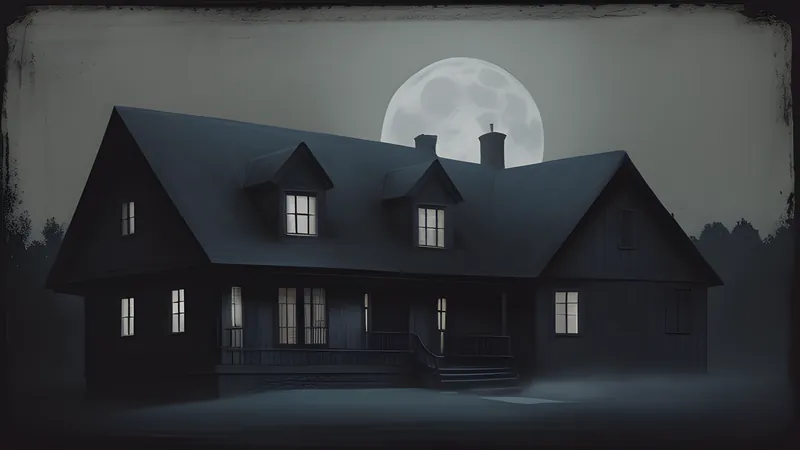
The house at 112 Ocean Avenue in Amityville, on the south shore of Long Island, is a large Dutch Colonial with a pair of quarter-round windows set high in the gambrel roof, so that from the street the upper storey looks faintly like a face with two watchful eyes. That detail has sold a great many book covers and cinema posters. It is also, once you know what really happened there, the least frightening thing about the address, because the true horror of Amityville needed no ghosts at all.
The kernel: a real and terrible crime
Everything about the Amityville legend rests on a foundation of genuine, documented atrocity, and it is worth stating that foundation plainly before any of the supernatural machinery is switched on.
In the early hours of 13 November 1974, twenty-three-year-old Ronald DeFeo Jr — known as Butch — took a high-powered rifle and shot dead six members of his own family as they slept in that house: his father Ronald Sr, his mother Louise, his two younger brothers, and his two younger sisters. All six were found lying face down in their beds. DeFeo was arrested, convicted in 1975 of six counts of second-degree murder, and sentenced to six consecutive terms of twenty-five years to life; he died in prison in 2021. The killings are a matter of court record, forensic evidence and multiple graves, one of the worst family mass murders in the history of New York State. That is the real thing at the centre of Amityville, and it earns every ounce of dread the name now carries.
The fork: twenty-eight days
Thirteen months after the murders, in December 1975, George and Kathleen Lutz bought the house. It was on the market cheaply — around eighty thousand dollars, remarkably low for a substantial waterfront-adjacent property, precisely because of what had happened in it — and the Lutzes, a young couple with three children from Kathy’s previous marriage, knew the history and bought it anyway. They moved in. Twenty-eight days later they fled, abandoning most of their possessions, and never spent another night there.
What they described in the weeks and months that followed became the Amityville Horror. George woke every night at around 3:15 a.m., close to the estimated time of the DeFeo killings. Green slime oozed from the walls and keyholes. Swarms of flies appeared in the dead of winter. Cold spots and foul smells came and went. A crucifix turned upside down. Kathy levitated off the bed and, briefly, aged into a haggard old woman. Cloven hoofprints appeared in the snow outside. A priest who came to bless the house was struck by a disembodied voice commanding him to get out, and afterwards suffered a mysterious illness. Youngest daughter Missy acquired an invisible friend, a demonic pig-like creature with glowing red eyes that George glimpsed at a window. It was a comprehensive, escalating, cinematic haunting, and within two years it was a hardback book on bestseller lists across America.
How the horror was built
This is the fork where the record and the story part company, and here the record is unusually candid, because one of the people who helped construct the tale later told on himself.
William Weber had been Ronald DeFeo’s defence attorney. He had a professional interest in the idea that the house was malign — a demonic influence made a useful angle for a possible appeal of his client’s conviction — and he was in contact with the Lutzes as their story developed. Years afterward, in interviews and in the course of the litigation that swirled around the case, Weber stated flatly that he and the Lutzes had “created this horror story over many bottles of wine.” He described the collaborative shaping of details, the fitting of the haunting to the known facts of the murders. He later fell out with the Lutzes and sued them, and they sued back, and the mutual recriminations of former collaborators are their own kind of evidence.
The physical claims fared no better under examination. When investigators checked the specifics, the specifics dissolved. There were no police records of the Lutzes summoning officers to the house during their twenty-eight days, despite claims of contact. Weather records for the relevant dates did not match the account of snow in which the cloven hoofprints were supposedly found. Locks and doors said to have been torn from their hinges by unseen forces showed no corresponding damage to later occupants. The priest at the centre of the story — rendered as “Father Mancuso” in the book, based on a real cleric, Father Ralph Pecoraro — gave accounts that shifted and conflicted with the dramatic version, and the more lurid elements attached to him grew in the telling. Skeptical researchers who went through the tale line by line, among them the folklorist and investigator Joe Nickell and, later, Benjamin Radford, found a structure of unsupported and often contradicted assertions.
Then there was the writing itself. The book, The Amityville Horror: A True Story, was assembled by the professional author Jay Anson, working largely from tape recordings supplied by the Lutzes rather than from his own investigation. Anson was a skilled craftsman of dread, and the “true story” subtitle did the crucial commercial work, promising the reader that the terror on the page had actually been endured. Published in 1977, it sold in the millions; the 1979 film built from it became one of the highest-grossing horror pictures of its era, and a franchise was born.
DeFeo’s changing story
The possession angle did not appear from nowhere; it grew out of the murder trial itself. Ronald DeFeo’s account of the night of 13 November 1974 shifted repeatedly. He told police at first of a mafia hit; he later claimed he had heard voices in the house urging him to kill, that the voices seemed to come from the walls and could read his thoughts. At trial his defence argued insanity, and William Weber floated the notion that a malign influence in the house bore some responsibility. The jury rejected it and convicted him. Over the following decades DeFeo changed his story many more times, at various points implicating his sister Dawn, claiming self-defence, and revising the sequence of the killings, until almost nothing he had ever said could be relied upon.
But the trial had already planted the essential seed: an official, courtroom suggestion that the house at 112 Ocean Avenue might drive its occupants to violence. When the Lutzes moved in the following winter, they inherited that idea ready-made. The “voices in the walls” that a murderer had offered as a legal defence became the supernatural charge that a haunting could run on. The kernel and the myth were braided together from the very start, in the transcript of a real trial, which is part of why they have proved so hard to separate since.
The story that ate the house
Amityville became a template as much as a tale. The phrase “based on a true story,” stamped across the book and every film that followed, turned out to be one of the most valuable four-word claims in the history of horror, and the franchise it launched has stretched to dozens of films, most with only the faintest connection to Long Island. The house itself was so besieged by tourists that later owners changed the address and altered the famous eye-like windows to break the silhouette that had appeared on a million paperbacks. The legend had become a burden on the very bricks that inspired it.
Sceptical reckonings arrived too, in books and documentaries that laid the contradictions side by side, and the broad verdict of investigators hardened over the years toward a constructed tale. Yet the debunkings never dented the franchise, because by then Amityville had stopped being a claim to be tested and become a brand to be enjoyed. People who would cheerfully agree that the haunting was invented still queue for the next film with the name on it, which tells you the story was always doing something other than reporting facts.
The witnesses who found nothing
The strongest quiet argument against the haunting comes from the people who lived in the house afterwards. The Cromarty family, who bought 112 Ocean Avenue after the Lutzes fled, reported no oozing walls, no phantom flies, no red-eyed pig, no voices — nothing beyond the considerable nuisance of sightseers trampling their garden and photographing their windows. They were sufficiently aggrieved by the circus that they took legal action. Subsequent owners have said the same: it is an ordinary, rather handsome house on a pleasant street, burdened only by its fame and by the memory of a real crime. A demon that torments one family for twenty-eight days and then politely ignores every household that follows is a demon behaving remarkably like a story.
Into this gap stepped Ed and Lorraine Warren, the celebrated self-styled demonologists, who investigated the Lutz house and produced its single most enduring image: a night-time photograph, taken during their vigil, that appears to show the face of a small boy with glowing eyes peering from a doorway. The “Amityville demon boy” photograph has haunted the internet ever since, offered as proof, though its provenance and interpretation have been contested for decades. The Warrens’ involvement links Amityville to a whole catalogue of celebrated modern hauntings they attached themselves to, in the same investigative tradition — and the same disputes about method — that surround the Enfield Poltergeist, the tape recorder and the girls across the Atlantic.
What it is really about
The reason Amityville will not die is that it fused two things that are almost impossible to hold apart once they have been joined: a real massacre and a manufactured haunting. The murders are unbearable and true. The ghosts are, on the best available evidence, a story shaped over wine and sold as testimony. But because the story was built directly on top of the atrocity — the 3:15 waking, the demonic influence offered as explanation for why a young man would murder his sleeping family — the fiction borrows the emotional authority of the fact. You cannot fully sneer at the haunting without feeling you are stepping on six real graves, and that discomfort is precisely what keeps the legend standing.
There is a deep human logic in the invention, too, and it deserves sympathy rather than contempt. A house where a man shot his whole family is a genuinely terrible place to try to live, thick with a horror that has nothing supernatural about it and everything to do with what human beings are capable of. The idea that the house itself was evil — possessed, cursed, driving its occupants to murder — is in one sense a consolation. It relocates the horror from inside a person, where it is truly frightening, to inside a building, where it can be blessed, filmed, and left behind by moving out. The demon in the walls is easier to bear than the far worse truth that no demon was required. The same instinct to blame the architecture rather than the human heart runs through many of our most durable haunted houses, from the Stanley Hotel, where a bad night’s sleep wrote a horror classic to the endlessly recounted ghosts of the Myrtles Plantation.
George and Kathy Lutz maintained their account, in its essentials, until they died. Perhaps they came to believe it; twenty-eight anxious nights in a notorious murder house, primed by everything they knew about the place, could make ordinary creaks and cold draughts feel like something watching. What is certain is that a real tragedy was turned into a product, and that the product endures because it lets us do the thing frightened people have always done with a house where something unspeakable happened: give the emptiness a face, name the darkness, and call it a ghost so that we do not have to call it a man.
Related Content