The Amityville Horror: How a Real Murder Became a Manufactured Haunting
Six people really died in that house on Ocean Avenue — everything that came after was written over their graves.
Contents
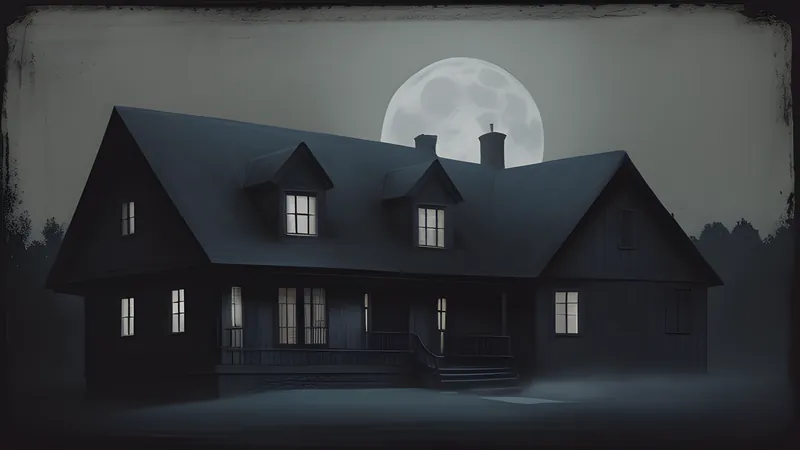
The house at 112 Ocean Avenue in Amityville, on the south shore of Long Island, is a three-storey Dutch Colonial with a gambrel roof and two quarter-moon attic windows that photograph like a pair of watching eyes. For a few years in the late 1970s it was the most famous haunted house in the world. Millions read the story of the young couple who fled it in terror after twenty-eight days, driven out by black slime oozing from keyholes, a demonic pig with red eyes glimpsed at a window, doors torn from their hinges, and a green ectoplasmic presence that clung to the family’s Catholic priest. The book sold in the millions and called itself “a true story.” The film franchise it spawned is still running.
Before any of that, on a November night in 1974, six real people were shot dead in their beds in that house. The haunting is a fabrication, and a fairly well-documented one. The murders are not. Understanding the Amityville Horror means holding both facts at once, and asking the more uncomfortable question underneath the ghost story: what does it mean that a genuine atrocity was so quickly paved over with a marketable invention, and why were so many people so willing to buy the paving?
The night that was real
At around three in the morning on 13 November 1974, Ronald DeFeo Jr, twenty-three years old, took a .35-calibre lever-action rifle and killed his entire immediate family. His father Ronald Sr and mother Louise, his brothers Marc and John Matthew, and his sisters Dawn and Allison all died in their beds. Each was found lying face down. DeFeo first told police an intruder had done it, then confessed. He was convicted in November 1975 on six counts of second-degree murder and sentenced to consecutive terms of twenty-five years to life. He died in prison in 2021, having spent decades offering shifting, incompatible accounts of that night, including a claim that his sister Dawn had been involved.
One detail from the trial would later be swallowed whole by the mythology. DeFeo’s defence had gestured at insanity, and at various points he said he had “heard voices” telling him to kill. That fragment — a killer’s self-serving claim of an inner voice — became, in the haunting that followed, evidence that something in the house itself had driven him to it. A tragedy with an entirely human explanation was quietly fitted with a supernatural one.
Twenty-eight days and a house on the market
Thirteen months after the killings, in December 1975, George and Kathy Lutz bought 112 Ocean Avenue. It was a large, handsome house going cheap for an obvious reason, and the estate agent had disclosed the murders. The Lutzes moved in with Kathy’s three children. Twenty-eight days later they left, abandoning most of their belongings, and never spent another night there. Out of that abrupt departure grew the story that would make them briefly famous: a house so aggressively haunted that a family had run for their lives.
The account was shaped into a book by the writer Jay Anson, published in September 1977 as The Amityville Horror: A True Story. Anson never visited the house or interviewed anyone beyond the Lutzes; he worked largely from tape recordings the couple provided. The book piles on the phenomena — swarms of flies in midwinter, a demonic presence, cold spots, Kathy levitating, George waking each night at exactly 3.15 a.m., the supposed hour of the murders. It weaves in a claim that the land had been a Shinnecock burial or confinement ground, a detail local historians and the tribe itself have flatly rejected. The book became a runaway bestseller and, in 1979, a hit film. The haunting was now a franchise.
The confession over the wine
The fork in this story is unusually well signposted, because one of the people who helped build the hoax later described building it. William Weber was Ronald DeFeo’s defence lawyer, and he had a clear interest in the idea that the house was malevolent: a haunted house made a tidier argument for a retrial than a young man who had simply murdered his family. Weber later told the Associated Press, and repeated in a 1979 interview, that he and the Lutzes had “created this horror story over many bottles of wine.” He said details had been invented to fit his legal theory and the couple’s commercial hopes, and he sued the Lutzes when the collaboration soured over money — litigation that itself put much of the fabrication on the public record.
Weber’s admission matters because it identifies the machinery, not merely the falsehood. A defence lawyer needed a supernatural cause to reopen a hopeless case; a young couple who had overreached financially on a large house needed a way out and, it turned out, a story worth selling; a publishing market hungry for demonic horror needed product. Each party supplied a piece, and the pieces fit because everyone wanted them to. The wine-fuelled sessions Weber described were less a single act of invention than the moment three separate motives found a shape they could share.
The physical claims fell apart under the mildest scrutiny. Father Ralph Pecoraro, the priest identified in the book as Father Mancuso and depicted being spiritually assaulted, gave accounts that varied sharply from the dramatic version and, in a later broadcast, downplayed the whole affair. The couple who bought the house after the Lutzes, James and Barbara Cromarty, lived there for years without incident and sued over the disruption of curious crowds; they pointed out that the doors, windows and hardware supposedly torn apart by demonic force showed the original 1920s hinges and locks, untouched. Investigators who examined the story, among them the researcher Rick Moran and the writer Ric Osuna, traced the phenomena back to invention and embellishment. Even George Lutz, who to the end of his life insisted something had happened, conceded that the book was heavily dramatised.
The weather record supplied one of the neatest disproofs. Anson’s book pinned specific supernatural events to specific dates during the Lutzes’ twenty-eight days — a blizzard on one night, damage on another. When investigators checked the meteorological data for that stretch of December 1975 and January 1976 on Long Island, the storms the book described had not occurred. A haunting can be argued about forever; a snowstorm either fell or it did not, and the ones in the book had not. Small, checkable details like these are usually where a fabricated “true story” comes undone, because invented drama rarely bothers to match the mundane public record it is laid over.
Why the ghost travelled faster than the facts
If the hoax was exposed almost immediately — and it was, within a couple of years of the book’s release — why is Amityville still a household word while its debunking is a footnote? The folklorist’s answer is that the haunting satisfied several needs at once, and the correction satisfied none.
The 1970s were primed for it. The Exorcist had been an enormous cultural event in 1973; The Omen followed in 1976. Suburban Catholic America was ready to believe that ordinary tract houses could harbour demonic evil, and Amityville offered a real address to attach the fear to. Crucially, the story came pre-loaded with a genuine horror — six actual corpses in real beds — which lent the invented parts a borrowed weight. A made-up ghost story is entertainment. A made-up ghost story built on a documented mass murder feels like it must have a kernel of something, because part of it plainly did happen. The reality of the DeFeo killings did the emotional work of authentication for a fiction stacked on top of them.
This is a recurring mechanism in the way frightening stories spread. A verified, upsetting fact at the centre acts as a licence for a cloud of unverified claims around it, because the audience reasons that where there is real smoke there must be more fire. The same borrowing of credibility from a true core underwrites plenty of enduring legends, from the haunted-house circuit to the way a real cluster of deaths gave lasting power to the curse of Tutankhamun. Once “a true story” is printed on the cover, and once a real crime anchors it, the burden of disproof somehow shifts onto the sceptic.
The people the story wrote over
What is quietly disturbing about Amityville is not that people believed in a ghost. It is who got erased in the process. The Amityville Horror is remembered as the Lutzes’ story — their twenty-eight days, their fear, their escape. The six people actually killed in that house have become set dressing, reduced to the “grisly backstory” that gives the haunting its atmosphere. Dawn DeFeo was eighteen. Allison was thirteen. Marc was twelve; John Matthew was nine. Their murders became a marketing feature.
There is a real cost to that, and the surviving DeFeo relatives have spoken about it for decades: the family’s worst night turned into a theme, an address on a ghost tour, a number in a film title. When a manufactured haunting is stacked on top of an authentic tragedy, the invention does not merely mislead. It feeds on the dead, drawing its power from grief it never acknowledges. The Cromartys, who simply wanted to live in a nice house they had bought, spent years chasing trespassers off the lawn.
What the haunting was really for
Underneath the flies and the red-eyed pig, the Amityville story answers a very old human question in a comforting way. When a young man murders his sleeping family, the true explanation — that a person did this, out of some mixture of resentment, money, drugs and rage that no one can fully reconstruct — is close to unbearable. It offers nowhere to put the horror. A haunted house offers somewhere. If the walls were evil, then the evil was external, containable, exorcisable; it could be sealed behind those crescent-moon windows and left on Long Island. The ghost story is a way of refusing to believe that an ordinary family in an ordinary house could simply come apart into slaughter.
That is the need the Amityville Horror really served, and it is why the fabrication outran its own exposure so decisively. The believers were not fools. They were people reaching, as people do, for a version of a terrible event that they could live with — the same impulse that keeps other cheerful hoaxes and misremembered horrors alive long after the record is clear, from the Loch Ness surgeon’s photograph to the whole industry of the manufactured haunting. The house on Ocean Avenue still stands, renumbered and remodelled by later owners who wanted the sightseers to move along. Six people died there on a November night, and no demon was involved. That is the part of the story that was always true, and the part the ghost was invented to help everyone forget.
Related Content