Spring-Heeled Jack: The Leaping Devil of Victorian London
A bogeyman who allegedly cleared nine-foot walls in a single bound haunted the outskirts of London for a year, then kept reappearing in print for seventy more
Contents
On the evening of 20 February 1838, an eighteen-year-old woman named Jane Alsop answered a knock at her family’s door in Bearbinder Lane, Old Ford, on London’s eastern edge, to find a man claiming to be a police officer, urging her to bring a light because “we have caught Spring-Heeled Jack here in the lane.” She fetched a candle. The figure that met her at the gate tore off a cloak, revealed what she would later describe to a magistrate as a helmet and tight-fitting white oilskin beneath, and vomited blue and white flame from its mouth directly into her face while raking her arms and neck with claws she swore felt like metal. She escaped back into the house with her dress torn and her hair singed, and her family’s account, given under oath days later at Lambeth Police Court, became the single most detailed and most widely reported description of a figure London newspapers had already spent months calling Spring-Heeled Jack.
Alsop’s testimony still anchors nearly every serious account of the case. It proves nothing supernatural happened in Old Ford that February; what it offers instead is exactly the kind of specific, dated, cross-examined testimony that lets a modern reader see how a Victorian bogeyman got built out of real fear, real crime, and a press hungry for both.
The year London decided something was loose
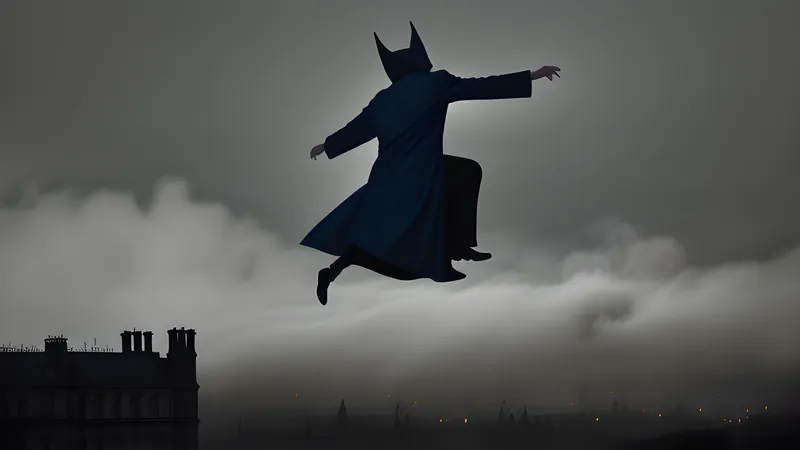
Reports of a strange figure attacking or startling people around London’s outer suburbs began circulating in the autumn of 1837, months before Alsop’s ordeal, with early accounts describing a man in a cloak who could leap over walls, hedges, and even small buildings with an ease witnesses found impossible to explain by ordinary means — hence the name that had already attached itself to him by the time the Alsop and Scales cases made national news. The pattern across the early reports was consistent enough to alarm the authorities without being consistent enough to describe a single reliable culprit: a figure who startled lone travellers, particularly women, on dark suburban lanes, sometimes breathing fire, sometimes simply terrifying by his leap and his glowing eyes, and always vanishing before anyone could lay hands on him.
The case that made the panic official arrived via an anonymous letter received by the Lord Mayor of London, Sir John Cowan, in early January 1838, purporting to be from a resident of Peckham and describing a wager among “a party of noblemen” that one of their number would take on the disguise of a ghost, devil, or bear to frighten the superstitious and had, in the process, caused genuine injury and even a death or two among the frightened. The Lord Mayor read the letter aloud at a public session, and The Times reported it on 9 January 1838, which is the point at which “Spring-Heeled Jack” stopped being suburban gossip and became a matter the Home Office and the Metropolitan Police, then not yet a decade old as an institution, felt obliged to respond to. Patrols were increased around the districts where sightings clustered, and a reward was floated for the culprit’s capture — treatment no purely fictional scare would normally receive from a city government with genuinely limited resources.
Jane Alsop and Lucy Scales
Alsop’s account in February came eight days after a second attack, on Lucy Scales, an eighteen-year-old returning home from her brother’s house in Limehouse on 18 February 1838, who was accosted by a man in a large cloak who spat blue flame into her face, leaving her temporarily blinded and in convulsions on the pavement, again by her own sworn testimony to a magistrate. Neither Alsop’s nor Scales’s account depended on the other; they came from separate households in separate parts of London within little more than a week, described independently to the police, and both described the same core details — a cloak concealing something worn beneath, fire from the mouth, and an assailant who did not pursue once the immediate assault was over.
The physical details witnesses across dozens of reports kept returning to — a tall, thin figure; a cloak that could be discarded or opened to reveal something more alarming beneath; blue or white flame breathed from the mouth; eyes that seemed to glow red; and, above all, an ability to leap far higher and further than any ordinary man — never resolved into a single arrest, a single named suspect proven guilty, or a physical device recovered and confirmed as the source of the “spring heels” the nickname implied. Contemporary theories ranged from phosphorus-based compounds that could be ignited in the mouth without immediate harm, a substance well known to Victorian chemists and stage performers alike, to some kind of mechanical device built into boots, though no surviving account from the period offers verified physical evidence for either.
The prime suspect who was never charged
The Lord Mayor’s Peckham letter named no one, but London gossip of the day supplied a candidate almost immediately: Henry de La Poer Beresford, third Marquess of Waterford, an Anglo-Irish peer already notorious across the capital for drunken, dangerous pranks, including an 1837 incident in Melton Mowbray in which he and his friends daubed tollgates, doors, and a town constable with red paint — the escapade widely credited with putting the phrase “painting the town red” into common English use. Waterford was young, wealthy, athletic, and by his own contemporaries’ account genuinely fond of frightening ordinary people for sport, which made him the obvious society suspect once newspapers started asking who had the means and the temperament for a wager-driven scare campaign. He was never charged, never formally questioned in connection with any of the London attacks so far as the surviving record shows, and married in 1842, after which the pattern of reports popularly associated with his name largely ceased. Waterford makes a satisfying suspect precisely because he fits the anonymous letter’s story of aristocratic wager-takers so neatly, and satisfying suspects are exactly the kind a folklorist learns to handle carefully: plausible, well documented as a person, and never actually connected to the crimes by anything more than reputation and good timing.
Where the record runs out
This is the honest limit of what the case actually supports. London in the winter of 1837–38 was, by every measure available to a modern reader, a city primed for exactly this kind of panic: gas lighting was still patchy on suburban lanes, leaving long stretches of genuine darkness; violent and opportunistic street crime against women walking alone was a real and reported problem, and the newly formed Metropolitan Police were still working out how to patrol London’s rapidly sprawling suburbs effectively. Some of the earliest “Spring-Heeled Jack” reports plausibly describe opportunistic assaults, robberies, or cruel pranks by ordinary criminals dressed to frighten, amplified into something supernatural by frightened victims and a press that had already given the phenomenon a memorable name. Later reports, spreading well beyond London and continuing for decades after any coordinated hoax could plausibly have persisted, describe something the historical record simply cannot pin to a single person, weapon, or method — which is exactly the point at which a criminal case, real but unsolved, becomes a folkloric one, sustained less by fresh evidence than by a name too good to let go.
The penny dreadfuls take over
What kept Spring-Heeled Jack alive long after the original 1837–38 panic faded from the newspapers was Victorian publishing far more than any fresh sightings. Cheap serialised fiction — the penny dreadfuls, sold in weekly instalments to a working-class readership hungry for sensation — adopted him as a recurring character starting with an 1840s serial and reaching its best-known form in the 1867 story-paper serial Spring-heeled Jack, the Terror of London, which reworked him from an ambiguous, sometimes malevolent street predator into something closer to a dark folk hero: a masked, cloaked figure with genuinely supernatural leaping ability who punished wrongdoers as often as he frightened the innocent. A further, hugely popular serial, Spring-Heeled Jack: The Terror of London, ran in the Boys of England story papers into the 1880s, and reprints and new tellings continued into the Spring-Heeled Jack Library penny publications of the early 1900s, by which point the character had drifted a long way from the frightened, specific testimony of Jane Alsop and Lucy Scales and become a stock supernatural adventurer in the mould later writers would recognise as an ancestor of the pulp-hero and even the costumed-vigilante tradition.
Sporadic real-world sightings, disconnected from the fiction, continued to be reported for decades in towns with no obvious connection to the original London panic — Aldershot’s army barracks in 1877, where soldiers reported a figure bounding over sentries and slapping their faces before vanishing, and Liverpool in 1904, where a crowd reportedly watched a figure leap between rooftops. Each fresh sighting borrowed the name and some of the established details, whether or not the witnesses had encountered anything connected to the events of 1837–38, which is itself a clean example of how a well-established legend supplies a ready-made vocabulary for describing any later fright that shares even a rough shape with the original.
What a leaping devil was for
Spring-Heeled Jack’s staying power owes a great deal to what Victorian London already needed a figure like him to explain. Rapid urban growth had produced suburbs that were neither fully lit nor fully policed, populated by people who had often moved recently from smaller, more socially legible communities where a stranger on a dark lane was a rarer and more identifiable event. A city that size, growing that fast, generates real violence against women walking home alone, and a press covering it faces two options: report each assault as a specific, mundane crime with a specific and possibly uncomfortable perpetrator, or fold an unsettling pattern into a single, semi-supernatural culprit whose motives need no social explanation because he is, by definition, not quite human. Spring-Heeled Jack offered London’s newspapers, its police, and its frightened residents a shared villain who required no difficult conversation about class, opportunity, or the limits of the era’s policing — only vigilance against a nearly unstoppable, nearly uncatchable predator loose in the dark.
The same civic anxiety, projected onto a single sensational figure, would resurface fifty years later around Jack the Ripper, whose Whitechapel murders produced their own flood of taunting letters, competing theories, and a press only too willing to give an unsolved horror a memorable name and a durable mythology. Spring-Heeled Jack’s fire-breathing leaps and the Ripper’s very different, very real killings share almost nothing in method, but they share the same civic machinery: a frightened city, an under-resourced police force, and a newspaper industry that had discovered a named, personified terror sold more copies than an abstract crime statistic ever could. The instinct is close cousin, too, to how younger audiences would later pass warnings and thrills to each other through Slender Man and Bloody Mary — a shared, escalating story doing the work that a single confirmed fact never quite manages.
The devil London kept needing
Spring-Heeled Jack never received a confirmed arrest, a proven identity, or a closed case file, and the historical record, honestly read, cannot tell a modern reader whether Jane Alsop and Lucy Scales encountered the same assailant, two separate opportunists borrowing an already-famous disguise, or something in between. What the record shows clearly is a city that needed the story regardless of the answer — needed a name for the fear that came with unlit lanes and a police force still finding its feet, and then, once the fear itself had mostly faded, kept the name anyway because it had become too good a character for the penny press to retire. London’s leaping devil survived by being exactly the shape of monster a growing, half-lit, imperfectly policed city already had room for, whether or not anyone was ever fooled for long about what he actually was.
Related Content