Sea Serpents and the Basking-Shark Carcass Problem
Why the rotting thing on the beach so often looks exactly like a monster
Contents
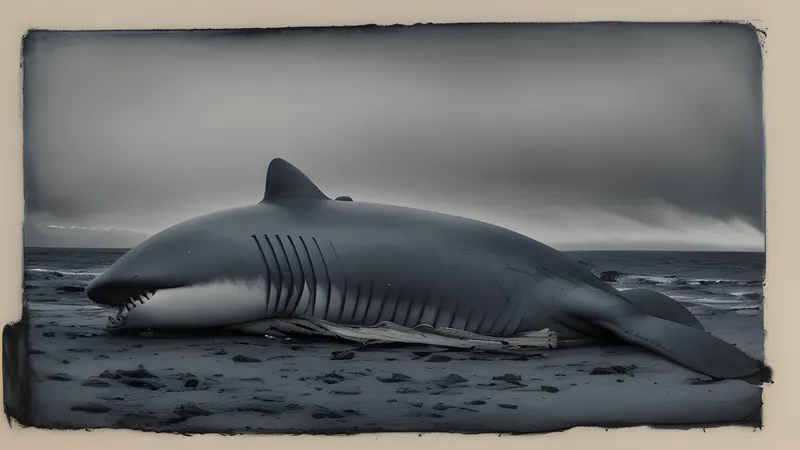
In the autumn of 1808, a storm threw a vast carcass onto the rocks of Stronsay, in the Orkney Islands. Local men who measured it made it fifty-five feet long. It had a small head, a long neck, a serpentine body and what looked like a mane running down its back, and three pairs of limbs. The Natural History Society of Edinburgh examined the drawings and the recovered bones, pronounced it a new species, and gave it a name worthy of the occasion: Halsydrus pontoppidani, Pontoppidan’s sea-snake, honouring the Norwegian bishop who had catalogued sea serpents half a century before. For a while, Orkney had produced a monster with a Latin binomial and the endorsement of learned men.
It was a basking shark. A large one, decomposed in the particular way that basking sharks decompose, which is the whole of the problem and, unravelled slowly, the whole of the story.
The kernel: how a shark becomes a serpent
Start with the animal and the chemistry, because they explain almost everything that follows. The basking shark, Cetorhinus maximus, is the second-largest fish in the ocean, reaching over ten metres, a harmless plankton-strainer that cruises the North Atlantic with its cavernous mouth open. When one dies and begins to rot, it falls apart in a sequence that is grimly reliable.
The gills and the whole cartilaginous basket that supports the enormous jaw are among the first structures to detach. That is the crucial event. Once the jaw and gill arches drop away, what remains is the small, rounded braincase perched at the end of the exposed spinal column. The bulky head is gone; a slender “neck” and a tiny “head” appear where there had been a shark. The paired fins persist as “limbs.” The long backbone trails behind as a serpentine “body.” Threads of decomposing muscle can hang from the spine like a mane. The finished object, lying on a beach, is a startlingly good plesiosaur — long neck, small head, four flippers, tapering tail. Naturalists gave the illusion a name: the pseudo-plesiosaur.
This is the ordinary fate of a basking shark corpse, which means that every stretch of North Atlantic coastline is, over the centuries, guaranteed to produce a supply of monsters on a predictable schedule. The Stronsay Beast of 1808 was one. The carcass hauled up off Scotland at Deepdale, the “monster” of Querqueville, the string of “globsters” washed ashore in the twentieth century — the same shark, the same chemistry, the same excited crowd.
The Zuiyo-maru: the case that should have settled it
The most famous instance is also the best documented, and it happened within living memory. In April 1977, the Japanese trawler Zuiyo-maru, fishing off the coast of New Zealand, brought up a rotting carcass in its nets at around three hundred metres. It was some ten metres long, with a small head on a long neck and four large fins. The crew, sensibly worried about spoiling their catch, photographed it, took measurements, sketched it, cut off some pieces of tissue and fin, and dumped the reeking mass back into the sea.
The photographs caused a sensation in Japan. Here, apparently, was a plesiosaur, a Mesozoic reptile pulled fresh from the Pacific, and for a giddy few weeks the possibility was taken seriously in the national press; a commemorative stamp was even proposed. Then the science was done. The tissue samples the crew had preserved were analysed by Japanese biochemists, who found the fibrous protein elastoidin and an amino-acid profile characteristic of shark, and specifically consistent with the basking shark. The “plesiosaur” of the Zuiyo-maru was a decomposed Cetorhinus strained through exactly the same process that had fooled the gentlemen of Edinburgh in 1808. The lesson had simply needed relearning, with better instruments, a century and a half later.
The globsters
The basking shark is the commonest culprit, yet it has understudies, and the wider category the beachcombers eventually coined for all of them is the globster: a large, shapeless, rotting mass thrown up by the sea that resists easy naming. Each famous globster repeats the Stronsay lesson with a different animal supplying the corpse.
In 1896, boys playing near St Augustine, Florida, found an enormous pale carcass half-buried in the sand, and a local physician, DeWitt Webb, preserved samples and corresponded with the Yale zoologist Addison Verrill, who first announced it as the remains of a colossal octopus with arms perhaps thirty metres long. The “St Augustine Monster” entered cryptozoology as evidence of a giant cephalopod beyond anything catalogued. When the preserved tissue was finally examined with modern methods in the 1990s and again in the 2000s, its composition matched whale collagen — the collapsed blubber of a large whale, with nothing of the cephalopod about it. The Tasmanian globster of 1960, a hairy-looking mass six metres across, and the West Coast globster of 1970 followed the same arc: alarm, speculation, and eventual identification as decayed whale. In 1924 witnesses at Margate in South Africa described a great white furry carcass, nicknamed Trunko, apparently battling two whales offshore before washing up; it rotted on the beach for days, was never sampled, and is now best explained as a whale-fall “blubber monster” of the kind that recurs worldwide.
The pattern across every tested case is the same, and it is worth stating plainly because it is genuinely reassuring rather than deflating: the sea disassembles its largest animals into unfamiliar shapes, and the strandline hands those shapes to whoever is walking the beach. What looks like proof of an unknown giant is, on analysis, the familiar giant we already knew, unmade by salt water and time.
The fork: where the carcass stops explaining things
Here is where honesty requires care, because the basking shark solves one problem completely and leaves another almost untouched. Every “sea serpent body” so far recovered and tested has resolved into something known — a shark, a whale, a mass of whale blubber, a giant squid. The carcass mystery is, for practical purposes, closed.
But the sea serpent was never primarily a carcass. It was a thing seen alive, moving, from the decks of ships, by sober sailors and, on occasion, by naval officers whose careers depended on not inventing dragons. Those sightings are the older and stranger half of the tradition, and a rotting shark does nothing to explain them. In 1734 the missionary Hans Egede, off the coast of Greenland, described a monstrous animal rearing its head above the masthead and diving with a long tail. In August 1848 the crew of HMS Daedalus, en route home across the South Atlantic, reported a sixty-foot creature holding its head above the water for twenty minutes; the captain, Peter M’Quhae, submitted a formal account to the Admiralty and defended it in The Times against a sceptical Richard Owen. These men saw something. The carcass problem cannot touch them, and pretending it can is the kind of overreach that turns curious people away from science entirely. The same long-necked silhouette that M’Quhae swore to in 1848 would later come ashore in fresh water: the plesiosaur template that shaped the Loch Ness Monster and its surgeon’s famous photograph is the sea serpent’s direct descendant, carried inland by the same Victorian appetite for a living relic of the age of reptiles. Once the shape exists in the culture, any body of dark water can host it.
The journey: how the serpent was assembled
What the living sightings actually contain is a different, richer question, and answering it means following how the sea serpent was built as an idea. The tradition has an author, more or less: Erik Pontoppidan, Bishop of Bergen, whose Natural History of Norway of 1752–53 gathered the sea-serpent and kraken reports of Norwegian fishermen into a single authoritative catalogue and lent them the dignity of print. After Pontoppidan, every naturalist who wrote about the sea had a serpent-shaped slot to fill.
Filling it was a comedy of over-eager science. In 1817, a large marine animal was repeatedly seen in the harbour at Gloucester, Massachusetts, by dozens of witnesses; the Linnaean Society of New England investigated with real diligence, and then, catastrophically, described a deformed three-foot land snake found in a nearby field as the monster’s terrestrial offspring, christening it Scoliophis atlanticus. The blunder made the whole subject a laughing stock and taught later naturalists to keep their distance. By 1892 the Dutch zoologist A. C. Oudemans could compile hundreds of sightings into a fat volume, The Great Sea-Serpent, arguing for a single unknown long-necked seal; in 1968 Bernard Heuvelmans repeated the exercise on a grander scale in In the Wake of the Sea-Serpents, sorting the reports into a bestiary of hypothetical animals. Both men were serious; both were, in the end, cataloguing perceptions rather than specimens.
For the living sightings almost certainly do have mundane sources, and good ones. The oarfish, Regalecus glesne, grows to eight metres or more, is silvery, ribbon-thin, crested with red, and swims with an undulating vertical motion — a sea serpent by any reasonable description, and real. A line of porpoises surfacing in sequence reads, at distance, as a single humped body rolling through the water. Basking sharks swimming nose-to-tail, a floating log with a root ball, a mass of tangled kelp, a whale’s flexing penis, a giant squid’s arm: the ocean is a generator of serpent-shaped ambiguity, seen briefly, at a distance, by a mind already carrying Pontoppidan’s template. The kraken, a real squid that became a sea monster, travelled that exact route from animal to legend and, unusually, was later dragged back to the animal when the giant squid was finally landed.
What it is really about
The basking-shark carcass is a small, precise gift to anyone who wants to understand belief, because it lets us watch the whole mechanism in slow motion. A real animal dies. Ordinary chemistry rearranges it into the shape of a legend that a bishop wrote down three centuries ago. A crowd gathers, a name is proposed, a drawing circulates, and for a season the monster is real — until the tissue is tested. Then it dissolves back into a shark, and waits for the next storm and the next carcass to do it all again.
But the reason the sea serpent survives every debunking is that the sea itself has never stopped being what it was to Egede and M’Quhae: enormous, opaque, and full of things that surface for twenty minutes and are never seen again. We now know the ocean holds animals stranger than any bishop imagined — the giant squid, the oarfish, the colossal filter-sharks themselves, creatures found by chance, photographed once, understood slowly. The monster on the beach was a shark. The unease that made a whole coastline of watchers ready to see a monster there was, and remains, entirely rational. The strandline keeps handing us bodies we can identify, and the water beyond it keeps its own counsel, which is exactly why the sighting on the horizon — the one no carcass explains — still refuses to lie down. Something like the same conversation plays out every time a bloated, unrecognisable thing washes up today, as it did with the Montauk Monster, where a small dead animal was read, for a week, as an alarm from the deep.
Related Content