Roswell: The Balloon That Became a Spaceship
The government really did lie about what fell on the ranch. What it was hiding was a Cold War listening device.
Contents
On 8 July 1947 the public information officer at Roswell Army Air Field in New Mexico issued a press release that no military base has ever quite lived down. It announced, in the flat language of an official statement, that the Army Air Forces had come into possession of a “flying disc,” recovered from a ranch in the surrounding country. For a few hours the wire services carried it around the world. Then, the same afternoon, a general in Fort Worth stood behind a table strewn with torn foil, splintered sticks and grey rubber, and explained that there had been a mistake. It was a weather balloon. The photographers snapped the debris, the story died, and Roswell went quiet for thirty years. When it came back, it came back as the most famous alien crash on Earth. The strangest part of that story is that the government really had lied on 8 July 1947. It had simply lied about something with no aliens in it at all.
The ranch and the retraction
The bare events are not in dispute, and they are worth setting down plainly before anyone reaches for a spacecraft.
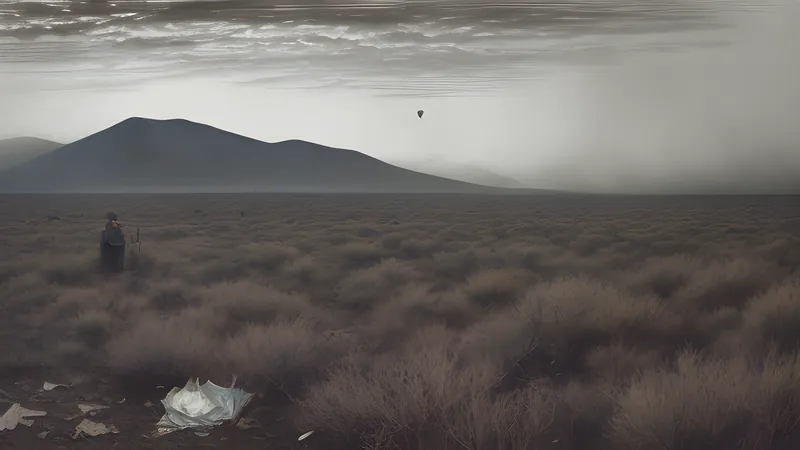
In late June or early July 1947, a rancher named William “Mac” Brazel, working the Foster spread near Corona, some seventy miles from the town of Roswell, found a scatter of odd wreckage across his pasture — tinfoil, rubber strips, tough paper, lengths of light wood like balsa, and tape. He had heard the recent radio chatter about “flying discs,” a phrase then only days old, coined after the pilot Kenneth Arnold reported nine bright objects skipping over Mount Rainier that June. Brazel mentioned his find to the local sheriff, who passed it to the airfield.
The base that took the call was not an ordinary one. Roswell was home to the 509th Bombardment Group, at that moment the only atomic-armed military unit in the world — the same wing that had flown the bombs to Hiroshima and Nagasaki two years earlier. Whatever landed on Brazel’s ranch was collected by the most secrecy-bound outfit in the United States. An intelligence officer, Major Jesse Marcel, drove out and gathered the debris. And on 8 July the base issued that press release.
Within hours the recovery was overruled from above. Brigadier General Roger Ramey, commanding the Eighth Air Force in Fort Worth, brought Marcel and the wreckage to his office, called in the press, and declared it the remains of a weather balloon and its foil radar-reflecting target. The photographs from that room still exist: Marcel kneeling over crumpled metallic sheet and balsa struts. The correction was accepted, more or less, and the matter closed. For three decades almost nobody spoke of Roswell at all.
The secret the foil was hiding
Here is the kernel, and it is the reason Roswell deserves patience rather than a smirk. The weather-balloon explanation was itself a cover story. There was a genuine classified secret in that debris, and the Army had every intention of hiding it.
The truth, declassified only in the 1990s, was a programme called Project Mogul. In the first years of the Cold War the United States had a desperate, specific problem: it needed to know when the Soviet Union tested its first atomic bomb, and it had no satellites, no seismic array, no reliable way to listen. Mogul was one attempt at a solution. The idea was to float long trains of balloons to the edge of the stratosphere carrying sensitive microphones, on the theory that the shockwave of a distant nuclear detonation would travel through a stable layer of the upper atmosphere and could be detected from far away. The balloon trains, the sensors, the very existence of the project were secret. Everything about them was.
One of these trains, catalogued as Flight 4, was launched from Alamogordo in early June 1947 and lost. Its construction matches Marcel’s debris with uncomfortable precision: neoprene balloons that perished to a grey, foul-smelling rubber; foil-backed radar reflectors; balsa struts; and reinforcing tape. The last detail is the one that would haunt the story for decades. The radar targets had been assembled by a toy and novelty firm, using tape printed with a pinkish-purple pattern of stylised flowers. Marcel’s young son, who handled the wreckage that night, would later insist the debris bore strange symbols along the beams — “hieroglyphics,” he called them, marks he could not read. He was remembering the flowers on the tape.
So the shape of the real event is this. The Army recovered a crashed, top-secret atmospheric-listening device built to catch a Soviet bomb test. It could not say so. It put out a weather-balloon story precisely because a weather balloon was dull, plausible and revealed nothing. The public had been deceived. The people who sensed a cover-up were correct. They were only wrong about what was being covered up — and thirty years later, that small correctness would be enough to carry an enormous myth. It is the same dynamic that keeps the grassy knoll alive: a real official lie, once exposed, licenses the belief that a far larger truth is still being withheld.
Thirty years of silence, then the bodies arrive
A myth needs a carrier, and for a long time Roswell had none. The town moved on. What revived it was memory, reworked in a changed decade.
In 1978 a UFO researcher named Stanton Friedman tracked down the elderly Jesse Marcel, who by then, three decades on, spoke of the debris as material he did not recognise, unlike anything he had seen, with properties no balloon should have. Marcel had genuinely handled classified equipment he was never told the purpose of, and time had polished his account into something stranger than the 1947 record. From that interview grew the first book, The Roswell Incident, by Charles Berlitz and William Moore, published in 1980. It reintroduced the crash to a public now primed by Close Encounters and a decade of ufology to hear “unexplained debris” as “spacecraft.”
Through the 1980s and into the 90s the story did what durable legends do: it accreted. New witnesses came forward with new memories, some sincere, some embroidered, a few invented outright. The single crash site became two, then more. And crucially, the bodies arrived. Early accounts had described only wreckage; later ones added small figures with oversized heads, an autopsy, a hangar, a military conspiracy of silence. In 1995 a British producer named Ray Santilli released grainy black-and-white footage of a supposed alien autopsy, presented as genuine 1947 film. It ran on television around the world. Years later Santilli admitted it was a reconstruction, staged in a London flat with a rubber model. The confession travelled nowhere near as far as the footage.
What the Air Force said back, and why it didn’t help
By the 1990s Roswell was too large to ignore, and the story had reached the point where a New Mexico congressman asked the government to account for itself. The reports that followed are a small case study in why the truth, arriving late, so often loses.
In 1994 the Air Force published The Roswell Report: Fact Versus Fiction in the New Mexico Desert, which for the first time named Project Mogul and laid out the balloon-train explanation for the debris. It was, on the physical evidence, convincing. But it left the bodies unexplained, and by 1994 the bodies were the heart of the legend. So in 1997 came a second document, The Roswell Report: Case Closed, which attempted to account for the alien corpses of witness memory. Its proposal was that people were conflating several unrelated events: high-altitude tests in which anthropomorphic crash-test dummies were dropped by parachute across New Mexico, a 1956 aircraft crash that killed eleven men, and a 1959 balloon mishap that badly injured a pilot.
The trouble was arithmetic. The dummy drops mostly happened in the 1950s, years after 1947, and the report’s suggestion that witnesses had simply compressed a decade of separate incidents into one 1947 memory struck even sympathetic readers as a stretch. To the believer it looked like exactly what a cover-up looks like: an official body reaching awkwardly for any earthly explanation, however strained, to close a file. The very clumsiness of Case Closed fed the thing it was meant to end. An institution that had genuinely lied in 1947 could not now be believed even when, on the debris at least, it was finally telling the truth.
What Roswell is really about
To understand why a lost microphone became a spaceship, look at the year and the place rather than the wreckage.
1947 sat in a narrow, frightening seam of history. The war had ended in two atomic flashes over Japanese cities, and the men who delivered them were stationed at Roswell. The Soviet Union was racing for its own bomb, and the United States had no reliable way to know how close. Everything about the national defence had gone abruptly, totally secret. Ordinary people in New Mexico lived beside installations they were forbidden to understand, in a landscape where the desert itself had, two years before, been lit by the first nuclear test at Trinity, less than a hundred miles from where Brazel found his debris. Secrecy was not a paranoid fantasy in that country; it was the visible, daily texture of life.
A population living next to real, guarded, world-ending secrets does not need much prompting to believe that another secret is being kept. When the government said “weather balloon” and everyone half-knew it was hiding something, the imagination was handed a blank and asked to fill it. The atomic age had made the impossible ordinary; a spacecraft was only one more impossibility in a decade already crowded with them. Roswell became the place where Cold War secrecy, sincere memory decades softened, a cheap novelty tape printed with flowers, and a genuine government lie all met and fused.
The honest close, then, is not to laugh at the town’s summer UFO festival or to sneer at the witnesses who grew old certain they had touched something from elsewhere. Marcel really did handle a secret he was never allowed to know. The Army really did deceive the public. The desert really was full of things no civilian could ask about. Given all that, believing the last, largest step — that what the desert hid was a spacecraft — is not stupidity. It is the natural reach of people who had been told the truth was classified and had learned, correctly, to distrust the cover story. Britain would grow its own version of exactly this hunger three decades later in a Suffolk pine forest, in the case that came to be called Rendlesham — the same shape, a different country’s fears. What fell on the Foster ranch was a machine built to hear the end of the world coming. It is almost poetic that a nation this frightened turned it into a machine that had come from somewhere else entirely.
Related Content