Rongorongo: Easter Island's Undeciphered Script
The wooden tablets of Rapa Nui, the last people who could read them, and the wisdom we imagine they hold
Contents
There are about two dozen of them left in the world. Dark, salt-cured lengths of wood, some of them driftwood, one of them cut from a European oar, all of them covered edge to edge with tiny incised figures: birds, fish, seated men with raised arms, curling hooks and lozenges and things that resemble nothing on earth. They come from Rapa Nui, the island the Dutch named Easter after the day they arrived in 1722, a speck of volcanic rock in the South Pacific more than 3,500 kilometres from the coast of Chile and 2,000 from the nearest inhabited land. The islanders called the inscribed boards kohau rongorongo — roughly, “lines for recitation.” And that is very nearly all anyone can say about them with confidence, because no one alive can read a word.
That silence is the whole of the mystery, and it is worth sitting with before the theories rush in to fill it. A script exists. It was made by human hands, carved with obsidian flakes or shark teeth in neat rows, and the people who cut those rows understood what they meant. Then, in the span of a single terrible decade, the understanding vanished. What remains is the shape of knowledge with the knowledge scooped out — and that shape is irresistible to us. We look at the glyphs and read them as a locked door, and behind it we place whatever we most want to find.
What the tablets are
The glyphs are arranged in a system called reverse boustrophedon. You read a line left to right, and then, to read the next line, you turn the entire tablet 180 degrees. The figures on alternate lines are carved upside down relative to each other, which means a reader was physically rotating the board in their hands as they went, like winding a reel. It is an elegant, deliberate arrangement, and it tells us the carvers were not doodling. There are somewhere between 120 and 150 basic signs, which balloon into many hundreds once you count the compounds and ligatures, where two figures are fused into one — a standing man given a bird’s head, a fish holding a staff.
The objects themselves are humble and various. Most are flat tablets of wood, but the corpus also includes a chief’s staff carved over its whole length (the Santiago Staff, the single longest text we have, with well over 2,000 glyphs), a rei miro breast ornament, a tangata manu birdman figure, and a length of what may be a reglued snuffbox. The wood matters. Rapa Nui was largely deforested by the time Europeans arrived, and good timber was scarce enough that carvers used driftwood and salvage, which is why one tablet is an old oar and why several are cracked, charred, or gnawed by later neglect. These were valued objects, kept wrapped in hau bark cloth and brought out for recitation.
The German ethnologist Thomas Barthel, working in the 1950s, produced the first serious catalogue of the corpus and gave the surviving objects letters as names — the Tahua, the Aruku Kurenga, the Mamari, the Santiago Staff, and so on. Barthel also assigned code numbers to the recurring signs, the numbering scheme researchers still argue over today. He noticed that one stretch of the Mamari tablet appeared to track the nights of the lunar month, a sequence of crescent-shaped glyphs interrupted at intervals that line up plausibly with an intercalary lunar calendar. That fragment, decades of later work broadly supports, really does seem to be about the moon. It is the single most solid toehold anyone has found, and it is a toehold, no more.
Beyond it, the debate has never settled even on the most basic question: is rongorongo true writing at all? A full writing system encodes a spoken language, so that a reader recovers actual sentences. The alternative is that rongorongo is proto-writing — a mnemonic scaffold, a set of prompts that a trained reciter used to hold a chant in memory, the way a rosary’s beads hold a sequence of prayers without spelling any of them out. Both camps have serious scholars. Neither has won, and the corpus is too small to force the question.
How the reading was lost
The reason no one can settle it is grimly specific, and it is the part of the story that deserves the most care. Rongorongo did not fade into obscurity over centuries. It was severed in a few years.
In late 1862 and 1863, Peruvian ships came to Rapa Nui to seize labourers for the guano workings and plantations of the mainland. The raids took, by the most-cited estimates, something like 1,500 people, a large share of the island’s population, and they took them selectively: the fit, the prominent, the knowledgeable. Among those carried off, or dead of smallpox and dysentery in the raids’ aftermath, were the ariki and the maori rongorongo — the chiefly and learned men whose office it was to carve and recite the tablets. International protest eventually forced Peru to return the survivors, but only a handful lived to sail home, and the returning ship carried smallpox, and the epidemic that followed hollowed the island further. By some accounts the population fell to little more than a hundred people within a few years. When Catholic missionaries, led by Brother Eugène Eyraud, settled on the island from 1864, they found tablets used as firewood, fishing-line reels, and roofing timber, and a population in which no one could reliably read them. Eyraud reported the boards in nearly every house; within a generation almost all had been burned or rotted.
The best-known attempt to salvage a reading came from Bishop Florentin-Étienne “Tepano” Jaussen of Tahiti, who in the 1860s and 1870s acquired several tablets and questioned a Rapanui labourer named Metoro Tau’a Ure, who chanted over the boards for him for days. Jaussen compiled the results into a glyph list that still bears his name. But Metoro’s chants did not match across repetitions, ran in inconsistent directions on the same tablet, and read to later scholars less like translation than like a man improvising plausible song over shapes he half-recognised. A later informant, Ure Va’e Iko, would only recite when plied with drink and, it was said, would chant from memorised texts while looking at photographs held upside down. That is the closest thing we have to native readers, and it dissolves in the hand.
The fork into wonder
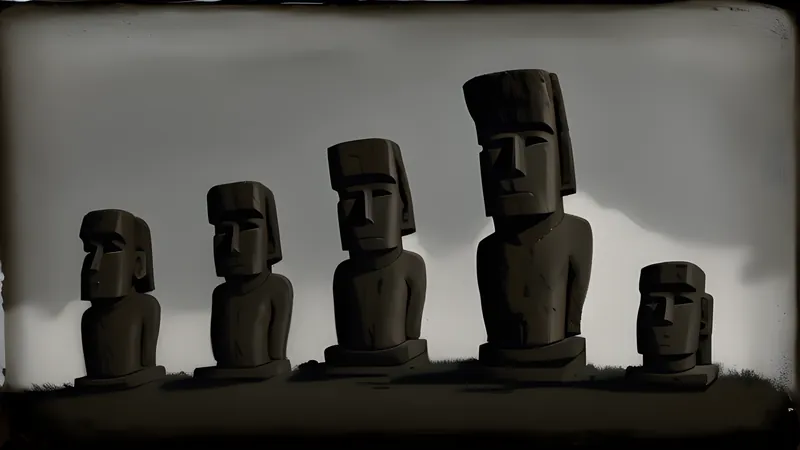
Here is where the story leaves the record and enters folklore, and it does so along a very well-worn groove. An undeciphered script is a magnet for the idea of lost wisdom. Because we cannot read it, we assume it must be worth reading — that a people who invented writing on the most isolated inhabited island on the planet must have inscribed something commensurate with the marvel of the moai, those enormous stone heads that lined the coast. So rongorongo gets recruited into grander stories: a record of a vanished super-civilisation, a key to the “real” history of the Pacific, a survival of sunken Lemuria, sometimes a message from somewhere further off entirely. It sits on the same shelf as the Voynich manuscript, the book in an unknown script that European buyers have wanted, for four centuries, to contain a secret proportionate to its strangeness.
The truth we can reconstruct is quieter and, to my mind, more moving. Rongorongo appears to be genuinely indigenous to Rapa Nui, with no convincing parallel anywhere else, which makes it one of only a handful of independent inventions of writing (or near-writing) in human history — alongside Mesopotamian cuneiform, Egyptian, Chinese, and Mesoamerican script. Whether it arose before European contact or was struck into being by the sight of Spanish writing during a 1770 annexation ceremony, when Rapanui chiefs were invited to make marks on a treaty, is itself contested. Either way it was a local achievement by a small society, and the fragments we can gesture at — a lunar calendar, probable genealogies, likely chants of creation and lineage — point to a script doing what early scripts usually do: keeping the count of moons, the order of ancestors, the words of the rituals that held a community together.
The engine of decipherment
There is a particular romance to the undeciphered, and it runs on a real historical memory: the Rosetta Stone. Champollion cracked Egyptian hieroglyphs in 1822 because a trilingual decree gave him the same text in a known script; Linear B fell to the architect Michael Ventris in 1952 through patient grid-work and a daring structural guess that the language beneath was an early form of Greek. Those triumphs teach us that scripts can be broken, and so we assume rongorongo is simply a puzzle awaiting its Ventris.
But decipherment needs raw material. Egyptian survives in miles of inscription; Linear B in thousands of clay tablets from Knossos and Pylos. Rongorongo survives in roughly 15,000 glyphs total, across two dozen objects, with no bilingual, no securely known underlying language in its archaic form, and no living reader. That is far below the threshold cryptographers reckon a blind decipherment needs. Steven Roger Fischer announced a decipherment in the 1990s, arguing that the Santiago Staff encodes a repeated procreation formula — “X copulated with Y, there issued forth Z.” It was a serious effort, built on a genuine structural pattern in the staff, and it drew serious objections about whether the pattern held across the corpus. It has not carried the field. The honest position, held by most who work on the tablets, is that we do not yet have enough to be sure of anything past the moon.
This is the same wall that other famous ciphers run into. The specificity we crave keeps outrunning the evidence the artefact can bear, which is exactly the tension at the heart of a case like the Beale ciphers, where a single solved passage tantalises us into believing the rest must be solvable too, and the Antikythera mechanism, where a genuinely astonishing object gets pressed to carry more meaning than it can hold.
What the silence is really about
Strip away the lost-civilisation gloss and what remains is a story about loss itself, and about the very human refusal to accept that some doors do not open. The tablets are mysterious for a concrete, datable reason: an act of violence killed the readers before anyone thought to write down what the reading was. The mystery is a wound, and the mythology that has grown over it — of hidden wisdom, of a code one clever outsider will one day crack — is a way of not looking at the wound directly. It is easier to imagine a secret than to hold the fact of a severed chain of memory.
I find the believers here entirely sympathetic, because the impulse is a generous one. To insist that rongorongo means something grand is, at bottom, to refuse to let the people of Rapa Nui be silenced twice — first by the slavers and the smallpox, and then by our own shrug. The dignified thing is to keep the tablets in their climate-controlled cases in Santiago and Rome and Saint Petersburg, keep photographing and 3D-modelling every glyph so the corpus can be studied without handling the fragile wood, keep the lunar calendar as our one honest sentence, and keep saying, without embarrassment, that we do not yet know. A script that outlived the hands that could read it remains a message from people who fully intended to be understood, arriving after the language that would have understood them was gone — and the ache of that is a truer thing to feel in front of the glass than any decoded secret could ever be. We keep hoping for a hero with a key. The tablets ask something harder of us: to sit with an absence, and to honour the readers by refusing to pretend it is smaller than it is.
Related Content