Resurrection Mary: Chicago's Dancing Ghost Hitchhiker
A girl in a white dress on Archer Avenue, a ballroom, a cemetery gate, and America's most fully realised vanishing hitchhiker.
Contents
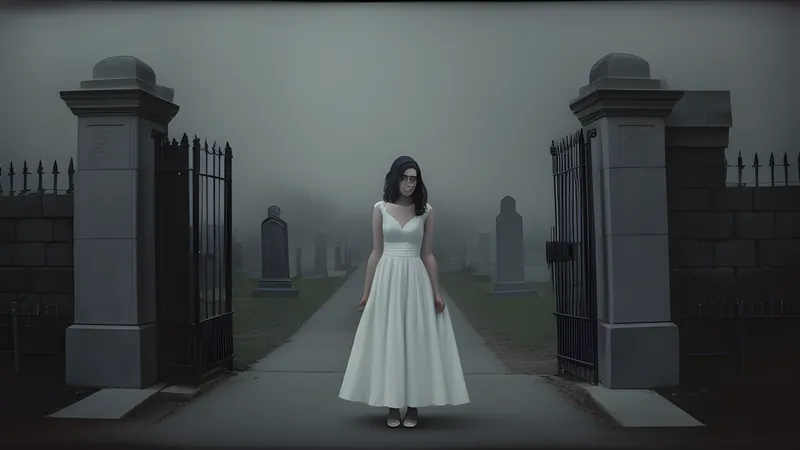
Archer Avenue runs south-west out of Chicago through the suburb of Justice, past a cluster of cemeteries and, at the relevant stretch, an old dance hall. The story, told for the better part of a century, goes like this. A man driving home late along Archer picks up a young woman walking alone by the roadside, beautiful, pale, in a white party dress and thin dancing shoes, unusually cold to the touch and strangely quiet. She asks to be taken north along the avenue. As the car approaches the gates of Resurrection Cemetery she cries out for him to stop, or she simply vanishes from the passenger seat while the car is moving, gone through the locked cemetery gates, leaving the driver alone and shaken on a dark road. Chicagoans call her Resurrection Mary, and she is the most famous ghost in a city that has never been short of them.
The vanishing hitchhiker
To understand Resurrection Mary you first have to understand that she is a local instance of one of the most widely distributed ghost stories on earth. The tale of a phantom passenger who is picked up on a lonely road and disappears before the journey ends is told, in some form, on nearly every continent, and folklorists gave it a name long ago: the Vanishing Hitchhiker. The American folklorist Jan Harold Brunvand made it the title story of his 1981 book that launched the popular study of urban legends, and by then scholars had already been collecting versions for decades. Two researchers, Richard Beardsley and Rosalie Hankey, published a major study of the type as far back as 1942, gathering scores of variants from across the United States and abroad.
The core is remarkably stable wherever it appears. A traveller offers a lift to a young person, usually a woman, met by the roadside at night. The passenger gives an address or a destination, then vanishes en route, often at or near a cemetery. When the driver makes inquiries, he learns that the young woman died years earlier, and that the date of her death, or the anniversary of some tragedy, is that very night. Sometimes a borrowed coat left with the passenger is later found draped over her grave. The specifics migrate; the shape does not. Resurrection Mary is Chicago’s contribution to this global family, and what makes her worth studying is that she is the type made unusually concrete, given a real avenue, a real ballroom, and a real cemetery gate, rather than any uniqueness of her own.
The furniture of a real place
Most vanishing hitchhikers are vague about geography. Resurrection Mary is not, and that specificity is the secret of her staying power. The legend names Archer Avenue, an actual road; it names the Willowbrook Ballroom, formerly the Oh Henry Ballroom, a real dance hall on that avenue that operated for decades until it was destroyed by fire in 2016; and it names Resurrection Cemetery in Justice, Illinois, a real Catholic cemetery whose gates Mary is said to pass through. A ghost with a street address behaves very differently in the popular imagination from a ghost that merely haunts “a lonely road.” You can drive to Archer Avenue. You can, or could, dance where Mary danced. You can photograph the cemetery gate. The legend is anchored to a landscape you can visit, and every visit is an invitation to add a chapter.
The stories that grew up around the cemetery gate itself show this anchoring at work. In the 1970s a widely repeated account held that a passer-by had seen a girl locked inside the cemetery grounds after hours, gripping the bars, and had summoned the police, who found no one but discovered that two of the bronze bars of the gate appeared bent apart and scorched, as if handprints had been burned into the metal. The cemetery’s management gave a prosaic explanation, that a maintenance worker’s blowtorch or a truck had damaged the bars and they had been worked on, and eventually the affected section was replaced. But the damaged bars became a physical relic of the legend, a thing you could go and look at, and their very existence, whatever caused it, fed the story for years. A ghost attached to a real gate can leave marks on real metal, and marks on metal are hard to argue with when you want to believe.
The search for a girl named Mary
Because Resurrection Mary is so specific, people have long tried to find the real girl behind her, the young woman who supposedly died on the way home from a dance and became the ghost of Archer Avenue. This is where the legend teaches its sharpest lesson, because the search has produced several candidates, none of them conclusive.
The most frequently cited is Mary Bregovy, a young Chicago woman who died in a car accident in March 1934 and was buried at Resurrection Cemetery. Her name fits, her cemetery fits, and researchers combing old records seized on her as the likely original. But the details resist the legend. Bregovy died in a downtown car crash, nowhere near the walk home along Archer the legend describes, and by some accounts she was buried in a dark dress rather than the white gown the ghost always wears. Other researchers have proposed different young women, some named Mary and some not, buried in the same cemetery after dying young, each a plausible-sounding anchor that dissolves on close inspection. The honest position, which serious local historians of the legend have reached, is that no single documented death matches the Resurrection Mary story cleanly, and that the ghost is very likely a composite, a figure assembled from the general tragedy of young women who died before their time and were laid to rest along Archer Avenue, rather than the specific revenant of any one identifiable girl.
Why this ghost, and why here
That composite quality is a clue to what the legend is actually doing, and it is worth sitting with rather than rushing past. Resurrection Mary is eternally young, eternally beautiful, and eternally caught at the moment of returning home from a dance, the very picture of a life interrupted at its most hopeful point. She is not a vengeful spirit; she frightens no one on purpose, harms no one, and asks only for a ride home she never completes. What she embodies is the particular grief attached to the young dead, the ones taken before they could grow old, whose deaths feel like a violation of the natural order in a way that the passing of the elderly does not. A girl in a party dress who dies on her way back from an evening of dancing is youth and joy and future all cut off at once, and the culture keeps her alive as a ghost because it cannot quite accept that she is simply gone.
The setting sharpens this. Archer Avenue threads through a corridor of cemeteries; it is a road that the living use to carry their dead to the ground, lined with the graves of the departed. A ghost who walks that particular road is walking the boundary between the living city and its dead, forever trying to cross from the cemeteries back toward the world of the dance hall and never arriving. Like La Llorona at her rivers and the Bunny Man at his railway trestle, Resurrection Mary belongs to a threshold, and the threshold is the point. She haunts the exact seam between the world of the living and the world of the dead, and she cannot pass either way, which is precisely the condition folklore assigns to a death that the living have not finished mourning.
The believers on Archer Avenue
It would be easy to file Resurrection Mary away as a well-travelled folktale that happened to land in a Chicago suburb, and in a narrow sense that is what she is. But that filing misses the people who have actually reported her, and they deserve to be taken seriously rather than laughed at. Over the decades a number of drivers on Archer Avenue have described, with evident sincerity and often to their own embarrassment, picking up or nearly striking a young woman in white who then was not there. Some of these people were not looking for a ghost and did not want the story; a few reported it to police as a possible accident, convinced they had hit a pedestrian who left no body. Whatever they experienced, they experienced something, whether a trick of a dark road, a real young woman in distress, a half-glimpsed figure filled in by an imagination primed with the legend, or something none of these categories captures.
The point of a folklorist’s attention is not to catch these people in a mistake. It is to notice what a community does with the sightings, how each one is gathered up, retold, matched against the existing legend, and used to keep Mary walking. A place that wants its ghost will find her, again and again, in the ambiguous shapes that any dark road throws up, and each finding is an act of collective devotion as much as observation. Chicago has kept Resurrection Mary dancing for the better part of a hundred years because the city wants her kept, wants the beautiful girl who died too young to still be out there on Archer Avenue asking for a ride home, forever almost making it back. She is a global story wearing local shoes, and she is also a genuine piece of a city’s heart, the shape Chicago gave to its refusal to let its young dead simply disappear. The gate has new bars now. The ballroom has burned. Mary, by every account that keeps arriving, is still walking.
A story every town keeps somewhere
Resurrection Mary has cousins in nearly every region, and setting her beside them shows how a single narrative pattern localises itself. The American South tells of the “lady of White Rock Lake” near Dallas, a dripping-wet young woman in white picked up near the water who vanishes and leaves the car seat damp. Hawaiian and other Pacific tellings of the vanishing hitchhiker attach the figure to particular coastal roads. Across Britain and Europe, phantom passengers and roadside women in white haunt specific lanes and bridges, each community insisting its version is the true and local one. The type is ancient and near-universal, and its persistence tells us that the anxieties it manages, about death on the road, about the young taken early, about the traveller alone in the dark, are anxieties no culture has ever fully put down.
What distinguishes Mary from most of her relatives is the sheer density of documentation Chicago has lavished on her. Local ghost-story writers, most notably the late Richard Crowe, who ran popular haunted-Chicago tours for decades, and later chroniclers of Illinois folklore, collected the Archer Avenue sightings, chased the candidate graves, and kept the legend organised and alive in print. That attention is itself part of the phenomenon. A ghost survives on the willingness of a community to keep records, run tours, argue over which Mary was the real one, and drive out to the cemetery gate at night to see for themselves, far more than on the strength of any single encounter. Resurrection Mary endures because Chicago decided, over generations and without ever quite meaning to, that she was worth the trouble of remembering, and a ghost that a city has resolved to keep is the hardest kind of all to lay to rest.
Related Content