Polybius: The Arcade Cabinet That Never Existed
A government mind-control machine in a 1981 Portland arcade, and how a legend of the internet age was built
Contents
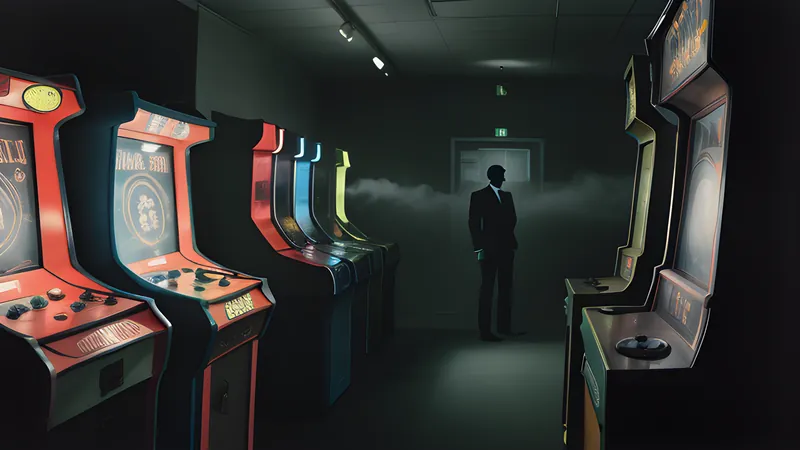
The story goes like this. In 1981, a black arcade cabinet appeared in a few arcades around Portland, Oregon. It was called Polybius. The game itself was some kind of hypnotic abstract shooter, and it was viciously addictive — kids queued for it, fought over it, played until they were sick. Players reported amnesia, nightmares, seizures, night terrors. One was said to have stopped playing games entirely; another became an anti-gaming activist overnight. And every so often, men in black suits would arrive, unlock the back of the cabinet, and remove data from it — not coins, data. Then, as suddenly as it had come, Polybius vanished. No cabinet survives. No board. No manual. Nothing.
It is a perfect story, and it is almost certainly not true — not in the sense of a real machine that did those things. But Polybius is worth taking seriously precisely because it is a fake, because we can watch it being assembled out of real parts in a way the older legends never let us. It is folklore we can practically fingerprint, and the fingerprints lead somewhere revealing about how a myth gets made in the age of the search engine.
A legend with a birth certificate
Most urban legends have no traceable origin. Polybius is unusual: it has something close to a documented birth.
The story as we know it seems to have entered the world in the early 2000s. The website coinop.org, a database of arcade machines run by a collector named Kurt Koller, carried an entry for Polybius around 2000, describing the game and its sinister reputation in the terms above. From there the legend spread through the early gaming internet — forums, message boards, the burgeoning creepypasta scene — and hardened into received history. There is no credible reference to Polybius, by that name and with that story, before roughly the turn of the millennium. A machine that supposedly haunted Portland arcades in 1981 left no trace in the enormous, obsessive contemporary record of arcade culture — no Play Meter or RePlay trade listing, no operator’s memory, no flyer, no photograph — until it appeared, fully formed, twenty years later on a website.
That gap is the single most damning fact about Polybius, and also the most interesting. A real arcade cabinet of 1981 would be one of the best-documented objects imaginable. The arcade industry of that era catalogued everything; collectors have preserved flyers and boards and cabinets for the most obscure and commercially disastrous games. For Polybius to be real and leave nothing is far less likely than for Polybius to be a story that someone wrote down around 2000, drawing on real materials, and set loose.
The real parts it was built from
What makes Polybius convincing is that nearly every component is real. The legend is a mosaic of genuine early-1980s facts, reassembled into something that never happened.
Start with the seizures. Arcade games really could make people ill. In the early 1980s there were documented reports and even news coverage of arcade-related health complaints — a real phenomenon sometimes discussed as “Space Invaders wrist” or, more seriously, photosensitive reactions to flickering screens. Photosensitive epilepsy is a genuine medical condition, and rapidly flashing game graphics are a known trigger. A story about an arcade game that caused seizures was not inventing a danger from nothing; it was exaggerating a real one.
Then the government surveillance. The men in black servicing the cabinet sound absurd until you recall that in the early 1980s the FBI genuinely did raid arcades in the early 1980s, chasing illegal gambling and the use of arcade machines for money laundering and unlicensed betting. There were real cases of federal agents turning up at arcades and seizing machines. A child watching serious men in suits open a cabinet and take something out was seeing something that actually occurred; the legend simply supplied a darker reason.
The addictiveness was real too. Anyone who lived through the arcade boom remembers the compulsion, the pockets emptied of quarters, the sense that a good game could take you over. And the black abstract shooter is a real genre; games like Tempest, released by Atari in 1981, were vector-graphics vortex shooters with exactly the hypnotic, tunnelling quality Polybius is described as having. Some tellings of the legend even name-check real Portland-area arcade activity and real developers to lend it texture.
Finally, the cultural soil: a genuine, well-founded public anxiety about government mind-control experimentation. This was not paranoid fantasy in 1981. The reality of what the CIA had actually done under the MKUltra programme had been dragged into the open by the Church Committee hearings and press reporting in the mid-1970s — real experiments, on real people, often without consent. A public that had just learned its government had genuinely experimented on citizens was a public ready to believe a government mind-control machine could be hidden in an arcade. The kernel of truth that makes Polybius stick is not about a game at all; it is that the state really had done the unthinkable, so a machine that did the unthinkable felt plausible.
How a fake behaves
Because Polybius is a modern legend, born on the documented internet, we can watch it do things older legends only did in the dark.
It attracted evidence, in the way any sufficiently interesting story does once it is loose. After the legend spread, “screenshots” and even playable ROMs of Polybius appeared — homebrew recreations built by fans to match the description. People made the game after the legend, to fit it, and the existence of these artefacts then circulated as if they were the thing itself. This is folklore closing the loop: the story called its own evidence into being, the way the crying-boy panic called forth a flood of confirming letters once the Sun announced the pattern. A legend that generates its own artefacts becomes very hard to kill.
It also acquired named authorities and shifting details in the manner of all living folklore. Various people have claimed knowledge of the “real” Polybius; a name, Sinneslöschen — dog-German for roughly “sense deletion” — attached itself to the supposed developer. Origin theories multiplied: a South American programming group, a CIA front, a genuine but mundane game whose reputation ran away from it. Each new teller added a detail that firmed up the story while quietly making it less falsifiable. The absence of any cabinet, which ought to be fatal, was reframed as proof: of course there is no cabinet, they took them all, that is exactly what you would expect.
That last move is the engine of every good conspiracy legend and it is worth naming plainly. The lack of evidence is converted from a problem into a confirmation. A normal claim is weakened by missing evidence; a conspiracy claim is strengthened by it, because the missing evidence is explained by the very cover-up the claim asserts. Polybius has no cabinet because the men in black took them. The story is built so that nothing can disprove it, and a story that nothing can disprove is a story that never has to die.
What the ghost cabinet is really about
Set aside the question of whether a machine existed — it did not, or at least nothing survives to suggest it did — and ask instead what the legend gives the people who tell it. That is where Polybius stops being a hoax and becomes revealing.
It is, first, a story about the loss of childhood autonomy to forces that were genuinely reshaping it. The arcade was one of the last unsupervised spaces of the early-1980s American childhood — a loud, dim room full of quarters and older kids, outside adult control. And it was, in reality, being watched and regulated: by parents who feared it, by police who raided it, by a moral panic that treated video games as a corrupting force. Polybius takes that real loss of a free space and dramatises it. The arcade was not just fun and dangerous; it was a trap, and the authorities really were coming for it. The legend is emotionally true to what the arcade panic felt like from the inside, even though no single fact of it happened.
It is also a nostalgia object, and this is why it flowered around 2000 rather than 1981. The people building Polybius on early gaming forums were adults reaching back to a childhood that was already gone, mythologising the arcade at the exact moment the arcade itself was dying, killed off by home consoles. Polybius is what the arcade era became once it was safely in the past: haunted, handed a secret and a danger and a government conspiracy, so that a room full of coin-op machines could feel as significant in memory as it had felt at eight years old. The men in black are, in a sense, the adult mind returning to the arcade and finding it more meaningful than the child could have known.
And it belongs to a broader family of internet-age legends about hidden knowledge and unreachable artefacts — the lost game, the cursed cartridge, the file that will damage you if you open it. These are the campfire stories of a generation that grew up in front of screens, and they share a common grammar with older tales of dangerous objects, from cursed paintings to the haunted item sold through an online listing. The medium migrated from the market stall to the message board; the appetite for an object that can reach out and hurt you did not change at all.
Why we keep it plugged in
No one has ever produced a Polybius cabinet. No board has surfaced in the collectors’ market that would have paid almost anything for it. No 1981 flyer, no operator’s ledger, no contemporary photograph. The trail, followed honestly, leads to a website entry around the turn of the millennium and a set of real 1980s anxieties waiting to be assembled. That is where Polybius comes from.
And it does not matter, which is the thing worth sitting with. Polybius has become real in the only way a legend needs to — it is told, remade, argued over, built into games and films and songs, believed in the pleasurable half-serious way that keeps a ghost story alive. It survives because it holds something true inside a frame that never happened: that the arcade was a wild and vanishing corner of childhood, that the authorities really were closing in on it, and that the government of that era had genuinely earned the fear that a machine could be built to take your mind. Plug all that into a black cabinet in a Portland arcade and you have a myth that runs perfectly on no electricity at all, forever, because the current it draws was never in the machine. It was in us.
Related Content