Pareidolia: The Face on Mars and Jesus on Toast
The brain is built to find faces in noise — and that same wiring turns a Martian hill and a grilled cheese sandwich into headlines.
Contents
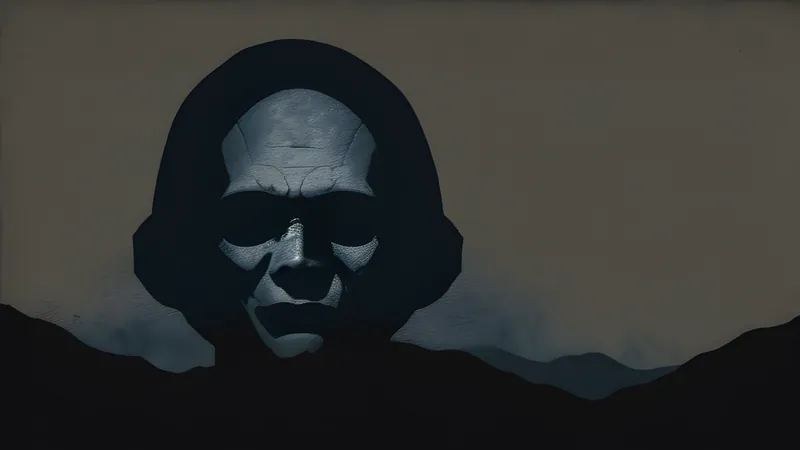
On 25 July 1976, NASA’s Viking 1 orbiter photographed a two-and-a-half-kilometre mesa in the Cydonia region of Mars while scanning for a landing site for its companion lander. Image 35A72, released to the press soon after, showed a lumpy hill under harsh, low-angle lighting, with a shadow falling across its western half in a way that produced two symmetrical dark hollows above a ridge and a horizontal line beneath. NASA’s own caption writer noted, half in jest, that the shadows “make it look like an inhuman face, staring into space.” Newspapers ran with the joke and dropped the jest. Within days, “the Face on Mars” existed as a phrase, and within a few years it had become one of the load-bearing images of an entire genre of ancient-astronaut speculation — proof, to a devoted readership, that an intelligence had once stood on Mars and looked up, or that later cultures had once looked up and built a monument to what stood there.
The kernel: a real rock, a real shadow, a real illusion
Nothing about the Cydonia mesa is manufactured. It is a genuine landform, roughly three kilometres by one and a half, part of the ordinary geology of the Martian northern lowlands, sitting among dozens of similarly eroded, similarly irregular mesas across the same region. What was real, too, was the coincidence of lighting and angle: Viking 1 photographed it under a sun elevation of roughly 20 degrees, throwing long, hard-edged shadows that happened, at that particular resolution and that particular sun angle, to produce a rough bilateral symmetry — two shadowed depressions where eyes would sit, a raised central ridge where a nose would sit, a horizontal crease where a mouth would sit. Nobody at NASA doctored the image, and nobody at NASA seriously proposed it was artificial. The “face” that launched a subculture was a low-resolution photograph of an eroded hill, caught at exactly the wrong moment to look like something else.
The correction came within a generation, once better cameras were in position to check. NASA’s Mars Global Surveyor, in orbit from 1997, re-photographed Cydonia in 1998 and again in 2001 at vastly higher resolution — around 1.56 metres per pixel for the sharpest 2001 pass, compared with roughly 43 metres per pixel for the original Viking frame — and under a higher, less dramatic sun angle. The mesa resolved into exactly what geologists had always expected: a heavily eroded plateau with gullies, boulders and slump features, no symmetry, no facial structure of any kind, a landform indistinguishable in kind from its unremarkable neighbours. The Mars Reconnaissance Orbiter’s HiRISE camera imaged it again in 2007 with even sharper detail and the same result. The mystery had been manufactured entirely by the interaction of low resolution, oblique light, and the shape a human brain was primed to see in ambiguous data — a limitation of the instrument and the moment, corrected the instant a sharper instrument was pointed at the same ground.
Why the brain is built this way
The tendency to see faces where none exist has a name — pareidolia, from Greek roots meaning roughly “beside” or “alongside” an image, coined in this psychological sense in the nineteenth century — and a well-mapped neural basis. A region of the brain called the fusiform face area, in the temporal lobe, is specialised for rapid facial recognition, and it fires in response to actual faces and, just as readily, to arrangements of shapes that only loosely resemble one — two roughly symmetrical dots above a horizontal line is functionally enough. Brain-imaging studies through the 2000s and 2010s, including work led by researchers such as Kang Lee at the University of Toronto, found the fusiform face area activating at similar strength whether subjects viewed genuine photographs of faces or images of random noise that subjects merely reported as face-like, confirming that the perception is generated by real, measurable neural activity rather than being a simple reporting error or a figure of speech.
The likely evolutionary logic is a matter of trade-offs, and it favours a specific kind of mistake. A face detection system tuned to be extremely sensitive, one that fires on ambiguous input rather than waiting for certainty, will produce a steady stream of false positives — faces glimpsed in wood grain, in electrical sockets, in cloud formations — but it will very rarely miss a real face that matters, and in the environment in which the human visual system evolved, a real face reliably mattered: a predator, a rival, an infant needing attention, a friend or stranger in the tree line at dusk. The cost of the false positive, a moment’s wasted attention on a knot in a fence post, is trivial. The cost of the false negative, failing to notice an actual watching face, could be lethal. Evolution built something closer to a smoke detector than a fire simulator, and a smoke detector calibrated correctly will go off constantly for burnt toast. The same over-sensitivity that produces “the Face on Mars” out of an eroded mesa is a feature doing exactly the job it was built to do, misapplied to a case — a photograph of a distant planet — that its ancient design specification never anticipated.
The gallery of accidental faces
Once you know to look, the effect is everywhere, and its most famous individual cases share the same anatomy as Cydonia: an ordinary, textured, irregular surface, an accidental arrangement, and an audience primed to find significance in it. In 1994, a Florida woman named Diana Duyser kept a ten-year-old grilled cheese sandwich because a scorch pattern on one slice, to her eye, resembled the face of the Virgin Mary; she later sold it on eBay for 28,000 dollars to an online casino, which displayed it on a promotional tour. It joined a long list of devotional pareidolia going back centuries — the Shroud of Turin’s disputed image among the most argued-over of them, treated at length in The Turin Shroud: Carbon Dating Versus Faith — water stains on underpasses read as saints, the grain of a tree trunk read as a weeping figure, a rust pattern on a garage door read as a religious apparition drawing genuine pilgrims in more than one American town in the 1990s and 2000s.
The Moon offers the oldest and most cross-cultural example of them all. Nearly every culture with a tradition of lunar folklore has looked at the same scatter of maria — the dark, ancient lava plains visible from Earth — and organised them into a face, a rabbit, a woman carrying a bundle of sticks, or a toad, depending on the storytelling tradition doing the organising; the “Man in the Moon” of English folklore and the moon rabbit of East Asian and Mesoamerican traditions are reading the identical set of grey patches into entirely different but equally coherent pictures, which is itself a demonstration that the faces and figures are supplied by the viewer rather than sitting latent in the terrain. Electrical outlets, the fronts of cars, the arrangement of knots and grain in a wooden door, all reliably produce the same double-take, and manufacturers have learned to work with the tendency rather than fight it — plenty of car-front designs are deliberately tuned by their engineers to read as a face, friendly or aggressive as the brand requires, because designers know the audience’s fusiform face area will supply the expression whether they intend it or not.
The illusion runs deeper than mere detection. Work by the perception researchers Colin Palmer and Colin Clifford at the University of New South Wales, published in 2020, found that the brain does not simply register an illusory face as face-shaped and leave it there; it reads an expression into it, processing the apparent emotion of a face glimpsed in a bin lid or a bell pepper through the same channels it uses for real ones, and even carrying a subtle bias toward perceiving those accidental faces as male. The knot in the fence post does not merely look like a face — it looks cross, or startled, or kindly, because the machinery insists on finishing the job it started. The same overreach extends to hearing. The mind hunts for voices in noise exactly as the eye hunts for faces in shadow, which is why people have long convinced themselves they can make out words in the hiss of a fan, the drone of an aircraft engine, or the static between radio stations — the auditory cousin of the face on the mesa, and the same mechanism underneath everything from misheard song lyrics to the recorded “spirit voices” that enthusiasts have been collecting since the 1950s. In every case the raw material is ambiguous and the pattern is supplied from inside.
What it is really doing for us
It would be a mistake to treat pareidolia purely as a glitch to be corrected, because the same machinery that turns a scorched sandwich into a religious relic is the machinery underneath ordinary social competence — reading a friend’s mood from a half-glimpsed expression across a room, recognising a parent’s face in dim light, picking a familiar figure out of a crowd at a glance. The system runs hot by design, and running hot is what makes it fast enough to be useful; a face-recognition process that waited for perfect, unambiguous data before committing to a judgement would be too slow to matter in the situations it evolved to handle. The Face on Mars enthusiasts of the late 1970s and 1980s were not exhibiting a unique credulity. They were doing, in public and at planetary scale, exactly what every human visual system does dozens of times a day without anyone noticing or minding, and what makes their case instructive is simply that a later camera happened to be sent to check the answer.
That, in the end, is the difference worth holding onto: every brain manufactures faces from ambiguous shadow, and the Cydonia case is instructive only because better data eventually arrived and the illusion dissolved cleanly on contact with it, the way illusions generally do when a sharper instrument is finally pointed at them. The instinct to see a face in the dark is one of the oldest, fastest, most reliably triggered pieces of software the mind runs, and understanding why it fires is a better use of the “face” on that mesa than either debunking it with contempt or defending it with conviction. It is, after all, only ever doing what it was built to do, in a place its builders never imagined it would be asked to look — a point worth remembering, too, when a scatter of coincidences starts to look like a plot, the subject of Red String and Corkboard, a piece of mental machinery built from the same hunger for pattern.
Related Content