Lemmings Don't Commit Suicide: Disney and a Cliff
How a 1958 nature documentary staged the most famous animal behaviour that never happens
Contents
We use the word as if it settled something. A crowd rushing toward a bad decision, investors piling into a doomed stock, a nation marching cheerfully to ruin — lemmings, we say, and everyone nods, because everyone knows that lemmings periodically gather in their thousands and fling themselves off cliffs into the sea in a spasm of collective self-destruction. It is one of the most useful metaphors in the language, and it rests on an event that does not occur in nature. Lemmings do not commit suicide. What actually happened is more interesting than the myth, because unlike most misconceptions this one has a crime scene, a date, and a film crew.
The real animal, and the real thing it does
Start with the kernel, because there genuinely is one, and conceding it is the only honest way in. Lemmings are small Arctic rodents, several species spread across the northern tundra, and they are famous among biologists for one authentic and dramatic trait: their populations boom and crash on a roughly three-to-four-year cycle, with swings so violent that in a peak year the ground seems to seethe with them and in a crash year they can be nearly impossible to find. The Norway lemming, Lemmus lemmus, is the classic case. In a good year, food is abundant, breeding is relentless — lemmings can produce litters through much of the year, including under the snow — and numbers explode to densities that strain the tundra’s capacity to feed them.
When that happens, the animals do something real and observable: they disperse. Driven by overcrowding, hunger and the stress of competition, lemmings in a peak year leave the high ground and strike out across the landscape in large numbers looking for unoccupied territory and food. They are not suicidal; they are refugees. And because they are strong swimmers by rodent standards, willing to cross water they judge to be narrow, some of these journeys end at rivers, lakes and fjords that the animals attempt to swim. A body of water that looks crossable from the bank may be wider or colder than the lemming can manage, and some drown. This is the true seed: mass movement, mass mortality, sometimes involving water. It is exactly the kind of half-glimpsed reality out of which a good legend gets grown.
The scientific study of these cycles predates Disney’s cameras by a generation and deserves its own credit. The British ecologist Charles Elton, who founded Oxford’s Bureau of Animal Population in 1932, spent decades gathering long-run records of vole, mouse and lemming numbers from trappers’ logs and fur-return data across the Arctic and subarctic, and set out his findings in the 1942 book Voles, Mice and Lemmings: Problems in Population Dynamics. Elton’s work established the boom-and-bust cycle as a real, measurable, recurring feature of these rodents’ lives, driven by food supply, predation and density-dependent stress rather than by any mysterious compulsion — the sober, quantitative version of the story that a film crew sixteen years later would find far less cinematic than a herd marching to the sea.
The centuries of confusion before Disney
The exaggeration is older than film. Because the population crashes were so total and so sudden — a landscape crawling with lemmings one season, empty the next — pre-modern observers reached for spectacular explanations. In the sixteenth century the geographer Ziegler of Strasbourg recorded the belief that lemmings fell out of the sky in storms, since no one could otherwise account for their sudden appearance in vast numbers. Others assumed that after the great migrations the animals must simply have destroyed themselves en masse, because where else had they all gone? The disappearance demanded a dramatic exit, and mass death is the most dramatic exit available. So by the early twentieth century there was already a folk belief, loose and unfilmed, that lemmings periodically marched off to a collective doom. What that belief lacked was a picture. Then it got one.
The film that manufactured the proof
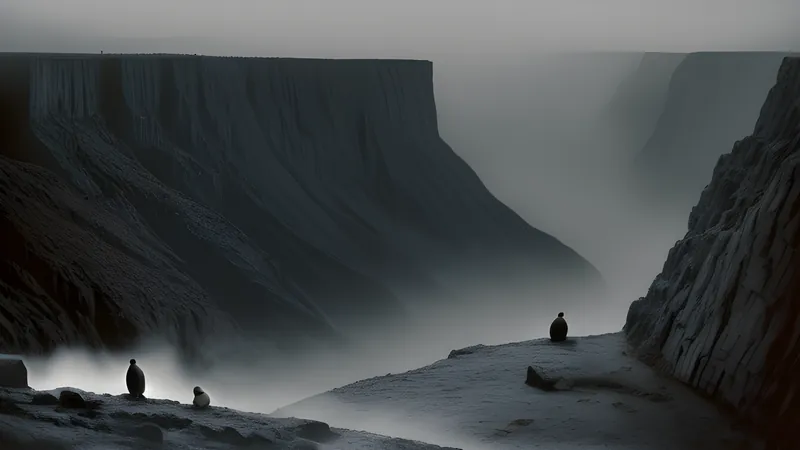
In 1958 the Walt Disney studio released White Wilderness, a feature-length instalment of its lucrative True-Life Adventures nature series. The films were prestige productions, narrated with grave warmth, and they won Academy Awards; audiences trusted them as documentary fact. White Wilderness contained a now-infamous sequence in which lemmings, driven by instinct, are shown surging over a cliff edge and tumbling into the water below to their deaths, the narrator solemnly framing it as the animals’ mysterious compulsion toward mass suicide. For a generation of viewers, that footage was the proof. The metaphor had been vague folklore; now it was on film, in colour, blessed by Disney and by an Oscar.
The sequence was staged, and the staging was uncovered in detail by a 1982 investigation by the Canadian Broadcasting Corporation’s programme The Fifth Estate, which tracked down people connected to the production. The lemmings in the film were not filmed in the open Arctic during a real migration. The production was shot in landlocked Alberta, near Calgary, nowhere near the sea the animals appear to plunge into. The lemmings themselves were reportedly bought from Inuit children who had trapped them, then imported to the location — a modest number of animals, perhaps a few dozen, standing in for the teeming thousands the narration describes. To create the impression of a vast migrating horde, the filmmakers are said to have placed the lemmings on a snow-covered turntable and filmed it spinning, generating footage of relentless movement from a handful of confused rodents. And the climactic plunge was engineered: the animals were driven off a cliff edge, herded and in some accounts pushed toward the drop, falling into a river rather than leaping into the ocean of their own accord. The most famous suicide in the animal kingdom was a herd of frightened creatures being shoved off a ledge for the camera.
Where the myth forks from the record
This is the precise point where the true thing and the false thing part company, and it is worth marking it exactly, because the kernel is real enough to make the fork feel small. The record supports: population booms and crashes, mass dispersal under overcrowding, and incidental drownings when migrating animals misjudge water. The record does not support: intentional self-destruction, a deliberate march to a chosen death, or any behaviour that could sensibly be called suicide, a concept that requires an animal to grasp its own death and choose it. Lemmings pressing forward across dangerous terrain because the pressure of the crowd and the drive to find food outweighs caution is not suicide; it is the ordinary, sometimes fatal, arithmetic of animal dispersal. The fork is the difference between “sometimes dies while trying to survive” and “seeks to die,” and Disney’s turntable and cliff-herding is the machinery that carried the story across that gap and made the wrong side look documented.
The wider practice behind one scene
It would be comforting to file the lemming sequence as a single rogue lapse, but it sat inside a house style. The True-Life Adventures were built to tell tidy dramatic stories about wild animals, and tidy drama is not what the wild reliably supplies. Nature is patient, repetitive and mostly uneventful; a film crew on a schedule cannot wait three years for a real lemming crash to coincide with a photogenic coastline. The temptation, in that gap between what the camera can capture and what the narration promises, is to help nature along — to stage, to bait, to re-cut, to relocate animals to a set that reads better on screen. The lemming plunge is simply the most notorious instance of a pressure that bears on the whole genre: the documentary’s authority depends on appearing to merely observe, while its economics reward it for arranging.
That tension is why the 1982 CBC exposé mattered beyond the single film. It made viewers reconsider what “documentary” had ever guaranteed, and it seeded a healthy suspicion that persists in how careful audiences now watch wildlife film — asking whether a night-time predation was really filmed in the wild or in a controlled set, whether a “chance” encounter was engineered. The lemmings did a service in the end. Their staged death became the standard cautionary tale for the difference between recording the world and directing it, told in film schools and ethics discussions decades after the turntable stopped spinning.
Why we needed lemmings to jump
The myth survives because it is enormously useful, and its usefulness has nothing to do with rodents. “Lemming” is one of the sharpest words we have for a specific human failure mode: the abandonment of individual judgement to the momentum of a crowd, the sense that a mass of people can march collectively toward catastrophe while each member assumes the others must know where they are going. We reach for the animal because we recognise the behaviour in ourselves and want a name for it that locates the folly safely in nature rather than in us. The metaphor is so good that its factual basis became almost beside the point; even people who know the Disney story still say “lemmings,” because no better single word exists for the thing they mean.
There is also the ordinary momentum of a trusted source. Disney was, for mid-century audiences, an authority on the natural world, and the True-Life Adventures carried the moral weight of education. A staged scene wearing the costume of documentary is far more durable than a mere rumour, because it recruits the viewer’s trust in the institution. The same dynamic — a fabricated proof laundered through a respected format — runs under a great many stubborn beliefs, from the nature footage that stages what it claims to observe to the confident, sourceless statistics we repeat about ourselves, like the notion that we only use ten percent of our brains. The costume of authority does the work; the content barely needs to be true.
There is a further reason the belief resists correction, and it is a quiet cognitive one. The lemming story flatters us by locating irrationality in an animal we can look down on. If even a mindless rodent will march off a cliff in a herd, then our own occasional surrender to crowd momentum feels less like a human embarrassment and more like a law of nature we merely share. Take the rodent away and the mirror turns back on us, which is uncomfortable; keeping the myth lets the folly stay safely outside the species. Beliefs that let us externalise a fault we would rather not own are always harder to dislodge than beliefs that cost us nothing either way.
What to keep and what to drop
The honest ending keeps the true part of the story and retires the false one. Keep the genuinely astonishing biology: rodents whose numbers pulse across the tundra in cycles violent enough to reshape whole ecosystems, whose peak-year dispersals send them swimming across water in a gamble that sometimes drowns them. That is a real and dramatic thing, and it earned people’s attention long before anyone staged a cliff. Drop the cliff. The lemmings of the metaphor — knowingly choosing oblivion, marching in ecstatic ranks toward the sea — were assembled in Alberta from a few dozen trapped animals, a spinning turntable, and a shove, and the only creatures who really behaved like lemmings that day were the audiences who believed it.
Related Content