Kuchisake-onna: Japan's Slit-Mouthed Woman
How a masked figure with a scissored smile swept through 1979 Japan, and where she came from
Contents
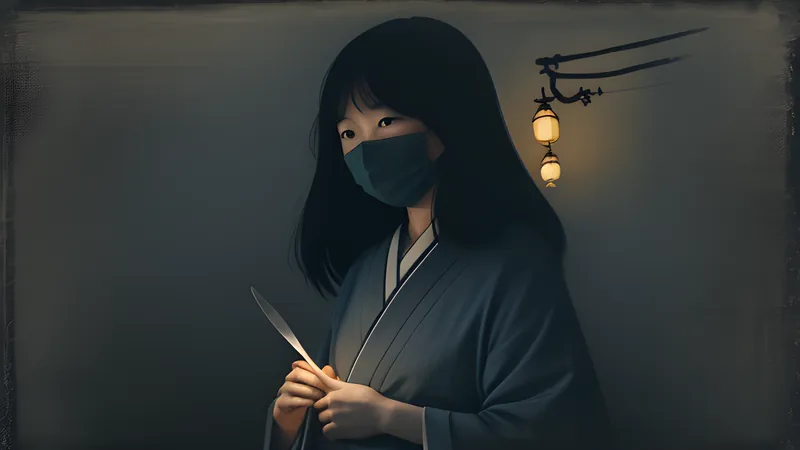
She waits at the edge of the evening, on a quiet residential street, a tall woman in a long coat with a surgical mask covering the lower half of her face. When a child comes past she steps out and asks a simple question: Watashi, kirei? — “Am I pretty?” There is no good answer. If the child says yes, she pulls the mask down to reveal a mouth slit open ear to ear, a wet red gash of a smile, and asks again: Even now? If the child says no, she cuts them. If the child says yes the second time, she cuts them anyway, so that their mouth will match hers.
This is Kuchisake-onna, the slit-mouthed woman, and in the spring and early summer of 1979 she brought parts of Japan to a genuine standstill. Schools arranged for children to be walked home in groups. Police in some prefectures increased patrols. Newspapers reported sightings. For a folk figure with no body, no crime scene, and no victim anyone could produce, she moved with remarkable speed and force — and to understand why, you have to look at what she was made of, and who was carrying her.
The rumour season of 1979
The panic can be dated with unusual precision. The rumour of the slit-mouthed woman appears to have begun circulating in the Gifu Prefecture area in late 1978 and reached a fever pitch across much of Japan through the first half of 1979. By June it was national news. The folklorist Nobuko Fujizuka, who documented the outbreak while it was happening, traced the way the story spread through the school-age population before it ever reached adults — child to child, in the classroom and on the walk home, in the manner that has always carried the most durable legends.
The details firmed up as the rumour travelled, which is itself a signature of living folklore. She wore a mask, which in Japan was — and remains — an entirely ordinary sight, worn against pollen and colds and to spare others one’s germs. That ordinariness is the horror’s foundation: the monster is indistinguishable from any woman on any pavement until the moment she is not. She was said to be supernaturally fast; some versions gave her the ability to appear behind you no matter how quickly you ran. She carried a weapon — scissors in most tellings, sometimes a scythe or a knife.
And, crucially, the children traded countermeasures. This is the part that marks Kuchisake-onna as folklore doing active work rather than a story merely told. If you answered her question with something ambiguous — “you’re average,” “so-so” — she would be confused long enough for you to escape. If you threw hard sweets, particularly a brand called Bekkō ame, she would stop to pick them up. If you said the word “pomade” three times, she would flee, for reasons tied to a sub-legend about her origins. A monster you can defeat with the right ritual is a monster the community has begun to metabolise. The precise details varied from school to school and prefecture to prefecture — some children swore the safe answer was to say she looked ordinary, others that you had to compliment her hair, others that only the sweets worked — and that very variation is the fingerprint of a legend genuinely alive in the mouths of the young rather than fixed on a page. The escape clauses are how children take a fear and make it survivable, and trading them was its own small ritual of reassurance passed hand to hand in the playground.
What she was made of
There is no single origin event here — no Rotherham fire, no founding hoax. Kuchisake-onna is a composite, and her power comes from the depth of the material she is assembled from.
The masked, disfigured female revenant is one of the oldest and most potent figures in Japanese folklore. The tradition of yūrei, the vengeful female ghost, runs back centuries through kabuki and ghost-story collections — women wronged in life, often by men, who return with wet hair and white robes to exact a patient, terrible justice. The most famous is Oiwa, from the play Yotsuya Kaidan, whose face is hideously disfigured by poison and who haunts the husband who betrayed her. The slit-mouthed woman inherits this whole lineage. Her disfigurement, in many versions, is explicitly the result of male violence: a jealous husband, or a botched cosmetic surgery, or a samurai in the oldest tellings who cut her face for her infidelity or her vanity. The “pomade” escape clause even encodes this — one origin story makes her the victim of a cosmetic surgeon or dentist, and the smell of hair pomade recalls the man who mutilated her.
Onto this ancient armature the 1979 version welded something modern and specifically anxious: cosmetic surgery. This detail is easy to skate past and it is the most telling thing in the whole legend. The late 1970s were a period of rising affluence and rising interest in appearance in Japan, and cosmetic procedures were becoming both more available and more culturally fraught. Some versions of Kuchisake-onna’s origin make her mutilation the result of surgery gone wrong — the pursuit of beauty turned into permanent horror. Her question, am I pretty?, is the question of a culture newly and uneasily obsessed with the answer. She is a woman destroyed by the demand to be beautiful, now roaming the streets forcing that same brutal appraisal onto children.
The journey through a nation of children
Why did this particular figure spread so fast in 1979, when the raw materials had been available for centuries?
Part of the answer is structural. The rumour lived in the child population, and the child population of 1979 Japan was densely connected in exactly the way a legend needs. Children walked to and from cram schools in the late evening, unsupervised, through quiet suburban streets — the precise setting the legend describes. The story was, in effect, a map of their own daily journey with a monster placed at the most vulnerable point of it. It named a real vulnerability: the walk home, alone, in the dark, past a stranger you cannot read.
Part of it was the media. Once the rumour reached a scale the newspapers could not ignore, their coverage — even sceptical coverage — amplified it enormously, in the same self-reinforcing loop that turned a firefighter’s stray observation into a national curse in the case of the crying boy painting. To report on a panic is to spread the thing the panic is about. Parents who read that children were frightened took protective measures; those measures — group walks, police patrols, warnings — told every child that the adults believed it too, which is the most powerful confirmation a child’s fear can receive.
And part of it was timing that had nothing to do with monsters. Japan in 1979 was a society moving fast — urbanising, prosperous, its old village structures thinning out into anonymous suburbs where a woman on the street was a stranger rather than a neighbour. The slit-mouthed woman is a suburban ghost. She could not have haunted a village where everyone knew everyone. She needed the anonymity of the modern residential estate, the surgical mask that made every face unreadable, the child walking home alone because both parents worked. She is what the old vengeful ghost becomes when the village becomes a commuter town.
What the question was really asking
Strip Kuchisake-onna down to her core and you are left with a woman, disfigured by the demand for beauty, who accosts the young and forces them to judge her appearance, then punishes them however they answer. Read that way, she stops being random and becomes almost unbearably legible.
She is a fear about women and what is done to them. The origin stories agree on one thing across all their variations: her mouth was cut by someone else, usually a man, usually as punishment for a failure to be what a woman was supposed to be — faithful, beautiful, obedient. She is the wound made flesh and sent back out into the world. That the wound takes the form of a forced, permanent smile is the detail a folklorist lingers on. A woman is expected to smile, to be pleasant, to present a pleasing face. Kuchisake-onna is that expectation taken to its grotesque limit: a smile cut into the face with a blade, a pleasantness that has become a mutilation.
She is also a fear about beauty itself, arriving precisely as cosmetic surgery entered the mainstream. The unspoken anxiety in the 1979 version is that the pursuit of a prettier face carries the risk of ruin — that the knife meant to improve you might destroy you, and that the whole enterprise of appraising and altering women’s faces is a kind of violence with a clinic’s lighting. Her question is the question the culture was asking itself, thrown back in a form no one could answer safely.
And for the children who told and re-told her, she was something simpler and older: the stranger on the walk home. Every culture equips its children with a monster who embodies the danger of the unknown adult, the one who approaches with a friendly question and means harm. She belongs beside the same anxieties that shape roadside phantoms like the vanishing hitchhiker remembered on a Chicago roadside — figures who materialise at the threshold between safety and the dark. The countermeasures the children traded — the ambiguous answer, the thrown sweets — were their way of rehearsing what to do when a stranger will not let you pass.
Why she never left
Panics burn out, and the acute phase of Kuchisake-onna passed by the end of 1979. But she did not go the way of a fad. She has resurfaced repeatedly — in a wave of renewed rumours in South Korea, in Japanese horror cinema, in a steady stream of manga, games and films that keep her mask and her scissors in circulation for each new generation of children. A figure assembled from such deep material does not dissolve; it goes dormant and waits.
That endurance is the tell. The crying boy needed a newspaper and cosmetic surgery needed a decade, but the thing underneath Kuchisake-onna — the wronged woman returning disfigured, the stranger at the edge of the safe world, the demand that a woman be beautiful and the violence tangled up in it — is not tied to 1979 at all. She wears a surgical mask because that is what the streets of modern Japan handed her, and if she surfaced now she would wear whatever made a face unreadable today. Ask her whether she is pretty and there is still no safe answer, which is the point, and always was. The question was never really hers to ask. It was ours, and she only carried it back to us wearing a mask, so we would not recognise our own reflection asking it.
Related Content