The Gulf of Tonkin: The Attack That Half-Happened
One clash was real. The second, which launched a war, almost certainly never occurred.
Contents
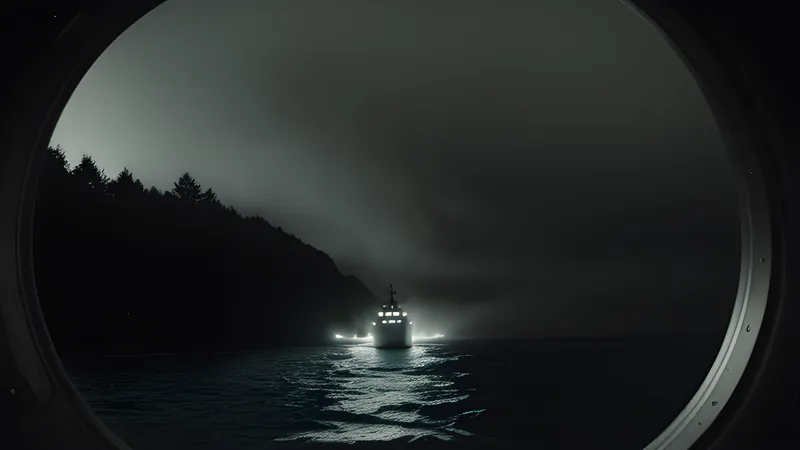
On the night of 4 August 1964, in heavy weather off the coast of North Vietnam, the destroyer USS Maddox and her companion the USS Turner Joy began reporting that they were under attack. The sonar rooms called out torpedoes in the water — dozens of them over the course of a couple of hours. The gun crews fired into the darkness at radar contacts that appeared, vanished, and reappeared. Somewhere over the horizon in Washington it was still afternoon, and within days that afternoon would produce a resolution of Congress that handed the President a nearly blank cheque to make war in Vietnam. Some 58,000 American names on a wall in Washington, and many times that number of Vietnamese dead, trace back through a long chain of decisions to a few hours of frightened men staring at green screens in the rain.
The trouble is that the attack on 4 August almost certainly never happened. And the reason this matters is subtler than the slogan it usually gets folded into. The Gulf of Tonkin is remembered as the clean case — the moment the government simply lied America into a war. The declassified record tells a stranger and more unsettling story, in which the lie, if that is even the right word, is braided together with genuine confusion, wishful reading, and a fog of war so thick that the men inside it could not agree on what they had seen while they were still seeing it.
The first night, which was real
Begin with the part that is not in dispute, because holding on to it is the whole discipline here.
Two days earlier, on 2 August 1964, the Maddox really was attacked. She was steaming through the Gulf of Tonkin on a DESOTO patrol — a signals-intelligence mission, listening to North Vietnamese coastal communications and radar. This was not an innocent pleasure cruise, and the North Vietnamese had reason to be jumpy: South Vietnamese commandos, under a covert programme designated OPLAN 34A, had been raiding North Vietnamese coastal installations, and the American destroyer was operating in the same waters at the same time. Three North Vietnamese torpedo boats came out and attacked the Maddox. She fired, aircraft from the carrier Ticonderoga joined in, and the engagement was brief and lopsided. A single bullet lodged in the Maddox’s hull. The torpedo boats came off far worse.
That clash was daylight-clear. It was witnessed, it left physical evidence, and no serious account denies it. It also, crucially, established an expectation. After 2 August, everyone aboard those ships and everyone reading their cables in Washington was braced for the North Vietnamese to try again. When you are certain an attack is coming, the mind becomes a generous interpreter of ambiguous signals. That is the hinge on which the second night turns.
The second night, which was fog
On 4 August the Maddox and Turner Joy were back in the Gulf, now expecting trouble. The weather was foul — low cloud, thunderstorms, a heaving sea. In those conditions radar throws phantoms and sonar hears things that are not there. The ships began reporting torpedo attacks. Over roughly two hours they logged a bewildering number of them, took evasive action, and fired at contacts that behaved less like boats than like weather.
The most important witness to what was happening turned out to be the man in command on the scene, Captain John Herrick, aboard the Maddox. Even as the “battle” was still unfolding, his own confidence was collapsing. In the hours afterwards he sent a cable to his superiors whose caution has become famous among historians. A review of the action, he warned, made many of the reported contacts and torpedoes appear doubtful. He pointed to freak weather effects on the radar and to overeager sonar operators. He urged a complete evaluation before anyone acted on the reports.
Think about what that cable represents. The commander who was supposedly under attack was, within hours, telling Washington that he was not sure the attack had happened at all, and asking them to wait. The other officers were divided. Some were sure they had fought off torpedo boats; others suspected they had spent the night duelling with a thunderstorm. Nobody produced wreckage, bodies, or a captured survivor. No aircraft flying overhead that night could visually confirm an enemy vessel.
President Lyndon Johnson did not wait. Within hours the United States launched retaliatory airstrikes against North Vietnamese targets — Operation Pierce Arrow — and on 7 August 1964 Congress passed the Gulf of Tonkin Resolution, authorising the President to take “all necessary measures” to repel armed attack and prevent further aggression. In the House the vote was unanimous. In the Senate only two men, Wayne Morse of Oregon and Ernest Gruening of Alaska, voted no. That resolution became the legal foundation for the vast American escalation of the war over the following years. Johnson himself, in a private remark that has aged into grim comedy, is reported to have said that for all he knew the Navy had been shooting at whales out there.
What the code-breakers found forty years on
For decades the argument over the second night ran on memoir and inference. Then, in 2005, the National Security Agency declassified an internal study that had been written by one of its own historians, Robert J. Hanyok. Its title is a small poem of its own — “Skunks, Bogies, Silent Hounds, and the Flying Fish: The Gulf of Tonkin Mystery, 2–4 August 1964” — and its findings are the most authoritative account we have.
Hanyok’s conclusion was blunt on the central fact: the attack of 4 August did not happen. There were no North Vietnamese boats in contact with the American destroyers that night. But the more disquieting part of his study is what it revealed about the intelligence that seemed, at the time, to prove the opposite. The signals intelligence used to support the reality of the 4 August attack was mishandled. Intercepts that actually referred to the genuine battle of 2 August were presented as though they described a fresh attack two nights later. Reports that pointed away from an attack were set aside; reports that could be read as confirming one were passed up the chain.
Hanyok’s careful judgement was that this skewing was deliberate — but he located the deliberateness not in a grand conspiracy hatched at the top, but among analysts and officers who, having decided what the answer was, arranged the evidence to fit it. This is the finding that makes the Gulf of Tonkin so much more instructive than its slogan. The system did not receive a clear picture and then lie about it to the public. The system manufactured a false clarity for itself, and then acted on its own manufactured certainty.
There is a further layer, exposed years before Hanyok, in the Pentagon Papers — the classified history of American decision-making in Vietnam that Daniel Ellsberg leaked in 1971. By an odd turn, Ellsberg had begun work at the Pentagon on the very day of the phantom attack, and watched the cables come in as the ships’ own reports curdled from certainty to doubt. What the Papers later showed was that the administration had drafted a congressional resolution authorising war weeks before the incident that supposedly prompted it. The Tonkin clash did not spark the decision to widen the war so much as supply the occasion for a decision already taken and a document already written. That is a different and colder kind of dishonesty from a fabricated battle: the willingness to use a murky night as the trigger for a policy that was loaded and waiting for one.
The murkier honest answer
Here is the fork, and it does not sit where people expect. The popular memory of Tonkin says: they lied us into war. It is a clean sentence, and clean sentences are exactly what this desk is suspicious of. The declassified record supports something messier and, I think, more frightening.
There was, without question, deception. Johnson’s administration presented the 4 August attack to Congress and the public as an established fact when the evidence for it was, at best, deeply contested — and the man on the scene had said so in writing. Robert McNamara, the Defense Secretary, assured Congress there was “unequivocal proof” of the second attack. There was no such proof, and some of the people vouching for it had reason to know the ground was soft. That is culpable. It got a resolution passed under false pretences.
But underneath the deception sat something that was not a simple lie: genuine institutional self-deception. Frightened sailors in a storm really did believe, some of them, that they were under attack. Analysts predisposed to expect a second engagement really did read ambiguous intercepts as confirmation. The confusion at sea was real; the eagerness to believe was real; and the machinery then smoothed all that raw doubt into a firm official narrative on its way up the ladder. The difference between “they knew there was no attack and said there was” and “they wanted there to have been an attack and talked themselves into it, then told the public the tidied-up version” is not a difference the slogan can hold. The truth lives in the gap between those two sentences.
Why the clean version wins
If the honest account is murkier, why does the clean one — pure fabrication, a war conjured from nothing — dominate the memory? Because it is easier to carry, and because the messier truth is, in a sense, more damning.
A deliberate lie is almost consoling. It implies a liar who knew the truth, which implies the truth was knowable, which implies that a more honest man in the same chair would have made a better decision. The record of the Gulf of Tonkin offers less comfort than that. It shows a superpower stumbling into a decade of war partly because thousands of people, from sonar operators to cabinet secretaries, filtered a genuinely ambiguous night through what they already expected and wanted to see, and then acted on the result with catastrophic speed. There was no single moment where a knowing villain chose the war. There were a hundred small moments where honest confusion and motivated reading and political convenience pulled in the same direction, and no one strong enough to say wait the way Captain Herrick tried to.
This is the pattern worth taking from Tonkin. Governments do sometimes lie outright — you can watch one do exactly that, on live television, in the story of Iran-Contra. And they do sometimes draft real plans for real deceptions, as the paperwork of Operation Northwoods shows in cold detail. But the Gulf of Tonkin is the case that should make even a committed sceptic slow down, because it refuses the clean shape. It asks us to believe two things at once: that we were misled into a war, and that a good part of the misleading was a great institution lying, first and most convincingly, to itself. That is the harder story. It is also, on the evidence, the true one.
Related Content