Denver Airport: The Blue Horse and the Underground Kingdom
A cursed statue, an apocalyptic mural, and a runaway construction budget become a temple for the end of the world.
Contents
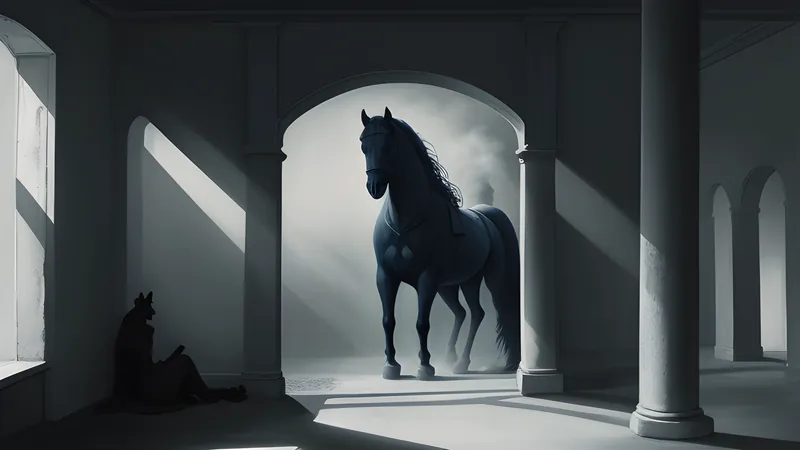
Drive in from the plains east of Denver and the first thing you meet is the horse. It stands nearly ten metres tall by the airport road, rearing on its hind legs, cobalt blue, its muscles anatomically exact, its mane wild — and its eyes glow red at night, lit from within, so that a traveller arriving after dark sees a monstrous cyan stallion with burning eyes standing guard over the way in. It is called Blue Mustang, though almost everyone who has passed it calls it Blucifer, because the story attached to it is that the sculpture killed the man who made it. That is where most people’s fascination with Denver International Airport begins: not with a document, not with a whistle-blower, but with a single, genuinely unsettling object standing in a field, doing exactly what a folk tale needs its first image to do. It stops you, and it makes you ask what kind of place would put that at its front door.
The straight version, as the faithful tell it
To the believer, Denver International is the least secret secret in America: a headquarters for the coming New World Order, built in plain sight and paid for by taxpayers who were told they were funding an airport. The evidence, they will say, is everywhere, and it starts with the sheer strangeness of the thing.
The airport opened in 1995, wildly over budget and years behind schedule, on a vast tract of prairie far larger than it could ever need — room, believers say, for something other than aeroplanes. Its white tented roof is said to evoke either the Rockies or a field of pyramids. A dedication stone in the main terminal bears the words “New World Airport Commission”, an organisation nobody can quite trace, and is set over a time capsule marked for opening in 2094. Beside it, a Masonic square and compasses are carved into the granite, with the names of two Masonic lodges — the builders of the temple, hidden in the temple’s own cornerstone.
Then the murals. A series of large paintings by the artist Leo Tanguma line the terminal walls, and to the faithful they are a prophecy. One panel shows a towering soldier in a gas mask, wielding a scimitar and a rifle, standing over a dead woman while a burning city smokes behind him and weeping refugees file past. Another shows children of all nations laying down weapons before a rising green plant. Read as a sequence, believers say, the murals depict genocide and environmental collapse followed by a purified, unified world — the New World Order’s own creation myth, painted on the wall of its capital. Add the blue horse that killed its maker, the endless rumours of a bunker complex beneath the runways, the strange floor symbols and the word DZIT DIT GAII set into the granite, and you have what the theory promises: a shrine, an ark, a fortress for the survivors of a culling the elite already have planned — anything except an airport.
What is actually there
Almost every hard fact in that story is true, which is exactly why the story is so durable — and almost every meaning attached to those facts is imposed from outside.
The airport really was a fiasco. It opened sixteen months late, in February 1995, and came in around two billion dollars over its budget, a scandal covered in exhaustive, unflattering detail by the Denver and national press at the time. The single most notorious cause was an automated baggage system — a computer-controlled network of tracks and carts meant to whisk luggage across the sprawling site without human hands. It never worked. In demonstrations it flung suitcases off the rails, jammed, shredded bags and lost track of them entirely. The airport eventually abandoned much of it and reverted to conveyor belts and tugs. The famous “underground tunnels” beneath Denver International are real, and they are exactly this: maintenance corridors and the ducting built to house that failed baggage machine, plus the ordinary utility runs any airport of that scale needs. There is no city down there. There is a great deal of very expensive, very embarrassing plumbing for a robot that dropped people’s luggage.
The vast site is real too, and it has a dull explanation: Denver was replacing the cramped, congested old Stapleton airport, and it deliberately bought a huge parcel — larger than the city of Boston — so that it would never again be hemmed in, and so it could add runways for decades without buying more land. Airports of that generation were planned for a century of growth.
The “New World Airport Commission” was a real but mundane body — a group of local business and civic boosters assembled to promote the airport’s opening and organise its dedication festivities. They paid for the dedication capstone, which is why their name is on it. And the Masonic square and compasses? American public buildings have had cornerstones laid in Masonic ceremonies since the eighteenth century — the United States Capitol among them, its cornerstone laid by George Washington in a Masonic apron in 1793. Two Colorado grand lodges laid Denver’s capstone in a public 1994 ceremony and put their names on it, as fraternal orders have done for two hundred years. It records a masonic building custom two centuries deep, the same one that placed George Washington’s apron on the Capitol’s cornerstone.
Even the mural has a plainer reading than the prophecy. Leo Tanguma is a Chicano muralist working in a long Mexican-American tradition of political art, and his Denver panels — titled In Peace and Harmony with Nature and The Children of the World Dream of Peace — were, by his own repeated account, an anti-war and environmental statement: the gas-masked soldier represents the horror of war and militarism, and the sequence moves from that horror toward the children disarming and the world healing. He has spent years, wearily, explaining that his paintings are a plea against violence, not an advertisement for it. Read left to right as he intended, the story is the opposite of the one the theory tells.
Where the story forks from the record
The fork is unusually clean, because you can watch the meaning invert at a single hinge: the direction you read the mural.
A mural is a sequence, and a sequence has an order. Tanguma painted despair giving way to hope — the burning city and the gas-masked soldier are the sickness, and the children laying down their swords before the growing plant are the cure. The airport is the audience’s departure point and Tanguma’s message is a hopeful one: humanity can choose peace. The conspiracy reading takes the same panels and treats the darkest image — the soldier, the dead woman, the smoke — not as a warning of what to avoid but as a blueprint of what is planned. It reads the artist’s nightmare as the elite’s intention. Same paint, same wall, opposite meaning, and the whole difference is whether you believe the image is a plea or a promise.
The other fork is the horse, and it holds a genuine tragedy the folklore turns into a joke. Blue Mustang was created by the New Mexico sculptor Luis Jiménez, a celebrated Chicano artist known for fibreglass sculptures of animals and working people. And Jiménez did die making it: in June 2006, in his studio, a large section of the horse’s body came loose from its hoist and struck him, severing an artery in his leg. He bled to death before help arrived. He was sixty. The statue really did kill the man who made it — a freak workshop accident of the kind that has killed craftsmen for as long as there have been heavy things overhead. The folklore keeps the fact and discards the man: it wants a cursed idol, not a grieving family and an artist who never saw his most famous work installed. The red eyes, added by the studio finishing the piece in tribute to Jiménez’s own love of glowing-eyed animal sculptures, became the devil’s eyes. The accident became the curse. A death became a punchline, “Blucifer”, and that is the small cruelty at the heart of this particular legend.
The journey — from a bungled opening to the world’s temple
The Denver airport legend is a native of the internet, and you can almost date its birth to the platform. The baggage disaster and the budget scandal were 1990s news, thoroughly reported, and for years the airport was simply a byword for public-works incompetence. The occult reading came later and grew with the web. Message boards and early conspiracy sites in the late 1990s and 2000s began stitching the pieces together; the murals, freshly photographable and shareable, gave the theory its viral engine, because a photograph of a gas-masked soldier over a dead woman needs no argument. It simply appals, and the caption supplies the plot.
By the 2010s the airport had become a fixture of conspiracy YouTube and, more importantly, of a certain knowing internet irony. Something strange happened: the airport’s own management leaned in. Denver International began joking about the theories in its marketing — putting up construction signs during a 2018 renovation that read “Remodelling the lizard people’s lair?” and installing a talking animatronic gargoyle that greeted travellers with references to the conspiracies. The airport monetised its own legend, and in doing so blurred the line between the people who believe it and the vastly larger number of people who simply enjoy it. That is a modern feature of folklore worth noticing: a legend can be sustained less by true believers than by an ironic audience passing it around for the pleasure of the thing, until the retelling keeps it alive regardless of belief.
Underneath the irony, though, the theory hooks into a much older and heavier lineage — the “New World Order” itself, the idea of a hidden global elite engineering catastrophe to rule the survivors. That framework did not begin at Denver. It descends from a much darker inheritance, the same forged-document tradition of a secret cabal plotting world domination anatomised in The Protocols of the Elders of Zion, and it shares its sealed, unfalsifiable logic with the internet-age rumours traced in Pizzagate: every ordinary detail becomes a clue, every denial becomes proof, and the absence of the secret city becomes evidence of how well it is hidden.
What it is really about
Strip the airport theory back and you find a very human response to a very real experience: the experience of standing inside enormous, impersonal, expensive infrastructure and feeling that you are not being told the whole story. And in Denver’s case, you weren’t — though the concealed story turned out to be a mundane one. The public was told it was getting a smooth, futuristic airport, and instead it got years of delay, two billion dollars of overrun, and a robot that shredded the luggage. Something was concealed at Denver International: the scale of official incompetence, the cost, the boondoggle. The building is genuinely a monument to things going wrong behind closed doors. The theory takes that accurate feeling — they are not being straight with us about this place — and supplies a grander, more bearable culprit than the true one.
Because the true one is, in its way, harder to sit with. Bureaucratic failure is banal and anticlimactic; a satanic elite building an ark for the apocalypse is a story with meaning, agency and a role for you as the one who sees through it. Faced with a giant, alienating structure raised by committees and contractors, the mind would often rather believe in a competent conspiracy than an incompetent one, because a competent conspiracy at least means someone is in control. The blue horse with the burning eyes is frightening. But it is a fear you can name, photograph, and share — and a named fear is a kind of comfort against the larger, shapeless unease of moving through a world of vast systems that no one person understands and no one quite admits are held together with tape.
Tanguma, for what it is worth, kept telling anyone who asked that his paintings were a prayer for peace. The airport keeps flinging luggage the old way, off conveyor belts, because the future never worked. And the horse stands out on the prairie with its red eyes, a memorial to an artist it killed by accident, mistaken by millions for a god of the coming end. Every part of the legend is true. It is only the story binding them together that was never there.
Related Content