Cropsey: Staten Island's Bogeyman and the Real Man Beneath
A campfire bogeyman who lived in the tunnels, and the real disappearances that gave a children's story a suspect.
Contents
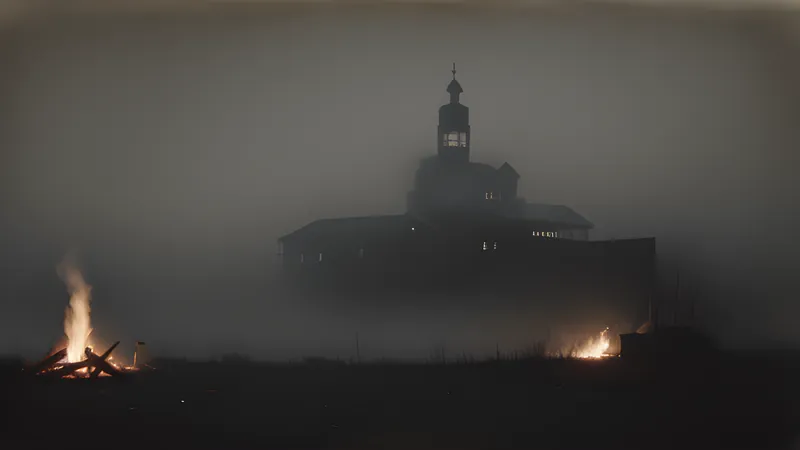
Every part of the United States has its campfire bogeyman, the local name you shout to make younger children flinch. On Staten Island, the borough of New York City that most New Yorkers forget exists, the name was Cropsey. He was said to have been a caretaker, or an escaped patient, or a grieving father, depending on who was telling it, and he lived somewhere underground, in the tunnels beneath an abandoned institution in the woods, and he came out at night with a hook or an axe to take children who stayed out too late. For decades Cropsey was exactly what he sounds like: a story, a way for summer-camp counsellors to keep kids in their bunks. Then, in the 1970s and 1980s, children on Staten Island actually began to disappear, and the story acquired something no bogeyman is supposed to have. It acquired a suspect.
The bogeyman before the crime
The Cropsey legend is older than any crime attached to it, and its earliest life was entirely ordinary as folklore goes. Variations of the “Cropsey” name turn up in camp-counsellor storytelling across the New York region through much of the twentieth century, one of a large family of “maniac in the woods” tales that campgrounds used to enforce curfews and discourage children from wandering off into genuine danger. The details were endlessly flexible. Sometimes Cropsey wielded an axe, sometimes a hook in a clear borrowing from the Hook Man; sometimes he was a caretaker driven mad by the death of his own children, sometimes simply a lunatic escaped from an asylum. What stayed constant was the function. Cropsey was a rule with a face, the personification of the boundary between the safe camp and the dark trees, and no one telling the story believed for a moment that he was real.
On Staten Island the legend found an unusually good home, because the island offered the perfect stage set. In its interior stood Willowbrook State School, a vast state institution for children with intellectual disabilities, surrounded by woods and, beneath it, a network of service tunnels. Willowbrook was the kind of place that generated its own darkness, and once the story of Cropsey attached itself to those specific woods and those specific tunnels, the bogeyman had a real address. That address is what made the difference when the disappearances began, because the community already had a monster who lived in exactly the place children were now going missing.
The kernel: Willowbrook was a genuine scandal
Before we reach the disappearances, we have to sit with the real horror underneath the legend, because it is documented, dated, and far worse than any campfire tale. Willowbrook State School, which opened in 1947 and by the 1960s held more than six thousand residents in a facility built for four thousand, was one of the most notorious institutions in American history. Conditions inside were appalling: children left unwashed and unclothed, chronic overcrowding, disease, and neglect on an industrial scale.
In 1965 Senator Robert Kennedy toured Willowbrook and described it publicly as a “snake pit,” saying the residents were “living in filth and dirt, their clothing in rags, in rooms less comfortable and cheerful than the cages in which we put animals in a zoo.” The definitive exposure came in 1972, when a young local television reporter named Geraldo Rivera, tipped off by a dismissed staff doctor, walked into a ward with a camera and broadcast the images to the country. The footage was genuinely shocking and it forced Willowbrook into the national conscience. A class-action lawsuit followed, and a 1975 consent decree began the long process of shutting the institution down; it finally closed in 1987. Willowbrook became a landmark in the history of disability rights, the case that helped end the era of the giant custodial institution.
This is the kernel, and it matters that it is true. Long before any child was taken, Staten Island had learned, correctly, that the institution in its woods was a place where children were genuinely harmed and where the authorities genuinely failed to protect them. The Cropsey story was a fairy tale, but the fear underneath it, that the wooded institution at the island’s heart was dangerous to children, was grounded in fact. When real children began to vanish near that same institution, the community was primed to believe the worst, and the worst turned out to be closer to the truth than anyone wanted.
Where the story forks: the disappearances
Between 1972 and 1987, several children disappeared on Staten Island, and it is here that the campfire legend and the criminal record briefly touch. The victims were mostly children with disabilities. Jennifer Schweiger, a twelve-year-old girl with Down syndrome, vanished in July 1987; after a mass search that gripped the borough, her body was found roughly a month later in a shallow grave on the grounds of the old, now-abandoned Willowbrook site. Suspicion fell on a drifter named Andre Rand, a former Willowbrook employee who had worked at the school before its closure and was known to camp in the woods around the derelict buildings.
Rand had a documented history. He had a prior conviction for the attempted kidnapping of a group of children on a bus in the 1960s, and he was living, at the time of Schweiger’s disappearance, in an encampment near the very tunnels the Cropsey legend described. He was convicted in 1988 of kidnapping Jennifer Schweiger, though not of her murder, and years later, in 2004, he was convicted of the 1981 kidnapping of another child, Holly Ann Hughes, aged seven. In both cases the prosecutions rested on circumstantial evidence; no one ever saw Rand take either child, and he was never convicted of killing anyone. The other disappearances sometimes linked to him, including that of five-year-old Alice Pereira in 1972, remain officially unsolved.
The fork, the precise point where the real case departs from the legend, sits exactly here. The legend says Cropsey was a caretaker-turned-monster who lived in the tunnels beneath the institution and took children. The record says Andre Rand was a former Willowbrook employee, living rough near those tunnels, twice convicted of kidnapping local children with disabilities. The overlap is uncanny, and it is why the two stories fused so completely in local memory that many Staten Islanders came to speak of Rand simply as Cropsey. But the overlap is also where honesty has to intervene, because the fusion papers over how much remains unproven.
What the record will and will not carry
It is tempting, given the fit, to close the case in the mind and declare that the bogeyman was real all along. The 2009 documentary Cropsey, made by Staten Island filmmakers Joshua Zeman and Barbara Brancaccio, sits with exactly this temptation, following the legend into the Rand case and refusing to resolve it neatly. The documentary grasps something the folklore glosses over: how much the story wants a monster, and how that wanting can outrun the evidence.
The evidence against Rand for kidnapping is a jury’s verdict, twice. But he was never convicted of murder, the theory that he was a serial killer of many children rests largely on inference and coincidence, and Rand himself has always maintained his innocence. The prosecutions leaned on his prior record, his proximity to the woods, and the powerful narrative of a strange man haunting the ruins where children vanished. That narrative is compelling precisely because it matches the legend the community had been telling for decades, and a story that matches what we already believe is the hardest kind to examine sceptically. Some of the disappearances attributed to him may have had nothing to do with him at all; some children who go missing are never accounted for by any single villain.
Why the island needed a name for it
The most human part of the whole affair is why the fusion happened so readily. Staten Island in those years had been handed a real, unbearable pattern: children with disabilities, some of them associated with the failed institution in the woods, going missing and turning up dead. That is precisely the kind of horror that resists comprehension, a chaos of grief with no shape to it. The Cropsey legend offered a shape. It gave the loose, terrifying facts a single author, a single face, a single set of tunnels where the evil lived. Naming Rand as Cropsey was a way of gathering an unbearable randomness into one containable villain, the same instinct that built a backstory for the Bunny Man out of a few unexplained nights.
And the community was not wrong to be afraid. That is the hardest and most important thing to hold. The fear that produced Cropsey, that the institution in the woods was dangerous to vulnerable children, was vindicated first by Willowbrook itself and then, at least in part, by two kidnapping convictions. The legend was a fiction that happened to be pointing, all along, in a true direction. Where it fails is where all bogeyman stories fail: it insists on total explanation, a single monster who accounts for every missing child, when the record can only carry some of that weight and leaves the rest as open graves. Cropsey the bogeyman is a story that tidies the world. Andre Rand is a man in prison whom a jury convicted twice of kidnapping and never of murder, and the difference between those two sentences is the whole distance between folklore and fact.
The tunnels after the trials
The old Willowbrook grounds did not disappear when the institution closed. Much of the land became the campus of the College of Staten Island and a large tract of protected woodland, but the derelict buildings and the tunnels beneath them lingered for years, drawing exactly the kind of teenage pilgrimage that any site this saturated with story attracts. Young Staten Islanders dared each other into the ruins the way Virginians dare each other onto the Bunny Man Bridge, half looking for Cropsey and half looking for the thrill of the search. The legend fed on its own aftermath: every trespasser who came back with a story of a shadow in the tunnels added another layer to a tale that had already absorbed a real institutional scandal and two real kidnapping trials.
What makes Cropsey unusual among American bogeymen is how little daylight the legend now leaves around the facts. Most campfire monsters can be safely dismissed once the lights come on. This one cannot, quite, because a genuine predator did live in those woods and did take at least one of those children, and the community’s oldest fear turned out to be warranted. That is an uncomfortable place for a sceptic to stand, and it is the honest one. The temptation is to swing to the opposite pole and declare that the legend was prophecy, that the island always knew. It did not know. It feared, correctly, that the place was dangerous, and when the danger materialised it reached for the only frame it had. Sometimes that frame fit a real man. It did not, and could not, account for every grave.
The most truthful thing to say about Cropsey is that the story and the case will never fully separate now, and that the community would not let them if it could. Jennifer Schweiger, Holly Ann Hughes, Alice Pereira and the others were real children, and the borough’s insistence on remembering them through a bogeyman’s name is, in its way, a form of keeping faith. The legend gives the loss a shape it can carry down the years. Underneath the shape are the facts, harder and less complete, and worth holding onto precisely because they refuse to resolve into anything as clean as a monster in a tunnel.
Related Content