Chemtrails: The Sky-Writing That Wasn't There
Why some people look up at ordinary aircraft and see a secret being sprayed across the sky.
Contents
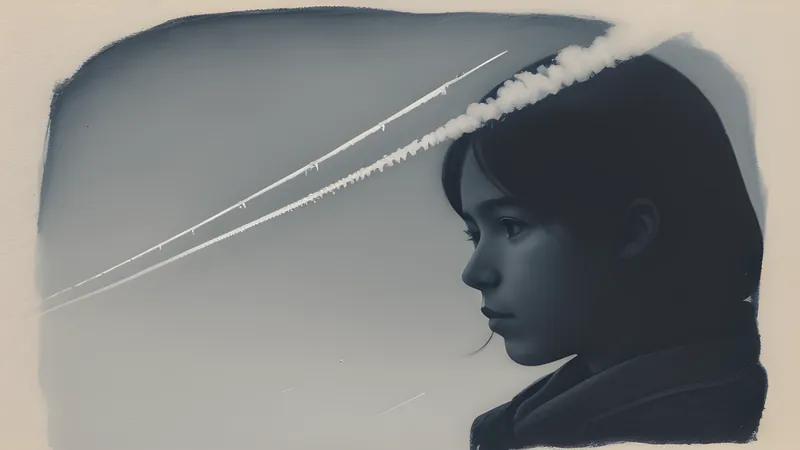
Stand in a field on a clear, cold morning and watch a high aircraft cross it. Behind the wings a white line unrolls, straight and clean, and then something curious happens. On some days the line thins to nothing in seconds. On others it thickens, spreads, feathers out into a smear that hangs for an hour and joins its neighbours until the whole blue is hazed over. Two aeroplanes, the same sky, and two completely different marks left behind. To a person who has never been told why, that difference looks like intent. One plane was simply flying. The other was doing something. The eye that notices the difference is not a foolish eye. It is doing exactly what human eyes evolved to do: it has spotted a pattern and gone looking for the hand behind it. The chemtrail theory begins in that entirely reasonable glance upward, and everything that follows is the story of what a mind does when nobody has answered its honest question.
The straight version, as its believers see it
To the person who has arrived at the theory, it is not a wild claim at all. It is the plainest reading of the evidence over their own head. Ordinary aircraft, they will tell you, have always left condensation trails — contrails — and those trails vanish quickly, the way your breath vanishes on a cold day. But somewhere around the mid-1990s the trails changed. They began to linger for hours. They spread into artificial cloud. They appeared in grids and X-shapes, laid down by planes flying patterns no scheduled airliner would fly. And on the days the sky filled with them, people reported headaches, sore throats, a strange metallic taste.
From there the architecture assembles quickly. The lingering trails are not water at all but a deliberate aerosol — aluminium, barium, strontium — sprayed from modified aircraft for a purpose kept from the public. The purpose varies with the teller. Some say weather modification, a programme to manage drought or steer storms. Some say climate engineering, a secret attempt to dim the sun. Some say population control, or mind control, or a slow poisoning whose beneficiaries are never quite named. Believers photograph the sky obsessively, catalogue “spray days” against “clear days”, send samples of rainwater to laboratories, and find aluminium in the results. They are not lazy. They gather what looks, to them, like a mountain of data. What holds the mountain together is a single conviction: the change in the sky is real, and someone is responsible for it.
What is actually up there
Here the honest answer has to concede the first thing the believer sees, because the concession is true and refusing it only confirms their suspicion that they are being managed. The trails really did change. What changed is how often we see them linger; what they are made of stayed exactly the same.
A contrail forms when hot, wet engine exhaust meets air that is far below freezing. The water vapour condenses onto soot particles and flash-freezes into a line of ice crystals — a cirrus cloud, made to order, a few metres behind the engine. Whether that line vanishes or spreads depends entirely on the air it is drawn in. If the upper air is dry, the ice crystals sublimate straight back to vapour and the trail is gone in seconds. If the upper air is already humid — close to saturation with respect to ice — the crystals do not evaporate. They persist, drift, and draw more moisture out of the surrounding air, spreading sideways until a knife-thin line becomes a broad band of what meteorologists call contrail cirrus. The physics of this was described in outline as early as the 1940s and 1950s, when high-altitude military flight first made persistent trails a common sight. Pilots in the Second World War already knew that a bomber stream could betray itself with a sky full of white ribbons.
So why did they seem to change in the 1990s? Because the sky did fill with more of them, and for a mundane reason: there were vastly more aeroplanes, flying higher, on more routes, than ever before. Global air traffic roughly doubled across the 1980s and 1990s. Engines grew more efficient and cruised in exactly the cold, moist band of the upper troposphere where persistent contrails form most readily. More flights crossing the same humid air means more lingering trails, more crossings, more of the grid-like lattice that looks so deliberate from below — and which is simply the map of the airways drawn in ice. The grids are flight corridors. The X-shapes are two routes intersecting. The plane laying a fat, spreading trail and the plane laying a thin one that vanishes are, very often, flying through slightly different pockets of air a few thousand feet apart.
As for the metals: aluminium, barium and strontium are three of the most common elements in the Earth’s crust. Aluminium alone is the most abundant metal in the ground beneath your feet. A rainwater sample, or a soil sample, that shows traces of them shows you the ordinary chemistry of the planet you are standing on. The tests that alarm believers are usually tests without a control — no comparison against ordinary background levels, no accounting for the dust that has always been in rain.
Where the story forks from the record
The fork has an unusually precise location, and it is worth standing on it, because it shows how a real document becomes a false one without anyone lying.
In 1996 a group of officers at the US Air Force’s Air University produced a paper titled Weather as a Force Multiplier: Owning the Weather in 2025. It was a speculative exercise — the kind of blue-sky “what might the year 2025 look like” thinking that military colleges set as assignments. It imagined future capabilities to influence weather for military advantage, and it opened with the standard disclaimer that it did not reflect current policy or capability. It was a paper about an imagined future, written by students.
To a movement looking for confirmation, that document was a smoking gun. Here, in the Air Force’s own words, was an interest in controlling the weather. The disclaimer and the date were quietly dropped in the retelling. A thought experiment about 2025 became proof of a programme running in 1997. The paper is still cited today, in videos and posts, as though it were an operations manual rather than a homework assignment.
The second half of the fork is a word. In 1999 the US Environmental Protection Agency, the Federal Aviation Administration, NASA and other agencies published a plain scientific fact sheet on contrails, explaining the condensation physics for a curious public. The document used the ordinary term “contrail”. Somewhere in the same period the coinage “chemtrail” appeared — a contrail that is secretly chemical — and the fact sheet was recast as the cover story, the official denial that proved there was something to deny. From that point the theory had everything a durable myth needs: a real document to point at, a real change in the sky to explain, and an official explanation it could reframe as a lie.
Who carried it, and how it spread
The vehicle was talk radio and, soon after, the early web. Through the late 1990s the American broadcaster Art Bell, whose overnight programme Coast to Coast AM was a nightly clearing-house for the strange and the unexplained, gave the emerging chemtrail idea a national audience of insomniac drivers and shift-workers. Callers reported the trails; a columnist named William Thomas pushed the story hard; the word travelled from the airwaves onto message boards, and from message boards onto the young platforms of YouTube and Facebook, where a photograph of a striped sky needs no argument at all. It simply shows, and the caption does the rest.
The theory proved unusually good at surviving contact with debunking, and the reason is structural. It rests on a sight anyone can reproduce at will. You do not need to trust a distant source; you need only look up. Every clear day with high humidity produces fresh “evidence” on schedule. And because the claimed programme is secret and its purpose unspecified, no observation can disprove it — a clear sky is a day they chose not to spray, a hazy one is a spray day, and the absence of any leaked document, any grounded worker, any invoice, becomes proof of how well the secret is kept. This is the same sealed logic that keeps other theories alive long after their factual base has crumbled, the pattern traced in Pizzagate, where a debunking that finds nothing is read as evidence of how deep the thing is buried.
It also, crucially, lives in a landscape where secret aerial and chemical programmes have genuinely existed. That is the ground the theory grows in, and it is not imaginary ground.
Why it holds — the real thing underneath
The chemtrail believer is standing on a foundation of true history, and any honest account has to say so. Governments really have sprayed things over unwitting populations. The United States really did run open-air biological-warfare simulation tests over its own cities in the 1950s and 1960s, releasing supposedly harmless bacteria and chemical tracers over San Francisco, over the New York subway, over St Louis, to study how an attack might spread — without telling the people below. Britain’s Porton Down conducted comparable trials over parts of England for decades. Weather modification is not entirely fantasy either: cloud-seeding with silver iodide has been a real, if modest and much-oversold, practice since the 1940s. The believer who says “the authorities have secretly put substances into the air we breathe and lied about it” is not describing a fantasy. They are describing declassified events. Their error is not in the premise. It is in mapping a true, historical pattern onto a specific present phenomenon that has an ordinary explanation.
This is the folklore of a low-trust age. The chemtrail theory took root in the same decade that produced a wave of institutional distrust, and it flourished among people who felt, often correctly, that the powerful did not consider them worth informing. The same instinct that had every reason to suspect a syphilis experiment on poor Black men in Alabama — the earned, evidence-backed suspicion traced in Tuskegee — is the instinct now pointed at the sky. It is the correct instinct, aimed at the wrong object. The tragedy of the chemtrail theory is that it takes a genuine and healthy scepticism of authority and spends it on ice crystals, leaving less of it for the times authority actually deserves the scrutiny.
And there is a quieter need underneath, too, one that has nothing to do with government. To look up and decide the sky is being managed is, strangely, less frightening than the truth of the sky, which is that it is vast, indifferent, and changing in ways — the real climate story, the real haze of a crowded troposphere — that no single villain controls and no single citizen can stop. A poisoner is a smaller, more human, more addressable fear than an atmosphere. If someone is spraying, someone could be caught, exposed, stopped. A named enemy restores a kind of agency. The grid overhead, terrible as it is imagined to be, is at least a grid with a hand on it.
So when someone points up at the feathering white and asks why that plane’s trail is still there an hour later, the kind answer is not a smirk. It is the honest one: because the air up there is nearly full of ice already, and the aeroplane has tipped it over the edge. The person asking has noticed something real, thought about it, and reached for the explanation nobody in authority ever bothered to give them. The sky did change. It filled with the traffic of a connected world. What is written across it every clear morning is not a message. It is only the weather, and the crowded, ordinary maps of everywhere we are all trying to go.
Related Content