Bohemian Grove: The Owl, the Fire, and the Powerful Men
A stone owl, a summer bonfire, and a century of watching the powerful vanish behind a curtain of redwoods.
Contents
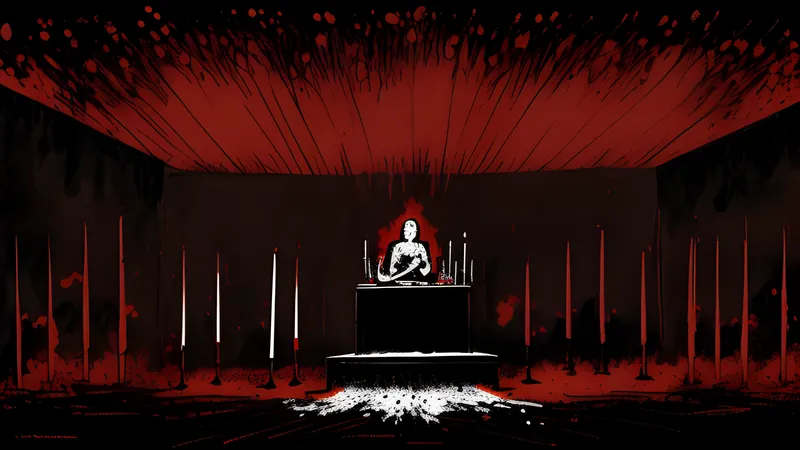
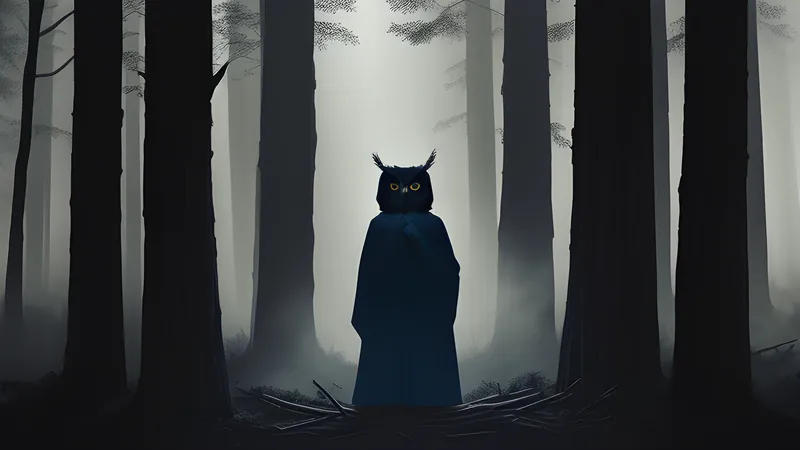
Picture a warm July night in the redwoods north of San Francisco. A lake lies black and still under the trees, and gathered on its shore are perhaps a thousand men — chief executives, cabinet secretaries, a former president or two, oil men, bankers, the odd Nobel laureate. Torches move through the dark. Across the water rises a forty-foot owl of grey concrete, and at its base a hooded figure delivers a body wrapped in cloth to the flames. A recorded voice booms out of the trees. Fire climbs. The men watch, rapt, and then the party begins. Every detail of that scene is true. That is what makes Bohemian Grove such an extraordinary object of belief — you do not have to invent a single thing to make it frightening. The rich really do gather in the woods. There really is an owl. There really is a fire. What people have done with those facts, over more than a century, is where the story properly begins.
The story, told straight
Here is the version that circulates, and it is a good one. Once a year, the most powerful men in the world slip away from public view into a private forest in northern California. No wives, no press, no accountability. Behind the redwoods they shed their suits and their names, and they perform an ancient ritual before a pagan idol — an owl that some insist is Moloch, the Canaanite deity to whom children were burned. They sacrifice a human effigy on the first night in a rite called the Cremation of Care. And in the quiet daylight hours, in cabins with names like Mandalay and Owls Nest, they decide things: who will be the next president, which war will be fought, where the money will flow. The Manhattan Project, the tale goes, was hatched here. Reagan’s path to the White House was smoothed here. What looks like a summer camp for the elderly wealthy is, in this telling, the boardroom of the world, and its business is conducted in robes by firelight.
It is a marvellous story because it answers a question everyone quietly carries: who is actually in charge, and why does it feel like they never have to answer for anything? The Grove offers a location for that anxiety. It gives the invisible a postcode.
The kernel: everything real underneath
Strip away the interpretation and a solid, well-documented history remains — and it is genuinely strange, which is half the trouble.
The Bohemian Club was founded in San Francisco in 1872 by journalists, artists and musicians who wanted a place to drink and talk. “Bohemian” then meant the arty and unrespectable, and the early membership really did lean literary: Mark Twain, Bret Harte and Jack London are all on the rolls. The club soon started admitting wealthy businessmen to pay the bills, and the balance of the membership drifted, decade by decade, from the garret towards the boardroom. By the twentieth century it was one of the most exclusive men’s clubs in America, with a waiting list measured in years.
From 1878 the club held a summer outing in the woods, and in time it bought the land: some 2,700 acres of old-growth redwood along the Russian River near Monte Rio, in Sonoma County. The annual encampment runs a fortnight in July. The motto, carved and repeated everywhere on the grounds, is borrowed from A Midsummer Night’s Dream — “Weaving Spiders Come Not Here” — an instruction, at least in theory, that members should leave their business dealings at the gate.
The owl is real and old. A permanent forty-foot hollow figure of reinforced concrete, faced to look like a great grey owl, has stood at the head of the lake since the early 1920s; earlier versions in wood and canvas go back further still. The owl is the club’s mascot, chosen as a classical emblem of wisdom, Minerva’s bird. Beneath it, since 1893, the encampment has opened with the Cremation of Care: a theatrical pageant in which a figure representing “Dull Care” — worldly worry, the burden of ambition and duty — is symbolically consigned to the flames so the men can relax for a fortnight. It is amateur dramatics with a very large budget, scripted, scored, and performed by members, some of whom in ordinary life have run film studios and symphony orchestras.
The attendees are not a rumour. Every Republican president from Coolidge to the second Bush is reported to have been a member or a guest. Richard Nixon attended; a tape later caught him grumbling about the place. Ronald Reagan spoke there. Herbert Hoover was a devoted regular for decades. Henry Kissinger went. And the most consequential meeting genuinely happened: in September 1942, the physicist Ernest Lawrence and a group of scientists and administrators met in a Grove clubhouse to plan the early organisation of what became the Manhattan Project. There is a plaque. The atomic age really was, in part, sketched out among those trees.
Even the infiltration footage is real. In July 2000 the broadcaster and conspiracy entrepreneur Alex Jones talked his way onto the grounds with a hidden camera and filmed the Cremation of Care from a distance. The grainy result — torches, chanting, the wrapped effigy, the fire at the owl’s feet — became, and remains, the visual proof that launched a thousand videos.
The fork: where the record ends and the myth begins
So there is an owl, a fire, a scripted funeral for an abstraction, and a guest list of the powerful. Follow the documented record and it stops there: a very rich, very old, rather self-indulgent summer club with a taste for ceremony and cross-dressing theatricals. The myth continues past that point, and the exact spot where it forks is worth marking precisely, because it is always the same spot.
The effigy in the Cremation of Care is a mannequin representing Care — a mood, a state of mind. The myth turns it into a human sacrifice, sometimes a real body, sometimes a child. The owl is Minerva’s, an emblem of wisdom. The myth renames it Moloch and imports the whole apparatus of infant sacrifice from the Hebrew Bible. The “Weaving Spiders” motto asks members to stop doing business. The myth reads it as proof that the business done there is too dark to name. And the informal networking — the deals and endorsements that surely do happen when powerful men spend a fortnight together, because that is what powerful men do everywhere — becomes a formal world government issuing binding decrees between cocktails.
Each leap follows the same logic. Take a real thing, keep its outline, and swap its meaning for the darkest one available. The pageant is real; only its purpose is rewritten. This is the engine of nearly every enduring conspiracy theory, and it runs the same way here as it does in the tale of the Business Plot, where a real approach to a real general hardened, in the retelling, into a fully-crewed fascist coup.
The journey: how a rich men’s picnic became a black mass
The Grove has been an object of public curiosity almost from the start, and the flavour of that curiosity has changed with the decade, which tells you the anxiety was never really about the club.
In the early years the local and national press treated the encampment as colour: eccentric millionaires playing at Druids, a society-page amusement. Through the mid-twentieth century it was an open secret of the powerful, winked at in memoirs and gossip columns. The tone curdled in the 1970s. The sociologist G. William Domhoff, no conspiracist but a serious scholar of American elites, published The Bohemian Grove and Other Retreats in 1974, arguing soberly that such gatherings help a ruling class cohere — that the real function is social bonding among people who already run things. His work is measured and evidenced, and it planted the durable idea that the Grove is where power networks, which is almost certainly true and not remotely satanic.
Then came the protesters. Through the 1980s and 1990s the Grove drew feminist and anti-elite demonstrators to its gates each July — angry, reasonably, that the men who governed the country decamped once a year to a place that excluded women entirely and answered to no one. Their grievance was democratic and material: unaccountable power, taking a holiday from scrutiny. That is a coherent political complaint, and you do not need a single robe to make it.
The final mutation arrived with Alex Jones and the internet in 2000. Jones took Domhoff’s sociology and the protesters’ anger and boiled off everything rational, leaving only the ritual. His footage of the Cremation of Care, stripped of the fact that it is scripted theatre, played as documentary evidence of literal occultism. The owl became Moloch. The pageant became a black mass. And because the images were real, the interpretation travelled with the authority of eyewitness proof. From there it fused with older and uglier currents — the notion of a secret cabal choreographing world events, which in its most poisonous form reaches back to the Protocols of the Elders of Zion, a proven forgery that has taught more than a century of conspiracists to picture hidden power as a ceremonial conspiracy of elites. It is worth naming that lineage plainly, because the “cabal in the woods” image carries antisemitic baggage whether or not any given teller intends it, and the honest thing is to see the inheritance rather than pass it along unexamined.
What it is really about
Set the sacrifice and the idol aside and look at what remains once the supernatural evaporates: a genuine and well-founded unease. The people who decide the largest questions of a society really do know one another. They really do gather in rooms the rest of us cannot enter. They really are, to a striking degree, unaccountable between elections, and they really do enjoy the company of their own kind behind walls, or in this case behind a curtain of thousand-year-old trees. None of that is invented. The Grove is a real place where real power relaxes in private, and a democracy is right to find that a little galling.
The theory takes that legitimate discomfort and does something very human with it — it makes the power legible. Diffuse, structural power is almost impossible to hold in the mind or the heart. You cannot picture “the interlocking incentives of concentrated capital and political access.” You can picture an owl and a fire. Ritual gives hidden influence a shape you can hate cleanly, a stage set, a villain in a hood. It converts an economics problem into a ghost story, and ghost stories are far easier to tell around a fire of one’s own. There is even a bleak comfort in it: if the world is run by a secret rite, then it is at least run, by someone, on purpose. That is less frightening, in its way, than the truer possibility that no one is fully in charge and the drift is nobody’s decision. The same craving to make chaos intentional drives the darkest turns of belief, the ones that go looking for a hidden ring of predators behind ordinary institutions, as the crowd did in Pizzagate.
The insight in the trees
The men of the Bohemian Grove built a self-caricature and then wondered why the world took it literally. They erected a giant owl, wrote a torch-lit funeral for their own worries, forbade spiders from weaving, and did it all in secret behind armed gates — and then acted surprised that the public read occultism into the smoke. The tragedy of interpretation is that the theatre was, by every serious account, exactly what it claimed to be: overgrown boys with real power performing an elaborate skit about leaving their cares at the gate, so they could drink and urinate on the redwoods in peace.
The believer who watches Jones’s footage and sees Moloch is not being stupid. They are responding, correctly, to a real asymmetry of power, and reaching for the only vocabulary grand enough to match how the asymmetry feels. The mistake is a category error, dressing a political grievance in a supernatural costume. And the useful thing the Grove can teach is to keep the grievance and drop the costume. The scandal of Bohemian Grove was never the owl. It is that the most powerful people in a democracy have a place to go where the democracy cannot follow — and that this has been true, in plain daylight, for a hundred and fifty years, with no ritual required.
Related Content