Bloody Mary: The Girl in the Mirror
A candle, a dark bathroom and thirteen chants — the sleepover ritual that turns out to be a rehearsal for growing up, backed by a genuine optical illusion.
Contents
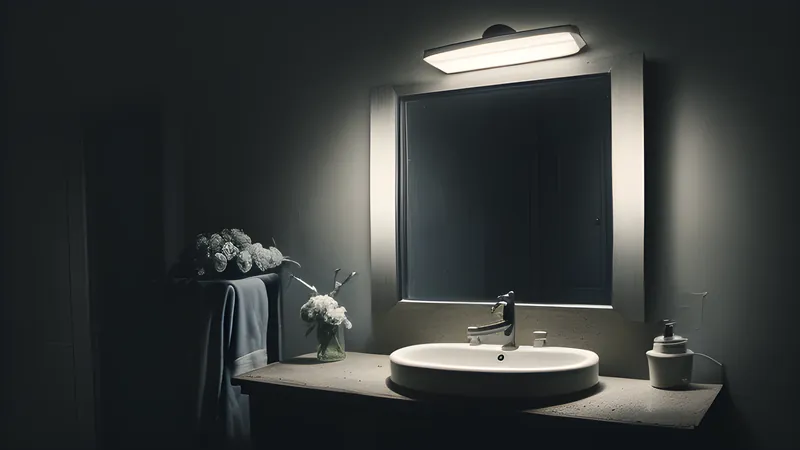
The version most people know starts with the lights off. A candle, sometimes two, throws just enough light to catch an outline in the glass. A knot of girls — it is almost always girls, almost always somewhere around the cusp of adolescence — takes turns standing close to a bathroom mirror and saying a name, usually “Bloody Mary,” a fixed number of times: three, or thirteen, or a hundred, depending on which sleepover you happened to grow up attending. Then everyone waits. The stories promise a woman will appear behind the reciter’s shoulder — bloodied, sometimes eyeless, sometimes missing a face altogether — and that she might simply stare, or claw at the glass, or reach through it and take whoever called her. Nobody in the room quite believes it will happen. Nearly everybody’s pulse picks up regardless. That gap, between what a twelve-year-old knows and what she feels standing in the dark saying a name into her own reflection, is where this particular piece of folklore actually lives.
The ritual, precisely
Strip away the regional variation and a fairly consistent skeleton survives. A mirror, ideally in a small enclosed room like a bathroom, is lit by nothing but candlelight — the ordinary electric light stays off. Someone stands directly in front of the glass, close enough to fog it with breath, and says the name aloud a set number of times, sometimes spinning in place between repetitions, sometimes with eyes shut until the final chant. The rules are usually policed fiercely by the group rather than any adult: don’t laugh, don’t peek early, don’t run before the count is finished. What is supposed to happen next varies by teller. In some versions Mary simply appears and stares. In others she scratches the reciter’s face, or drags her into the mirror, or whispers how she will die. A gentler strand, much closer to the ritual’s ancestors, promises she will show the caller their future instead of harming them at all.
What matters about the mechanics is less the content of the threat than the shape of the event: a dare, performed by a group, in the dark, with an audience. Someone has to go first. Everyone else watches to see whether she flinches. The social theatre — who is brave enough, who breaks the silence with a laugh, who bolts for the door — is doing at least as much work as anything that might or might not be waiting in the mirror.
An older mirror magic
Mirror-gazing rituals are far older than any bathroom horror story, and for most of their history they promised something people wanted rather than something they feared. English and Scottish Halloween customs recorded from at least the eighteenth century describe young unmarried women gazing into a looking-glass by candlelight, sometimes while combing their hair or eating an apple, hoping to see the face of a future husband appear over their shoulder. Robert Burns’s 1785 poem “Halloween” catalogues a whole evening of these divinatory games among Ayrshire villagers, mirrors included, and the same custom later gave English painter Daniel Maclise the subject for his 1833 canvas Snap-Apple Night, depicting a mirror-gazing game at an Irish Halloween party. A cousin tradition attaches to St Agnes’ Eve, the night of 20 January, when a fasting young woman was said to see her future husband in a dream — the version John Keats immortalised in verse in 1820, though that custom worked through sleep rather than glass.
The common logic across all of these is a mirror in low light, treated as a threshold rather than a surface, consulted by someone anxious about what is coming for them. For centuries that threshold was aimed at romantic hope. Bloody Mary is what happens when the same tool is aimed at fear instead.
Whose Mary
Ask ten people who Bloody Mary actually is and the honest answer is that nobody agrees, and the disagreement itself is informative. The folklorist Janet Langlois documented the ritual among schoolgirls in the Detroit area in the 1970s, publishing her findings in Indiana Folklore in 1978. Langlois found the figure summoned went by several names depending on which school and which year: Mary Whales, Mary Worth, Mary Jane, Hell Mary, Bloody Bones. The chant, the candle and the mirror stayed constant. The name attached to it drifted like a label that had come unstuck and been reapplied slightly wrong each time — which suggests the ritual came first and the backstory was assembled afterwards, borrowing whatever name was locally current.
Some tellers reach for Queen Mary I of England, the Tudor monarch nicknamed “Bloody Mary” for the roughly three hundred Protestants burned during her reign in the 1550s. It is a satisfying echo, but the nickname itself was largely a later invention of her Protestant critics, popularised through John Foxe’s Book of Martyrs, and there is no documented link between the historical queen and any mirror ritual — the connection rests on the resemblance of a name and little else. Other American oral traditions offer a local ghost: a woman who died in a car accident, or in childbirth, or looking into a mirror at the wrong moment, her story unverifiable and regionally specific, the kind of tale every town seems to keep one of. None of these candidates can be shown to precede the ritual itself. The mirror-summoning game is the constant; “Mary” is a name of convenience draped over it.
The “Bloody Bones” strand that Langlois recorded has its own long pedigree, and it predates the mirror entirely. “Rawhead and Bloody-Bones” was a stock English bogeyman by the sixteenth and seventeenth centuries, invoked by parents and nurses to frighten children into obedience long before anyone lit a candle in a bathroom for sport; the philosopher John Locke complained about exactly this practice in his 1693 treatise Some Thoughts Concerning Education, warning that filling a child’s head with tales of “raw-head and bloody-bones” did lasting harm to their nerves. By the time American schoolgirls in the 1970s were saying the name into a mirror, they had, without knowing it, revived a bogeyman with three centuries of service behind him and handed him a new job.
Alan Dundes and the body in the glass
The folklorist Alan Dundes, who spent much of his career at Berkeley reading ordinary rituals for the anxieties hiding inside them, offered the interpretation that has shaped most serious discussion of the game since. In his 1998 essay “Bloody Mary in the Mirror: A Ritual Reflection of Pre-Pubescent Anxiety,” published in Western Folklore, Dundes pointed out that the ritual is performed almost exclusively by girls in a narrow age band, roughly nine to thirteen — precisely the years in which menstruation typically begins. He read the mirror itself as significant: it is the object girls use daily to monitor a body that is visibly changing in ways they did not choose and cannot stop. Layered onto that is the ritual’s insistence on blood as the central threat, summoned deliberately, by choice, in the presence of friends, in a setting that is frightening but controlled and ends, almost always, in relieved laughter rather than harm.
Read this way, Bloody Mary functions as rehearsal. A body about to bleed for reasons a nine-year-old only half understands gets to summon blood on her own terms, with an audience, and survive it. Dundes’s reading is an interpretation rather than a settled fact — folklorists still argue over how much psychoanalytic weight a children’s game can bear — but it has stuck for a good reason: it explains, better than any theory about a specific dead woman, why this particular ritual belongs so precisely to this particular age.
The face that will not hold still
There is also a piece of straightforward optics working in Mary’s favour, and it was measured properly only in 2010. Giovanni Caputo, a researcher at the University of Urbino, published a study in the journal Perception in which he asked participants to sit in dim lighting and stare, without looking away, at their own reflection for about ten minutes. Within under a minute, most reported the face beginning to change: features drooping or elongating, the reflection warping into a stranger’s face, an animal’s, a deceased relative’s, sometimes something monstrous. Caputo called it the strange-face-in-the-mirror illusion, and the likely mechanism is well understood even if the exact experience varies — sustained fixation on a low-contrast, dimly lit image causes the visual system’s face-processing regions to adapt and misfire, a relative of the well-documented Troxler effect in which an unmoving image at the edge of vision seems to fade from view. Denied the stream of small, fresh visual updates a face normally provides, the brain starts filling the gap with distortion.
A candlelit bathroom, a fixed stare into the glass, a held breath and a chant is, quite by accident, close to a laboratory protocol for producing exactly the effect Caputo measured. Children performing Bloody Mary are reliably conjuring something. It is being generated by their own visual cortex rather than arriving from the other side of the glass, but the fear it produces is entirely real, which is presumably why the game has never needed anyone to actually believe in Mary for it to work.
A game with cousins everywhere
The precise shape of the Bloody Mary ritual — a group of children, a controlled setting, a chant that invokes something frightening on cue — turns out to recur in cultures with no connection to American sleepovers at all. Japanese schoolchildren tell of Hanako-san, a ghost said to haunt the third stall of the girls’ toilets in elementary schools, summoned by knocking three times and asking if she is there; folklorists studying contemporary Japanese school ghost stories have catalogued dozens of regional variants, all sharing the same structural bones as Mary — a fixed location, a fixed number of repetitions, a group daring one member to perform it. Mexican schoolyards have their own summoned figures, and British children have long had their own catalogue of dares involving graveyards, disused mirrors and empty houses. None of these grew from the other. The likeliest explanation is plain convenience: whenever children are given a safe, enclosed space and a little privacy from adults, they seem to build some version of the same machine — call the frightening thing, on purpose, together, and survive it — because the machine itself is doing something useful for them, regardless of which name gets plugged into it.
What the sleepover is actually for
Sleepovers have long been one of the few genuinely unsupervised social spaces available to children, a room with the door shut and the adults elsewhere, its rules made and enforced entirely by the children inside it. Performing a fear-summoning ritual together, with witnesses, takes something otherwise private and hard to name — anxiety about a changing body, about blood, about the general strangeness of the years just ahead — and turns it into a shared performance with a clear beginning, middle and end. You go in, you are frightened, together, on purpose, and you come out the other side safe and slightly triumphant. Children have always been remarkably good at building their own folklore this way, whole and functioning, without adult help; a monster invented on an internet forum in 2009 could be turned within a few years into something children believed in and performed for each other using exactly this same mechanism of shared, deliberate, escalating performance. And when adults later caught sight of children’s rituals that looked, from the outside, like real occultism, the results could run in the opposite direction entirely, curdling into the kind of adult panic that produced the Satanic Panic of the 1980s — grown-ups mistaking a coping mechanism for a genuine threat.
Bloody Mary has survived for as long as she has by never needing to be settled. Nobody has to decide whether she is real for the ritual to do its work, and that may be the most useful thing folklore can teach about growing up in general: the value was never really in what showed up in the glass. It was in the standing together in the dark, choosing to be frightened on your own schedule, for once, instead of waiting for your body to frighten you on its.
Related Content