Black Shuck: The Ghost Dog of East Anglia
A storm, two dead in a Suffolk church, and eight centuries of a spectral hound
Contents
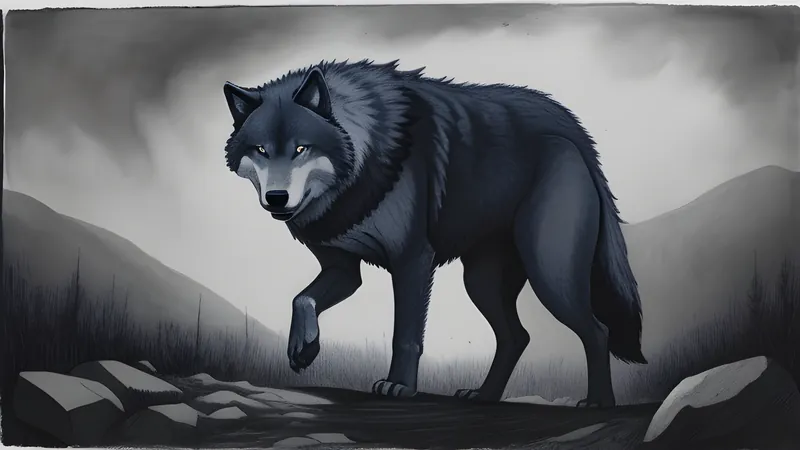
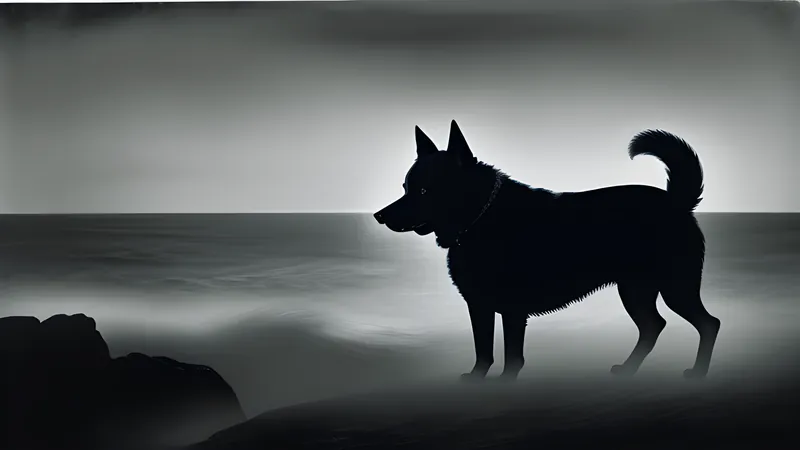
On a lonely lane along the Norfolk or Suffolk coast, with the sea fret coming in off the grey water, a traveller hears the pad of something large behind them. They turn, and there is a dog the size of a calf, shaggy and black as tar, with eyes that burn like coals, sometimes a single eye set in the middle of its brow. It keeps pace without menace or hurry. Then it is gone, dissolved into the hedge or the dark, and the traveller walks home cold to the bone, because everyone in East Anglia knows what it means to meet Black Shuck. To see him is to be marked. Within the year, the old people say, you or someone close to you will be dead.
Told in the right voice on the right night, it is one of the most atmospheric legends England possesses, and it is genuinely ancient. Black Shuck is no Victorian invention or modern hoax but a folk belief with roots reaching back at least to the medieval period, woven into the specific geography of the eastern coast. The interesting task is not to ask whether a phantom hound walks the marshes, which no one can answer, but to trace where such a creature came from, what real events it fed on, and why the image of a great black dog has proved so uncannily durable in the human imagination.
The night the dog came to church
The single event that fixed Black Shuck in the historical record happened on Sunday, 4 August 1577, and it is documented in a contemporary pamphlet, which makes it unusually well attested for a ghost story. On that morning a violent thunderstorm broke over the market town of Bungay in Suffolk. According to the account, as the congregation knelt at prayer in St Mary’s Church, a great black dog burst in amid the tempest, ran the length of the nave in a flash of fire, and passed between two people who were kneeling together, both of whom fell dead where they knelt. A third man was badly burned and shrivelled but survived.
The same storm struck Holy Trinity Church at Blythburgh, a few miles away, on the same day. There the black dog was said to have crashed through the church, killed worshippers, and fled, leaving scorch marks seared into the north door where its claws had raked the wood. Those marks are shown to visitors to this day, sometimes called the Devil’s fingerprints. The story reached print through a clergyman named Abraham Fleming, whose 1577 pamphlet bore the splendid title A Straunge and Terrible Wunder Wrought Very Late in the Parish Church of Bongay, and it is Fleming’s lurid, moralising account that carried the Bungay dog down the centuries.
The kernel: a real and deadly storm
Here the record is solid, and it is worth conceding fully, because the concession is what makes the rest legible. There genuinely was a catastrophic storm over east Suffolk on 4 August 1577. People genuinely died in those churches that day. At Blythburgh the storm is recorded as having caused real structural damage, the church steeple falling through the roof, and the deaths and injuries there are consistent with a building full of people struck by exactly the kind of violence a severe thunderstorm can deliver.
The most economical explanation, offered by later commentators, is that the churches were struck by lightning, and quite possibly by ball lightning, the rare and still imperfectly understood phenomenon in which a glowing sphere appears during storms, moves erratically, and can scorch and kill before vanishing. A blinding ball of fire tearing through a packed medieval church, killing those it touched and leaving burns on the timber, is a terrifying real event in search of an explanation, and the sixteenth-century mind reached for the vocabulary it had. That vocabulary already contained a great black dog. The storm did not create Black Shuck; it dressed an existing terror in fresh, unforgettable clothing.
Older than the storm: the name and the dog
Black Shuck did not begin in 1577. The belief in a spectral black hound was already old in East Anglia, and it belongs to a much wider British tradition of ghostly black dogs. The name itself points back a long way. “Shuck” is generally derived from the Old English scucca, meaning a demon or fiend, a word older than the Norman Conquest, though some folklorists connect it instead to a regional dialect word for shaggy. Either root deposits the creature in deep linguistic time, long before any pamphlet.
Across Britain the same figure appears under a crowd of local names. Yorkshire has the Barghest and the Padfoot; the Gytrash haunts the north; the Church Grim is the guardian spirit of a churchyard, often a black dog; other districts speak of Hairy Jack, the Trash, or simply the Black Dog. These hounds share a grammar. They are large, black and shaggy, with eyes that glow red or green or blaze like fire; they haunt boundaries, crossroads, gallows, lonely lanes, churchyards and the coast; and above all they are omens, their appearance foretelling death or disaster. Black Shuck is the East Anglian dialect of a language spoken all over the islands.
Who carried the legend, and how it travelled
A folk belief this widespread is carried by the ordinary machinery of oral culture rather than any single author: parents warning children off dangerous roads after dark, travellers explaining a fright on a lonely path, communities making sense of a sudden death by recalling who had lately seen the dog. Along the East Anglian coast, with its treacherous marshes, its drowned villages and its long history of shipwreck and hard weather, a death-omen hound had endless material to feed on. Every unexplained death, every traveller who never arrived, could be quietly folded into the legend.
Abraham Fleming’s pamphlet gave the tradition a fixed, printed anchor, and later collectors did the rest. The great Victorian and Edwardian folklorists who swept the countryside for surviving beliefs recorded Shuck sightings across Norfolk and Suffolk, fixing the creature in the written record just as the oral culture that produced it began to fade. The black dog also seeped into literature; the moorland death-hounds of the West Country helped inspire Arthur Conan Doyle’s Hound of the Baskervilles, and the spectral dog has haunted English fiction ever since, keeping the folk image alive for audiences who had never walked a coastal lane at dusk.
The legend even attracted a modern relic. In 2014, archaeologists excavating at Leiston Abbey in Suffolk uncovered the skeleton of a very large dog, and the press promptly christened the bones “the remains of Black Shuck”. The animal was a real, if unusually big, dog buried in the abbey grounds, and the excitement said far more about the enduring pull of the legend than about any phantom. A community will always be delighted to find that its ghost might have left bones.
The grammar of the black dog
The black dogs of Britain are worth studying as a set, because their consistency is itself revealing. From Cornwall to the Scottish borders the reports rhyme: the animal is always larger than a natural dog, usually the size of a calf or a small pony; its coat is shaggy and black; its eyes are its most dwelt-upon feature, glowing, saucer-sized, burning red or a sickly green; it makes little or no sound; and it appears at the edges of things. Some black dogs are malign, harbingers of death or the Devil himself; others are strangely protective, a benign presence that escorts a lone woman safely home along a dangerous road before melting away at her gate. The Church Grim, in particular, was believed to be the guardian spirit of a churchyard, sometimes explained by the grim old custom of burying a black dog on the north side of a new burial ground so that its ghost, rather than a human soul, would stand watch over the dead.
This spread of meaning, from omen of doom to guardian angel, tells us the black dog was never a single monster but a flexible symbol, a shape the folk imagination could bend to the emotional need at hand. On a night of dread it became a death-hound; for a frightened walker it became a protector. What stayed constant was the form, because the form was doing the deep work: a great dark animal at the threshold of the safe world, standing exactly where fear lives. East Anglia simply had its own dialect word for the figure, and its own devastating storm to prove the creature real.
Coastal geography sharpened the belief further. The eroding shoreline of Norfolk and Suffolk is a landscape of loss, where whole medieval towns such as Dunwich slid into the sea, where sea mists erase the horizon, and where drowning and shipwreck were commonplace facts of life. A country so intimate with sudden death and so full of vanishing edges was always going to keep a death-omen close to hand. Shuck patrols the exact line where the solid land gives way to the dangerous water, which is the same line, in miniature, that every human being is walking.
What the black dog is really carrying
Strip the story to its bones and Black Shuck is a way of thinking about death and about the dark. The dog haunts precisely the places where a person is most alone and most vulnerable: the empty lane, the crossroads, the churchyard, the shore. These are the thresholds of ordinary life, the points at which the safe and the unknown press against each other, and the human mind has always populated such thresholds with guardians and warnings. A black dog at a boundary is folklore’s way of marking that a boundary is dangerous.
As a death omen, Shuck performs a subtle emotional service. Sudden death is unbearable partly because it is arbitrary, arriving without reason or warning. A death-hound imposes a kind of order on that chaos: the death was foretold, there was a sign, the universe was paying attention after all. To be able to say that the deceased had seen the dog is to make a senseless loss into part of a pattern, a small and cold comfort, but a comfort, in the same way that so many legends answer the intolerable randomness of grief with the reassurance that someone, or something, saw it coming.
The colour and the animal matter too. The dog is the most familiar and loyal of creatures, the guardian of home and hearth, which makes a demonic dog especially disquieting, a betrayal of the one animal we trust to protect us. Black has carried associations of death and the diabolical for so long that “the black dog” became, centuries later, a common name for depression, that following presence at the edge of a life. Shuck sits at the meeting point of these deep currents: our love of dogs, our fear of the dark, our need to read omens into misfortune, and the particular loneliness of a wild, storm-battered coast.
So the great hound still pads along the sea walls and the sunken lanes of Norfolk and Suffolk, refreshed every generation by a fresh chill on a dark path, anchored by a real and lethal storm in 1577 and by a name older than English kings. What keeps him alive is resonance rather than evidence. He gives shape to the fear of walking alone in the dark, meaning to the shock of sudden death, and a face to the ancient unease that something out on the marsh is watching us go home. That the image should have lasted eight centuries is no mystery once you have stood on that coast at dusk and heard the wind come off the water. For other legends grown from lonely English places and the human need to name the dark, see the Owlman of Mawnan, Cornwall’s answer to Mothman, the cemetery panic that became the Highgate Vampire, and the phantom prowling the granite of Bodmin Moor.
Related Content