Area 51: The Base That Was Real and the Aliens That Weren't
The government denied the base existed for decades while flying spy planes out of it. When a real secret is that big, the imagination fills the rest
Contents
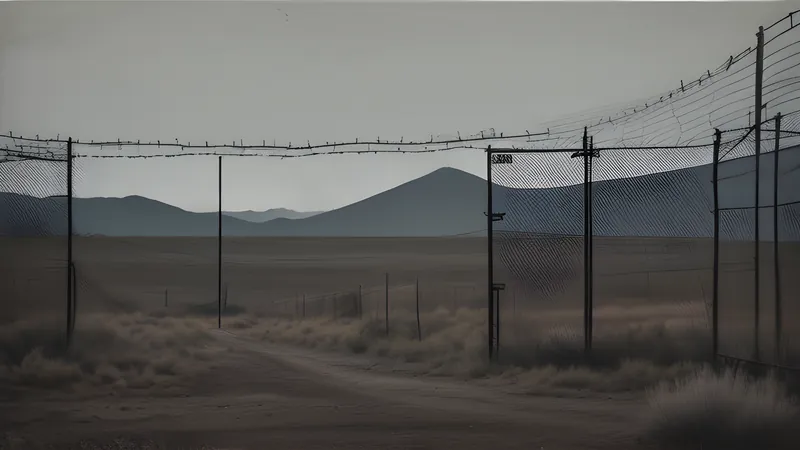
Drive north out of Las Vegas on Highway 95, then turn onto the long empty ribbon of State Route 375 — the stretch Nevada renamed the Extraterrestrial Highway in 1996 — and you will eventually reach a dirt road that ends at a boundary. There is no fence you can see for miles, only orange posts, warning signs promising the use of deadly force, and a white pickup truck parked on a distant ridge, watching you through binoculars. You cannot see the base. That is the point. Beyond the ridgeline, out of sight, sits one of the most famous places on earth: a place the United States government insisted, for nearly sixty years, did not exist at all. The believers who make the pilgrimage to that boundary are not foolish for sensing that something enormous is being hidden from them. Something enormous was. The only question worth asking is what.
The story, told straight
Here is the version that pulls people down the dirt road. Somewhere in the Nevada desert there is a facility so secret it has no official name and appears on no public map. Inside it, or in an even deeper annexe near a dry lake called Papoose, the American military keeps the recovered wreckage of craft that were not built by human hands — and, in the coldest tellings, the bodies of their pilots. Scientists work there under oaths that never expire, reverse-engineering technology decades ahead of anything Boeing or Lockheed could manage. The lights people photograph over the range at night are the test flights. The government denies all of it, of course. The government would.
It is a marvellous story, and its power comes from a single hard fact sitting underneath it: the government really did deny everything, for a very long time, about a base that was genuinely there. When the official account is a flat lie, every wilder account gets a hearing. To understand why the aliens stuck, you have to start with the part that is true.
The kernel: a real base, a real lie
In the spring of 1955, a CIA officer named Richard Bissell and Lockheed’s chief designer Clarence “Kelly” Johnson flew over the Nevada desert looking for somewhere to hide an aeroplane. They found a dry lakebed called Groom Lake, on the edge of the Atomic Energy Commission’s Nevada Test Site, where the government was already detonating nuclear weapons and where no civilian had any reason — or permission — to go. The secrecy infrastructure was already built. They simply borrowed it.
What they needed to hide was the Lockheed U-2, developed under the cover designation CL-282 by Johnson’s legendary Skunk Works. The U-2 was a spy plane built to overfly the Soviet Union at around 70,000 feet, far above the reach of 1950s interceptors and anti-aircraft missiles. To test it they built a rough camp beside Groom Lake, and on the internal grid of the Nevada Test Site the parcel of land carried the label that would outlive every programme flown from it: Area 51.
The U-2 was only the beginning. Through the 1960s the same runways hosted the A-12 OXCART, a titanium reconnaissance aircraft that cruised above Mach 3 and became the direct ancestor of the Air Force’s SR-71 Blackbird. In the 1970s and 80s came HAVE BLUE and the F-117 Nighthawk, the first operational stealth aircraft, whose faceted shape was so strange it had to be flown only at night and kept out of every photograph. The base also housed captured Soviet fighters — MiGs acquired by various means and flown in evaluation programmes with codenames like HAVE DOUGHNUT — so that American pilots could learn the enemy’s aircraft from the inside. Real machines. Real physics. Nothing from another star, and all of it more than secret enough to shoot a trespasser for.
Through all of it, the official position was silence bordering on denial. The base was not confirmed, not named, not admitted. It took a Freedom of Information Act request by the historian Jeffrey Richelson of the National Security Archive at George Washington University to break the seal, and only in August 2013 did a declassified CIA history of the U-2 programme finally print the words “Area 51” and “Groom Lake” in an official document. Fifty-eight years after the first spy plane lifted off that lakebed, the government admitted the lakebed was there. If you had spent decades insisting the place was real while officials called you a crank, 2013 was your vindication. It was also, quietly, the vindication of the wrong lesson — because being right that they lied about the base is not the same as being right about what the base contained.
The fork: where spy planes became saucers
Trace the alien story backwards and it does not actually begin at Groom Lake. It begins two hundred miles and eight years away, in the summer of 1947 near Roswell, New Mexico, where a rancher found scattered debris and an Army press officer briefly, disastrously, described it as a “flying disc.” The wreckage was from Project Mogul, a classified array of balloons carrying microphones to listen for Soviet nuclear tests — itself a genuine secret, which is why the cover story was clumsy. Roswell went quiet for thirty years, then roared back in the late 1970s as UFO researchers reopened it, and the legend needed somewhere for the recovered saucer to have been taken. The most secret base anyone could name became the obvious warehouse. Roswell supplied the crash; Area 51 supplied the vault.
The other half of the fork has a date and a face. In May 1989, a man appeared in silhouette on Las Vegas television station KLAS-TV, interviewed by the investigative reporter George Knapp under the pseudonym “Dennis.” He soon went public as Bob Lazar, and his claim was specific in a way Roswell never had been: he said he had worked at a site called S-4, near Papoose Lake just south of Groom, where he had helped reverse-engineer nine alien spacecraft. Their reactors, he said, ran on a stable superheavy element he called element 115, which he described bending gravity itself. It was vivid, technical-sounding, and unforgettable, and it welded the flying-saucer folklore permanently onto the real map coordinates of a real base.
Lazar’s account has a stubborn problem the believers tend to step around. The credentials on which his whole authority rests — degrees from MIT and Caltech — have never been verified by either institution or by anyone else, despite forty years of searching. Element 115 was eventually synthesised in a laboratory (moscovium, in 2003) and behaves nothing like his description; it exists for milliseconds before decaying, nothing anyone could machine into a reactor. What Lazar had was a story perfectly shaped to fit a hole the government’s own secrecy had dug, and a story is all it ever turned out to be.
The journey: who carried it, and how far
A legend needs couriers, and this one had unusually good ones. George Knapp was a credentialed local journalist with a serious newsroom behind him, and his repeated coverage on KLAS gave Lazar a legitimacy that a supermarket tabloid could never have conferred. Through the 1990s the story compounded: hobbyists discovered they could photograph the base from a nearby mountain called Freedom Ridge until the Air Force seized that land too in 1995, which of course only confirmed for everyone that there was something worth hiding. The bar out on Route 375, the Little A’Le’Inn, sold burgers to the pilgrims. Television did the rest — The X-Files premiered in 1993 and made government-alien collusion the background hum of the decade — and by the time the film Independence Day stored its captured saucer at Area 51 in 1996, the base’s fictional job was fixed in the public mind.
The strangest chapter came last. In the summer of 2019 a young Californian created a joke Facebook event titled “Storm Area 51, They Can’t Stop All of Us,” proposing that a crowd overwhelm the guards by running in “Naruto style.” More than two million people clicked “going.” Almost none actually came — a few thousand gathered at the gates for what turned into a desert festival — but the episode showed how completely the legend had detached from any claim and become pure cultural furniture, a joke everyone was in on. You do not need to believe in the aliens to know exactly what the words “Area 51” are supposed to mean. That shared meaning is the folklore doing its work.
What it’s really about
Strip the saucers away and a plainer, sadder mechanism is left turning. A government kept an enormous secret and lied about it directly for the better part of a lifetime — and it was right, by its own lights, to keep the U-2 and the Blackbird and the stealth fighter hidden from Moscow. But an ordinary citizen watching from outside cannot tell a justified secret from a sinister one. All they see is officials looking them in the eye and saying nothing is there while something plainly is. Once you have caught the state lying about one true thing, every subsequent denial spends from an empty account. “There are no aliens at Area 51” arrives in the same flat official voice that once said “there is no Area 51” — and why would you believe the second man when the first turned out to be lying?
The people who filled the vault with alien bodies were making a reasonable inference from genuine evidence of deception. They had simply lost the ability, because the government destroyed it, to calibrate how big the hidden thing was. And they were not paranoid to think secret programmes could be monstrous. They were living downwind of real ones. The CIA’s MKUltra experiments dosed unwitting Americans with LSD; the Pentagon’s Operation Northwoods proposed staging attacks on American citizens to justify a war. When those were the documented behaviours of your own institutions, “they are hiding alien technology in the desert” becomes an understandable over-shoot from solid ground, the same over-shoot that turned a stretch of stormy but ordinary ocean into the Bermuda Triangle. The secrecy was real, the abuses were real, and the imagination did what imagination does with a locked door: it built a room behind it grander than anything actually there.
There is even a documented feedback loop. The U-2 flew at 70,000 feet at a time when airliners cruised around 20,000, and its silver wings caught sunlight long after the ground was dark, producing exactly the high, luminous, impossibly-fast objects that people began reporting as flying saucers in the late 1950s. A 1997 study by CIA historian Gerald Haines in the agency’s in-house journal Studies in Intelligence estimated that more than half of all UFO sightings during the Cold War were in fact secret reconnaissance aircraft. The government knew the truth of many sightings and could not explain it without exposing the very programmes the base existed to protect. So it let people believe in flying saucers rather than admit to spy planes. The state, for its own reasons, chose to feed the myth it would later be accused of hiding.
The room behind the door
Area 51 is the clearest case in all of folklore of a real secret and a false one occupying the same address. The base is genuine. The decades of denial were genuine. The classified aircraft were genuine, and some of them were nearly as astonishing as a saucer to anyone allowed to see them. The aliens are the part the human mind supplied to fill a space the government insisted on keeping dark, and it filled it in proportion not to the evidence but to the size of the lie.
That is the thing worth carrying away from the boundary line on the dirt road. The believers standing at the orange posts have correctly detected that they are being deceived. Their instrument is working; only the scale is off. When an institution earns that much distrust honestly, it forfeits the right to be believed about anything, including the boring truth — and the boring truth about Groom Lake, a titanium aeroplane that outran its own missiles, was itself a marvel worth the secrecy. The tragedy of Area 51 runs deeper than a few pilgrims believing in aliens. A government taught a generation it could not be trusted, and then acted surprised when they took it at its word.
Related Content