Xinjiang Cumin Lamb Stir-Fry
Smoky, fiery lamb off the Silk Road grill
Contents
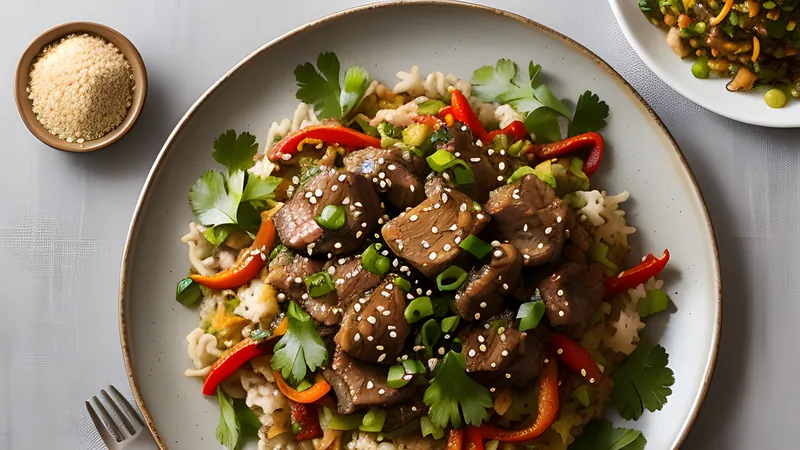
↓ Jump to recipeXinjiang cumin lamb is the taste of a night market skewer stall condensed into a stir-fry: charred meat, whole toasted cumin, a fistful of dried chilli, all cooked hard and fast over the fiercest heat your stove can manage. My twist doubles down on that origin, toasting whole cumin seeds and dried chillies together before they ever touch the lamb, then crushing half of them roughly so the dish carries both whole, popping seeds and a coarser spice dust that clings to every strand of meat. It is smoky, aggressive, and nothing like the timid cumin-dusted lamb you sometimes get on Chinese restaurant menus outside China.
Xinjiang Cumin Lamb Stir-Fry
Ingredients
- 600g lamb shoulder or leg, thinly sliced against the grain
- 1 tbsp light soy sauce
- 1 tbsp Shaoxing rice wine
- 1 tsp cornflour
- 2 tbsp whole cumin seeds
- 8 to 10 dried whole chillies, snipped into 2cm pieces, seeds mostly removed
- 1 tsp Sichuan peppercorns
- 4 tbsp neutral oil, divided
- 1 large white onion, cut into thin wedges
- 1 red pepper, thinly sliced
- 5 garlic cloves, thinly sliced
- 2 tbsp finely chopped fresh ginger
- 1 tsp chilli flakes
- 1 tsp ground cumin
- 1 tsp caster sugar
- 0.5 tsp salt, to taste
- 1 large handful fresh coriander, roughly chopped
Method
- Toss the sliced lamb with the soy sauce, Shaoxing wine and cornflour, and marinate for 15 minutes at room temperature.
- Toast the whole cumin seeds, dried chillies and Sichuan peppercorns in a dry wok over medium heat for 1 to 2 minutes, shaking constantly, until the cumin is deeply fragrant and the chillies darken and smell smoky rather than raw; tip out and roughly crush half the mixture with a pestle and mortar.
- Heat 2 tablespoons oil in the wok until visibly rippling and almost smoking, add the lamb in a single layer and sear undisturbed for 60 to 90 seconds, then toss for a further 30 seconds until well charred at the edges but still pink in the centre; remove and set aside.
- Add the remaining 2 tablespoons oil to the wok, add the onion wedges and red pepper, and stir-fry over high heat for 2 minutes until charred at the edges but still crisp.
- Add the garlic and ginger, stir-fry for 30 seconds until fragrant.
- Return the lamb to the wok along with the toasted and crushed cumin-chilli mixture, chilli flakes and ground cumin, and toss vigorously for 1 minute so the spices coat everything evenly.
- Season with sugar and salt to taste, toss through most of the coriander, and tip onto a warmed platter.
- Scatter with the remaining coriander and serve immediately with flatbread or rice.
The story
This dish comes from Xinjiang, the vast autonomous region in China’s far northwest, home to the Uyghur people and a food culture shaped as much by Central Asia as by the rest of China. Sitting on the old Silk Road, Xinjiang’s cuisine draws on Turkic, Persian and Chinese influences all at once, and lamb, not pork, is the region’s dominant meat, reflecting the largely Muslim Uyghur population and a landscape of grasslands better suited to grazing sheep than raising pigs.
The dish’s most famous form is yang rou chuan, skewered lamb grilled over charcoal and dusted with cumin and chilli at a street stall, the smell of which is one of the defining aromas of Xinjiang’s cities, particularly Kashgar and Urumqi. Cumin itself arrived in the region via those same Silk Road trade routes centuries ago, likely from Central Asia or further west, and it took root so thoroughly that it’s now considered inseparable from Xinjiang cooking, unusual in a Chinese culinary landscape where cumin barely features elsewhere. This wok-fried version, da pan ji’s cousin in spirit though a different dish, translates the skewer stall’s flavour profile into a home-kitchen technique, searing thin-sliced lamb hard and fast rather than threading and grilling it, but chasing exactly the same charred, cumin-heavy result.
Urumqi’s night markets, the best known running through the Erdaoqiao district, sell yang rou chuan by weight off long charcoal braziers, the skewers turned constantly and dusted from small perforated shakers loaded with ground cumin, chilli powder and salt — a seasoning trio simple enough to look casual but calibrated by vendors who’ve been doing it for decades. The flatbread served alongside, girde nan, is baked in a clay tandoor-style oven called a tonur, thick, chewy and slightly charred where it presses against the oven wall, a close structural cousin of the tandoor breads found right across Central Asia and northern India, tracing the same trade routes that carried cumin east in the first place. Hand-pulled laghman noodles, tossed with lamb, peppers and the same cumin-chilli backbone, are the other pillar of Uyghur street food, and the two dishes, skewer and noodle, define most people’s first encounter with Xinjiang cooking outside the region.
Hand-pulled noodles, flatbread (nan, distinct from Indian naan but a linguistic cousin) and rice all appear alongside Xinjiang lamb dishes, and cumin lamb itself sits on nearly every Xinjiang restaurant menu across China as the dish most people order first. It’s also, increasingly, one of the more recognisable regional Chinese dishes internationally, thanks to a wave of Xinjiang and Northern Chinese restaurants that have opened in cities with large Chinese diaspora communities over the past couple of decades.
The method, explained
Two things do the heavy lifting in this recipe: the whole-spice toast, and genuinely aggressive wok heat.
Toasting whole cumin seeds and dried chillies together in a dry pan before cooking releases their essential oils through gentle heat, the same principle behind toasting any whole spice, but the payoff here is bigger than usual because both ingredients are added again later in the cooking, so the pre-toast sets a foundation the rest of the dish builds on. Watch the pan closely: cumin goes from raw and slightly bitter to deeply aromatic within about a minute, and tips into acrid and burnt within another 30 seconds after that, so pull it the moment it smells nutty and toasted rather than green. Crushing half the toasted mixture rather than leaving it all whole means you get two textures in the finished dish, popping whole seeds that release little bursts of aroma as you eat, and a fine dust that coats the meat evenly and clings to the sauce.
The second element, wok heat, is what separates this from a soft, steamed-tasting lamb stir-fry. A properly smoking-hot wok sears the lamb’s surface almost instantly, caramelising the exterior through the Maillard reaction while the inside stays pink and tender, mimicking the intense direct heat of a charcoal grill. This only works if the lamb goes in dry, thinly sliced against the grain (which shortens the muscle fibres and keeps each piece tender despite the high heat), and in a single layer rather than a crowded pile; overcrowding drops the wok’s temperature and the lamb boils in its own juices instead of charring. Cook it in batches if your wok or pan is on the smaller side, it’s worth the extra few minutes for the right texture.
Buy cumin whole rather than pre-ground for this dish if at all possible. Ground cumin loses most of its aromatic oils within weeks of grinding, sitting flat and dusty on the tongue, while whole seeds keep their punch for a year or more in a sealed jar; the toasting step here is specifically designed to unlock a whole seed’s flavour, something a jar of stale ground cumin simply can’t replicate no matter how long it cooks. Sichuan peppercorns should smell citrusy and faintly numbing the moment you crush one between your fingers — if a jar smells musty, flat or of not much at all, it’s past its best and worth replacing before it ruins an otherwise careful dish. Judge the lamb’s doneness by touch and colour rather than the clock: it should still give slightly when pressed and show a blush of pink at the very centre when you cut into a piece, since it will carry on cooking for a few seconds after it leaves the wok, and lamb pushed past that point turns tight and stringy fast.
The recipe
Serves 4. Prep 20 minutes (including marinating), cook 10 minutes.
Toss 600g thinly sliced lamb with 1 tablespoon soy sauce, 1 tablespoon Shaoxing wine and 1 teaspoon cornflour, marinate 15 minutes. Toast 2 tablespoons whole cumin seeds, 8 to 10 snipped dried chillies and 1 teaspoon Sichuan peppercorns in a dry wok over medium heat for 1 to 2 minutes until deeply fragrant and the chillies darken; tip out and crush half roughly.
Heat 2 tablespoons oil until rippling and nearly smoking, sear the lamb undisturbed for 60 to 90 seconds, toss a further 30 seconds until charred but still pink inside, then remove. Add the remaining 2 tablespoons oil, stir-fry a sliced onion and a red pepper for 2 minutes until charred but crisp. Add 5 sliced garlic cloves and 2 tablespoons chopped ginger, stir-fry 30 seconds. Return the lamb with the toasted cumin-chilli mixture, 1 teaspoon chilli flakes and 1 teaspoon ground cumin, toss vigorously for a minute. Season with 1 teaspoon sugar and salt to taste, toss through most of a handful of chopped coriander, tip onto a platter, scatter with the rest, and serve immediately with flatbread or rice.
Tips, substitutions, make-ahead and storage
Lamb shoulder gives the most flavour and forgives a slightly longer sear, but leg works well too if sliced thinly and not overcooked. If lamb isn’t available, beef flank or bavette makes a decent substitute, sliced the same way against the grain. This dish is genuinely best cooked to order, the char and crunch of the vegetables fade within 20 minutes, so avoid making it ahead of time. Leftovers keep for 2 days refrigerated and reheat best in a very hot dry pan for a minute or two rather than a microwave, which turns the lamb grey and chewy.
Variations
A version with cumin-crusted skewers, threading marinated lamb cubes and grilling or broiling hard, gets you closer to the original street-stall form if you want to fire up a barbecue instead. Some cooks add thin strips of green chilli alongside the red pepper for extra heat and colour. For a Xinjiang-style noodle version, toss the finished lamb and vegetables through hand-pulled or thick wheat noodles with a splash of the pan juices — closer to a home cook’s laghman than the restaurant version, but genuinely good. If you can’t get lamb shoulder or leg, ask a halal butcher, who is far more likely to stock cuts suited to fast, thin slicing than a general supermarket counter; failing that, a well-marbled beef flank sliced thinly across the grain is the better fallback over a leaner cut, since some fat helps carry the toasted spice through the dish the way lamb naturally does.
This pairs naturally with hong shao rou if you want two very different Chinese meat dishes on the table, or with scallion pancakes in place of flatbread for scooping everything up.
Related Content