Wonton Soup with Prawn-and-Pork Dumplings
Silky wrappers, a bouncy prawn-and-pork filling, and a clear broth built on charred ginger
Contents
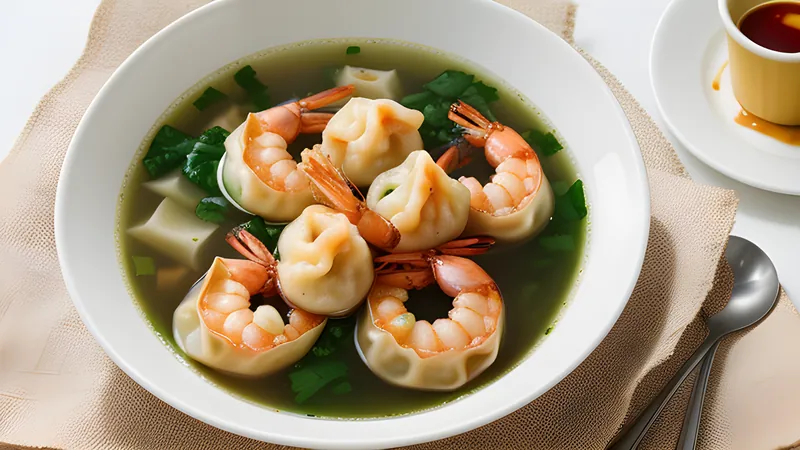
↓ Jump to recipeThere is a particular kind of contentment in a bowl of wonton soup: the broth clear enough to read a newspaper through, the dumplings loosely tied and slightly frilly at the edges, a filling that gives a faint snap when you bite it. It reads as restaurant food, something ordered rather than made. It is well within reach of a weeknight, and the folding is the sort of quietly absorbing job that makes an hour disappear.
My one change to the standard playbook is what happens to the broth before the wontons go anywhere near it. Rather than simply steeping raw ginger and onion, I char them hard over the flame until they blister and blacken in patches. That smoke turns a decent chicken stock into something with a low, toasty hum underneath, and it costs you four minutes and a wiped-down hob.
Wonton Soup with Prawn-and-Pork Dumplings
Ingredients
- 200g minced pork (roughly 20% fat)
- 150g raw peeled prawns, half finely chopped, half left in rough 1cm pieces
- 1 tbsp light soy sauce
- 1 tsp Shaoxing rice wine
- 1 tsp toasted sesame oil
- 0.5 tsp caster sugar
- 0.25 tsp white pepper
- 2 tsp cornflour
- 1 spring onion, very finely sliced
- 1 tsp grated fresh ginger
- 1 tbsp cold water
- 1 packet thin square wonton wrappers (about 32; the yellow egg type)
- 1.2 litres good chicken stock
- 40g fresh ginger, unpeeled, halved lengthways
- 3 spring onions, whole, plus extra sliced to serve
- 1 tbsp light soy sauce, plus more to taste
- 1 tsp Shaoxing rice wine
- 1 small pak choi or a handful of choi sum, leaves separated
- toasted sesame oil and chilli oil, to finish
Method
- Char the aromatics: hold the halved ginger and 3 whole spring onions directly over a gas flame (or press onto a dry hot pan) until blackened and blistered in patches, about 3-4 minutes. This is the broth's backbone.
- Add the charred ginger and spring onions to the chicken stock with the soy and Shaoxing. Bring to a gentle simmer and hold there, partly covered, for 20 minutes while you make the wontons. Fish out and discard the aromatics before serving.
- Make the filling: combine the pork, both cuts of prawn, soy, Shaoxing, sesame oil, sugar, white pepper, cornflour, spring onion and grated ginger in a bowl. Add the cold water and stir vigorously in one direction for 2 minutes until the mixture turns sticky and paste-like.
- Fill a wonton: put a heaped teaspoon of filling in the centre of a wrapper. Wet two edges with a fingertip of water, fold into a triangle and press out the air. Dab water on the two long corners, bring them together under the filling and pinch to seal, so the wonton sits like a little bundle.
- Repeat with the rest, keeping filled wontons under a damp cloth so they don't dry out.
- Cook the wontons in a wide pan of gently boiling water (not the broth, which would cloud) for 3-4 minutes, until they float and the wrappers turn translucent. Blanch the greens in the same water for the last 30 seconds.
- Divide wontons and greens between warm bowls. Ladle over the hot strained broth. Finish each bowl with sliced spring onion, a few drops of sesame oil and chilli oil to taste.
A dumpling that carried a whole cuisine
Wontons belong to the broad family of Chinese filled dumplings, and the word itself is worth pausing on. Húntún in Mandarin, wan tan in the Cantonese that gave English its spelling, is sometimes linked by folk etymology to hùndùn, the primordial chaos of Chinese cosmology, the formless state before heaven and earth separated. Whether or not the pun is ancient, it is a lovely image for a soft parcel of something wrapped in a cloud of wrapper.
The dish as most of us know it is Cantonese, and specifically it owes a great deal to the wonton-noodle shops of Guangzhou and, later, Hong Kong. There the benchmark is wonton lo mein and its soupy cousin: dumplings built around whole prawns, a broth simmered from pork bones and dried flounder, and thin egg noodles cooked so they still have spring. Emigration carried those shops around the world, which is why you find serious wonton noodles in Kuala Lumpur, San Francisco and Sydney, each with its own accent.
The Cantonese insistence on prawn is the detail that matters most for texture. Pork alone gives you a tender, savoury filling; prawn gives you bounce, that faint resistance against the tooth the Cantonese prize and call sōng or springiness. Leaving half the prawn in rough pieces means you actually meet it, rather than blending it into anonymity. It is the same instinct that makes a good tonkotsu ramen worth the trouble, or a bowl of bún bò Huế sing: the broth is the stage, and the thing you bite has to earn its place on it.
Why you stir in one direction
The single most useful trick in the whole recipe is invisible in the finished bowl. When you mix the filling, stir hard and always the same way for a good two minutes, until the meat stops looking like loose mince and starts to cling to the spoon like a paste. What you are doing is coaxing the salt-soluble proteins in the pork to link up into a loose gel, the same mechanism that gives a good sausage or a fish ball its snap. Add the tablespoon of cold water gradually as you go, and the mixture drinks it in, which keeps the cooked filling juicy rather than dense.
Skip that step and the filling turns out crumbly and dry, and the wontons feel stuffed rather than filled. It is genuinely the difference between a home dumpling and one you would happily pay for.
Folding, without the fuss
Wonton folds range from the elaborate flower to the plain triangle, and none of them changes the flavour. I use the classic Cantonese bundle: a triangle first, then the two long corners pulled together underneath and pinched. The tail of loose wrapper that floats free is not a flaw, it is the point, because those frills catch the broth and go silky.
A few things that keep the process smooth:
- Do not overfill. A heaped teaspoon is plenty. An overfilled wonton splits, and a split wonton clouds the broth and loses its filling to the pot.
- Press the air out as you seal the first fold. Trapped air makes wontons burst and bob about lopsidedly.
- Keep everything under a damp cloth. Wrappers dry to brittle in minutes, and a dry edge will not seal.
- Seal with water, sparingly. Too much and the wrapper turns gluey and refuses to stick; a wet fingertip run along the edge is enough.
If your first three look like something the cat brought in, keep going. By the tenth your hands will have found the rhythm, and the shape genuinely does not affect how they taste.
Cook the wontons apart from the broth
Here is the detail that separates a clear soup from a murky one: boil the wontons in a separate pan of plain water, then lift them into bowls and pour the clean broth over. Cooked directly in the broth, the wontons shed starch and stray filling, and your beautiful clear stock turns cloudy and thick. The two-pan method takes one extra pan and keeps the broth glassy. Blanch your greens in that same wonton water at the very end so nothing is wasted.
The wontons are done when they float and the wrappers turn from opaque to translucent, roughly three to four minutes. Prawn cooks fast, so do not wander off.
The broth, and the charred-ginger twist
A good wonton soup lives or dies on its broth, and you have licence here. The purist route is a long pork-and-chicken stock with dried seafood, and if you keep Cantonese ingredients in the cupboard it is glorious. For a weeknight, a good chicken stock does the job, and the charring is what lifts it. Held over a naked flame until the ginger hisses and the spring onions blacken, then steeped for twenty minutes, the aromatics give up a gentle smokiness and a rounder, sweeter ginger note than raw slices ever manage. It is the same principle behind a charred-onion pho broth, borrowed sideways.
Season the broth so it tastes properly of itself in the spoon before any wontons arrive. It should be savoury, faintly sweet from the onion, and clean. A last few drops of sesame oil and chilli oil in the bowl, not the pot, keeps those flavours bright.
Make-ahead and freezing
This is the recipe’s quiet superpower. Filled raw wontons freeze beautifully. Lay them on a floured tray so they are not touching, freeze until solid, then tip into a bag. Cook them straight from frozen, adding a minute or so to the boil. A bag of thirty in the freezer means a proper bowl of soup is fifteen minutes away on the worst kind of evening.
The filling can be mixed a day ahead and kept covered in the fridge; it actually firms up and folds more neatly cold. The broth keeps three or four days refrigerated and freezes well too, so a big batch of stock is never wasted.
Substitutions and variations
- No prawn? All pork works, though you lose the bounce; add a little more cornflour and a finely chopped water chestnut for texture.
- Heat. A spoon of chilli oil at the table is traditional; for a fierier bowl, add sliced fresh red chilli to the broth as it steeps.
- Greens. Pak choi, choi sum, gai lan or even a handful of spinach all work. Anything faster than the wontons goes in for the final thirty seconds.
- Noodles. Add a nest of cooked thin egg noodles to each bowl and you have wonton noodle soup, the Hong Kong classic in full.
- Dumplings alone. Boiled and tossed in soy, black vinegar and chilli oil, the same wontons become a plate of Sichuan-style hóngyóu chāoshǒu, red-oil wontons, no broth required.
A bowl of this, steam rising, chilli oil pooling red at the edges, is one of the great small pleasures of home cooking. Once you have the fold in your hands and a bag of them in the freezer, it becomes a reflex, the thing you make when you want to be looked after and there is nobody about to do it but you.
Related Content