Whole Roasted Cauliflower with Green Tahini
A whole head steamed until tender, then roasted until its crown blackens, and drowned in a herb-green tahini sauce
Contents
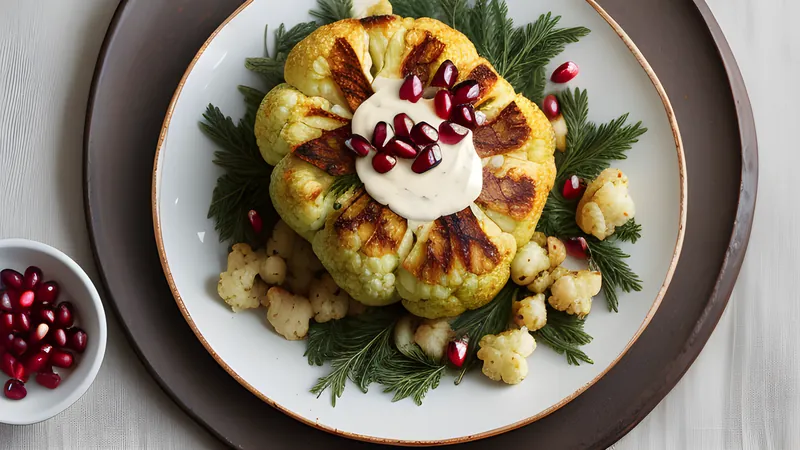
↓ Jump to recipeA whole roasted cauliflower is one of the great pieces of kitchen theatre for almost no effort. You bring a browned, blistered dome to the table, spoon a green sauce over it, and carve it into wedges like a joint of meat, and everyone is impressed out of all proportion to what you actually did. The trick that makes it work — and the step most recipes skip — is to steam the whole head through first, then roast it. Cauliflower is dense at the core, and if you simply put a raw head in the oven the outside chars to charcoal long before the middle is cooked. Pre-cooking it in salted water gets the centre tender and seasoned, so the oven’s only job is to brown the crown. The herb-green tahini poured over the top does the rest: nutty, sharp with lemon, and coloured a startling green by a fistful of parsley and coriander.
Whole Roasted Cauliflower with Green Tahini
Ingredients
- 1 large cauliflower (about 1kg), leaves trimmed, base levelled
- 3 tbsp olive oil
- 1 tsp ground cumin
- 1 tsp smoked paprika
- 1 tsp fine salt, plus more for the water
- 100g tahini
- 1 small garlic clove, finely grated
- Juice of 1 lemon (about 3 tbsp)
- 20g flat-leaf parsley
- 20g coriander
- 60-80ml ice-cold water
- 2 tbsp pomegranate seeds, to finish
- 1 tbsp toasted pine nuts or flaked almonds, to finish
Method
- Bring a large pot of well-salted water to the boil. Lower the whole cauliflower in stem-side down, cover, and simmer for 10 minutes until a knife slides into the core with only slight resistance. Lift it out carefully and let it drain and steam-dry, upside down, for 10 minutes.
- Heat the oven to 200C fan (220C conventional, gas mark 7). Whisk the olive oil with the cumin, smoked paprika and 1 teaspoon salt into a loose paste.
- Sit the drained cauliflower in an oiled ovenproof pan or dish and rub the spiced oil all over it, working it down into the crevices between the florets.
- Roast for 35-40 minutes, until the crown is deeply browned and blackening at the tips and a skewer passes through the centre with no resistance.
- While it roasts, blend the tahini, garlic, lemon juice, parsley, coriander and 1/2 teaspoon salt with the ice-cold water, adding the water a little at a time until you have a pourable, vivid green sauce. It will thicken then loosen as you add water; keep going until it drops from a spoon in a ribbon.
- Spread half the green tahini on a warm platter, sit the roasted cauliflower on top, and spoon the rest over the crown so it pools in the florets.
- Scatter with pomegranate seeds and toasted pine nuts, and carve into wedges at the table.
The dish and its lineage
Whole roasted cauliflower as a showpiece is most associated with the modern Middle Eastern and Israeli restaurant cooking that spread through London and beyond in the 2010s, where a burnished head of cauliflower under tahini became a signature of the meze table. The pairing of cauliflower with tahini, cumin, lemon and pomegranate is genuinely rooted in the eastern Mediterranean and Levant, where cauliflower is fried, pickled and roasted across Lebanese, Palestinian, Syrian and Turkish kitchens, and tahini — ground sesame paste — is as fundamental a pantry item as olive oil.
Tahini deserves its status. Sesame has been cultivated for its oil-rich seeds for at least four thousand years, and grinding the toasted seeds into a paste gives one of the oldest condiments in the region. On its own tahini is intensely nutty and a little bitter; loosened with lemon and water, it transforms into a smooth, savoury sauce with a texture somewhere between a dressing and a dip. The green version here, blitzed with soft herbs, is a riff on the herb tahini sauces served across the Levant, and the colour it lends the plate is half the pleasure. My one liberty is leaning hard on smoked paprika in the spice rub, which gives the roasted crown a faint barbecue depth that plays off the fresh green sauce.
Why steam first, then roast
Cauliflower is a brassica with a deceptively solid core, and heat travels through it slowly. Put a raw whole head straight into a hot oven and you’re asking two incompatible things of the same fire: brown the surface, and cook a dense two-inch-thick centre. The surface always wins that race, so you end up with a scorched exterior and a squeaky, raw middle. Poaching the head in well-salted water first solves this by cooking it from the outside in via water, which is a far more efficient conductor of heat than air. Ten minutes of simmering gets the core to just-tender and, crucially, seasons the cauliflower all the way through, since salt penetrates in water in a way it never does from a dry surface rub.
The steam-drying step that follows matters more than it looks. A cauliflower straight from the pot is waterlogged, and wet surfaces steam rather than brown. Sitting it upside down for ten minutes lets gravity and residual heat pull the water out of the florets and off the surface, so that when the spiced oil goes on and the head hits the oven, the exterior can dry out fast and start browning almost immediately. Skip the drain and you’ll roast for an age while the crown stays stubbornly pale. Rub the oil right down into the crevices between the florets too, because those recessed edges are where the deepest, most delicious char develops.
Loosening tahini without splitting it
Tahini does something alarming the first time you make a sauce from it: you add lemon juice and it seizes into a stiff, grainy paste, looking utterly broken. This is normal, and it’s a feature. Tahini is an emulsion of sesame oil and solids, and introducing an acidic or watery liquid causes it to tighten before it loosens. The fix is simply to keep adding cold water, a little at a time, whisking as you go — the paste passes through that thick, claggy stage and then suddenly relaxes into a smooth, pourable cream. Ice-cold water does this more reliably than warm, and gives a paler, glossier sauce. Add the water gradually until it ribbons off the spoon; too little and it sits on the cauliflower in a stodgy layer, too much and it runs straight off.
The recipe
Serves 4 as a side, 2 as a light main.
Ingredients
- 1 large cauliflower (about 1kg), leaves trimmed
- 3 tbsp olive oil
- 1 tsp ground cumin
- 1 tsp smoked paprika
- 1 tsp fine salt, plus more for the water
- 100g tahini
- 1 small garlic clove, finely grated
- Juice of 1 lemon
- 20g flat-leaf parsley
- 20g coriander
- 60-80ml ice-cold water
- 2 tbsp pomegranate seeds
- 1 tbsp toasted pine nuts or flaked almonds
Method
- Simmer the whole cauliflower stem-side down in well-salted water for 10 minutes, until a knife meets slight resistance. Drain upside down for 10 minutes.
- Heat the oven to 200C fan. Whisk the oil with cumin, smoked paprika and salt.
- Sit the cauliflower in an oiled dish and rub the spiced oil all over, into the crevices.
- Roast 35-40 minutes, until the crown is deeply browned and a skewer passes through easily.
- Blend the tahini, garlic, lemon, herbs and salt with the cold water, added gradually, until pourable and green.
- Spread half the sauce on a platter, sit the cauliflower on top, and spoon over the rest.
- Scatter with pomegranate and pine nuts, and carve at the table.
Tips, substitutions and storage
The poaching step is forgiving on timing — err towards tender, since the oven won’t soften the centre much further, it only browns. If your pot won’t hold the whole head submerged, steam it in a covered pan with a couple of centimetres of salted water for 12-14 minutes instead. Any soft herb works in the tahini: mint or dill in place of some coriander both suit it. If you want the sauce without garnish faff, the pomegranate can be left off, though it earns its keep with jewel-bright acidity and crunch. Leftover green tahini keeps three days in the fridge and thickens as it sits — loosen it with a splash of water and it’s a superb dressing for roasted carrots with honey, cumin and yoghurt or a bowl of grains.
Roasted cauliflower keeps two days in the fridge and reheats in a hot oven, though the crown loses its crispness. I’d sooner eat the leftovers cold, torn into a salad with the tahini spooned over.
Variations
For a heartier main, serve the carved cauliflower over a bed of spiced chickpeas or lentils with the green tahini pooled underneath, and it becomes a full plate. A drizzle of chilli oil or a scatter of Aleppo pepper over the top adds warmth and colour if you like a little heat. If you’re cooking for a crowd, two smaller heads roast faster and more evenly than one enormous one, and they carve more neatly. This belongs on a table alongside other big-flavoured vegetable dishes — it’s a natural companion to cauliflower cheese with a mustard crumb if you want to play the same vegetable two entirely different ways, or sag aloo with mustard seed for a spiced, saucy foil to the roasted crown.
Related Content