Tuna mousse
A retro cocktail-party spread, brightened with lemon and dill
Contents
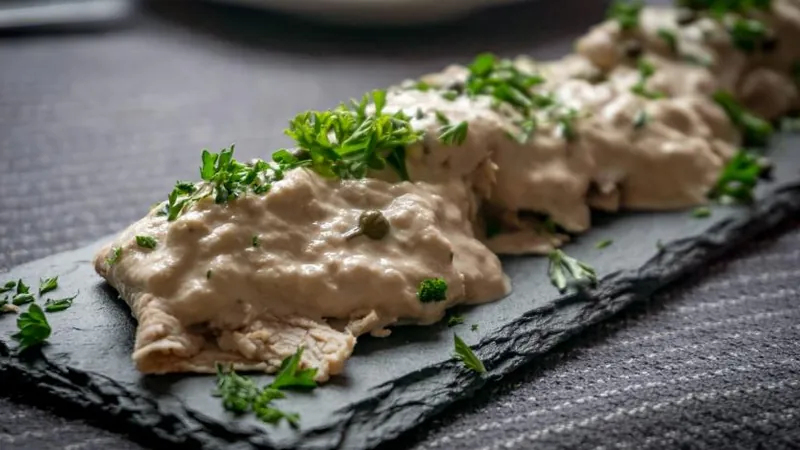
↓ Jump to recipe<p>Tuna mousse is unapologetically retro, and that is exactly why I love it. It is the sort of thing that belonged on a 1970s cocktail trolley, piped into cherry tomatoes or set in a fish-shaped mould with an aspic glaze, and it has an undeserved reputation for being naff. Made properly it is silky, savoury and bright, the kind of spread that vanishes off a plate of crackers while nobody quite admits to eating it. My one insistence, and the thing that lifts it above the tinned-fish sludge you might be imagining, is a sweet sautéed onion and a proper hit of lemon to cut the richness clean.</p>
<div class="recipe-card" id="recipe">
<div class="recipe-card-head"><p class="recipe-card-title">Tuna mousse</p>
<div class="recipe-card-actions"><a class="recipe-pin" href="https://www.pinterest.com/pin/create/button/?description%3dTuna%2bmousse%26media%3dhttps%253A%252F%252Fmedia.vo.rs%252Fantipasto-3484785_1280-x.jpg%26url%3dhttps%253A%252F%252Fvo.rs%252Fstory%252Ftuna-mousse%252F" target="_blank" rel="nofollow noopener" aria-label="Save to Pinterest"><i class="fab fa-pinterest-p fa-fw"></i> Save</a><button type="button" class="recipe-print" onclick="window.print()" aria-label="Print recipe"><i class="fas fa-print fa-fw"></i> Print</button>
</div>
</div>
<div class="recipe-meta"><span class="recipe-meta-item"><span class="recipe-meta-label">Serves</span>6 servings</span><span class="recipe-meta-item"><span class="recipe-meta-label">Prep</span>15 min</span><span class="recipe-meta-item"><span class="recipe-meta-label">Cook</span>5 min</span><span class="recipe-meta-item"><span class="recipe-meta-label">Cuisine</span>British</span><span class="recipe-meta-item"><span class="recipe-meta-label">Course</span>Appetiser</span></div>
<div class="recipe-cols">
<div class="recipe-ingredients">
<h3>Ingredients</h3>
<ul><li>1 small onion, finely chopped</li><li>1 tbsp olive oil</li><li>2 x 145g tins tuna, in spring water, well drained</li><li>150g mayonnaise</li><li>100ml sour cream</li><li>1 tbsp finely chopped fresh dill (or 1 tsp dried)</li><li>Juice of 1 lemon</li><li>0.5 tsp fine salt, plus more to taste</li><li>0.25 tsp freshly ground black pepper</li></ul>
</div>
<div class="recipe-method">
<h3>Method</h3>
<ol><li>Warm the olive oil in a small pan over a medium heat and cook the finely chopped onion for 6 to 8 minutes until soft, sweet and translucent but not coloured, then tip onto a plate and cool completely.</li><li>Drain the tuna, then press it firmly through a fine sieve or squeeze it in a clean cloth to remove as much liquid as possible.</li><li>Put the tuna, cooled onion, mayonnaise, sour cream, dill and half the lemon juice in a food processor and blend for 1 to 2 minutes, scraping down the sides, until completely smooth.</li><li>Season with the salt, pepper and the remaining lemon juice, then blend for a few more seconds and taste.</li><li>Scrape into a serving bowl, smooth the top, cover with cling film pressed onto the surface and chill for at least 5 hours, or overnight, before serving.</li></ol>
</div>
</div>
</div><h2 id="the-rise-of-the-tin">The rise of the tin</h2><div class="ad-unit ad-in-article" aria-label="Advertisement">
<span class="ad-label">Advertisement</span>
<ins class="adsbygoogle" style="display:block;text-align:center"
data-ad-client="ca-pub-3726833845844946"
data-ad-slot="3291553914"
data-ad-format="auto"
data-full-width-responsive="true"></ins>
<script>(adsbygoogle = window.adsbygoogle || []).push({});</script>
</div>
<p>Tuna mousse is a child of the canning age. The technique of preserving food in sealed tins was patented by the Englishman Peter Durand in 1810, but tinned tuna specifically is a twentieth-century phenomenon. The American albacore fishery around San Pedro, California, began canning tuna in earnest around 1903, when a sardine cannery experimented with the fish after a poor sardine season, and it took off during the First World War when tinned protein became strategically valuable. By the mid-century, tinned tuna was a cheap, ever-present pantry staple on both sides of the Atlantic.</p>
<p>That abundance, colliding with the mid-century fashion for moulded, chilled dishes set with gelatine, is what produced tuna mousse. The moulded savoury mousse was a hostess’s dream: made a day ahead, turned out with a flourish, sliceable and cool for a summer buffet. Cookbooks of the 1950s and 60s are thick with them, from salmon mousse to the notorious tomato-aspic salads. Tastes moved on, gelatine fell out of fashion, and the moulds went to the back of the cupboard, but the soft, spreadable version survived because it is genuinely good. This recipe drops the aspic and keeps the pleasure: a light, savoury spread that leans on chilling rather than setting agents to hold its shape.</p>
<h2 id="draining-is-not-optional">Draining is not optional</h2>
<p>If there is one step that separates a good tuna mousse from a watery, grey disappointment, it is drying the fish out. Tinned tuna carries a surprising amount of liquid, and even the spring-water kind will loosen the mousse and dilute the flavour if you tip it straight in. Drain it in a sieve, then press it hard with the back of a spoon, or better still squeeze it in a clean tea towel until barely any liquid runs out. You want the tuna almost dry and flaky before it meets the dairy. This is the same discipline that keeps a fishcake from collapsing, and it pays off in a mousse that holds a clean quenelle rather than slumping on the plate.</p>
<p>Choose tuna in spring water rather than oil or brine. Oil-packed tuna makes the mousse greasy on top of the mayonnaise and sour cream, and brine makes it aggressively salty; spring water gives you a neutral base you can season yourself.</p>
<p>It is worth thinking about which tuna you buy beyond the packing liquid. Skipjack is the most common and cheapest tinned tuna, mild and pale and perfectly good for a mousse where it is blended and seasoned anyway. Albacore, sometimes labelled white tuna, is firmer and richer with a meatier flake, and gives a slightly more luxurious result if you want to push the boat out. Whichever you choose, look for pole-and-line caught on the label if you can; it is the more sustainable method and avoids the bycatch problems of large-scale netting. The fish is doing the heavy lifting of flavour here, so a decent tin repays the small extra cost.</p>
<h2 id="why-the-onion-is-cooked-first">Why the onion is cooked first</h2><div class="ad-unit ad-in-article" aria-label="Advertisement">
<span class="ad-label">Advertisement</span>
<ins class="adsbygoogle" style="display:block;text-align:center"
data-ad-client="ca-pub-3726833845844946"
data-ad-slot="3291553914"
data-ad-format="auto"
data-full-width-responsive="true"></ins>
<script>(adsbygoogle = window.adsbygoogle || []).push({});</script>
</div>
<p>Raw onion in a chilled spread is a trap. It stays harsh and sharp, its flavour intensifies as the mousse sits overnight, and it can turn slightly bitter against the dairy. Sweating the finely chopped onion gently in a little oil until soft and translucent tames all of that: the harsh sulphur compounds cook off and the natural sugars come forward, so what you fold in is sweet and mellow rather than pungent. Cook it slowly and do not let it colour; you want sweetness, not the caramelised, jammy flavour that browning would bring.</p>
<p>Then cool it completely before it goes near the mayonnaise. Warm onion will slacken and split the emulsion, giving you an oily, broken mousse instead of a smooth one. A few minutes spread on a cold plate does the job.</p>
<h2 id="balancing-the-richness">Balancing the richness</h2>
<p>Mayonnaise and sour cream together give the mousse its body and tang, but left alone they read as flat and heavy. Lemon juice is the counterweight. Added in two stages, half before blending and the rest to season at the end, it brightens the whole thing and cuts through the fat so the fish flavour comes forward rather than being smothered. Taste after the first lemon and before the second; tinned tuna varies, and you are aiming for a spread that tastes fresh and lifted rather than merely creamy.</p>
<p>Dill is the classic herb here, its grassy, faintly aniseed note being a natural partner to both fish and sour cream. Fresh is better than dried if you have it, stirred through at the end for flecks of green. Chives, tarragon or flat-leaf parsley all work if that is what is in the fridge.</p>
<h2 id="the-blend-and-how-smooth-to-go">The blend, and how smooth to go</h2>
<p>How long you run the food processor decides the character of the mousse. A brief pulse leaves it coarse and flaked, more of a rustic tuna spread, which is lovely piled onto toast. A full minute or two of blending, stopping to scrape down the sides, gives the smooth, aerated, almost pâté-like texture that earns the name mousse and that pipes cleanly. I prefer it fully smooth, so the fish flavour is distributed evenly and the spread feels light rather than chunky, but there is no wrong answer.</p>
<p>Whichever you choose, blend the mayonnaise and sour cream in gradually rather than all at once. Adding the dairy in two or three additions, letting each incorporate before the next, keeps the emulsion stable and stops it turning oily and split. If it does begin to look greasy or grainy, a tablespoon of cold water blended in will often bring it back together, the extra liquid re-emulsifying the fat. Keep the machine’s bowl and blade cool if your kitchen is warm; a mousse blended in a hot processor can loosen and weep.</p>
<h2 id="the-chill-is-what-sets-it">The chill is what sets it</h2>
<p>This mousse has no gelatine, so it relies entirely on time in the fridge to firm up and for the flavours to marry. Five hours is the minimum; overnight is better. Press cling film directly onto the surface to stop it forming a skin, and the mousse will set to a soft, sliceable, spoonable texture. Because it contains mayonnaise and sour cream, keep it refrigerated until the moment you serve it, and do not leave it sitting out for more than a couple of hours at a party.</p>
<h2 id="lightening-it-if-you-like">Lightening it, if you like</h2>
<p>The classic proportions here lean rich, with mayonnaise and sour cream in roughly equal measure to the fish. If you want a lighter, tangier mousse, swap the sour cream for thick Greek yoghurt or a soft, whipped cream cheese, which cuts the fat while keeping the body. Yoghurt brings extra acidity, so taste before you add all the lemon or you may find it too sharp. Cream cheese, on the other hand, sets firmer in the fridge and gives a mousse you can spread thickly without it collapsing, closer to a potted fish than a soft dip.</p>
<p>You can also fold air into it deliberately. Whip 50ml of double cream to soft peaks and fold it through the blended base right at the end, and the mousse becomes genuinely light and airy, the closest this humble spread comes to living up to its grand French name. It will not keep quite as long once the cream is in, a day at most, so make that version to eat the same evening rather than as a make-ahead.</p>
<h2 id="serving-storing-and-variations">Serving, storing and variations</h2>
<p>Serve it as it should be: spread thickly on toasted sourdough, piped into halved cherry tomatoes, spooned onto cucumber rounds, or simply put out with crackers and a knife. It keeps for up to three days covered in the fridge, and any leftovers make an excellent sandwich filling with crisp lettuce and cucumber.</p>
<p>For a smoky version, fold in half a teaspoon of smoked paprika, or use tinned smoked mackerel in place of the tuna. For a bit of bite, add a teaspoon of grated horseradish or a small spoon of capers, roughly chopped. And if you want to lean into the sharpness, a teaspoon of Dijon mustard blended in gives a subtle warmth that suits a drinks tray.</p>
<p>If you are building a spread of nibbles, this belongs alongside <a href="/story/smoked-salmon-dill-blinis/">smoked salmon and dill blinis</a> and a batch of <a href="/story/seeded-rye-crackers-with-smoked-salt/">seeded rye crackers with smoked salt</a> to spread it on. For something on the sweeter, richer end of the same silky-blended texture, there is always a <a href="/story/dark-chocolate-mousse-with-espresso-and-flaky-salt/">dark chocolate mousse with espresso and flaky salt</a>.</p>
Advertisement
Related Content


Advertisement
