Trifle with Sherry, Custard and Raspberry
The proper English trifle, with a bay-scented custard
Contents
↓ Jump to recipeEvery family has an opinion about trifle, and most of them are wrong in some cherished, non-negotiable way. Someone insists on jelly, someone else on tinned fruit, a great-aunt swears by hundreds and thousands, and a purist mutters darkly about custard from a tin. I am not here to settle those wars, only to make the case for a version built entirely from scratch, layered in a glass bowl so you can see the strata, and lifted by one small trick that nobody expects: a couple of bay leaves steeped into the custard. Bay in a pudding sounds odd until you taste it, at which point it becomes the thing you cannot leave out. It gives the custard a faint, resinous warmth that reads almost like vanilla’s savoury cousin.
A pudding older than the empire
Trifle is genuinely ancient. The first printed recipe appears in Thomas Dawson’s The Good Huswifes Jewell in 1596, though that early “trifle” was closer to a spiced, thickened cream than the layered affair we know. The version with sponge, wine and custard took shape over the eighteenth century, when soaked biscuits called “tansies” and the arrival of ratafia and sherry turned it into a boozy centrepiece. By the Victorian era the trifle had settled into its familiar architecture of alcohol-soaked cake, fruit, custard and cream, and it became the grand finale of Christmas and Sunday tables across Britain.
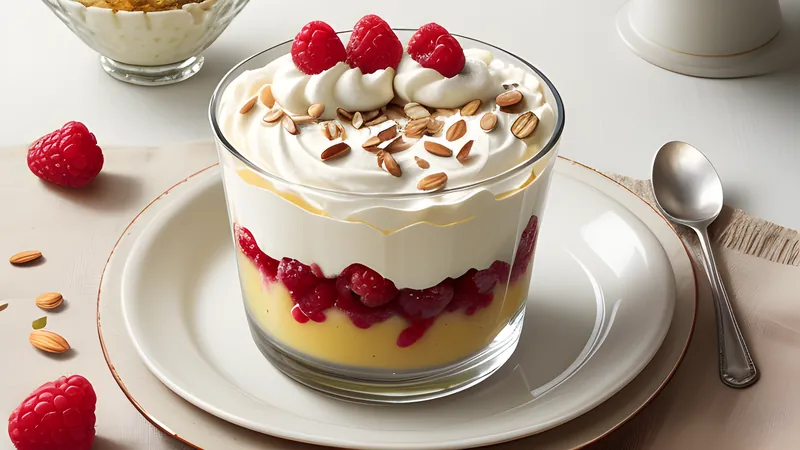
The name itself is telling. A “trifle” means something of little consequence, a bagatelle, and the pudding was originally a way of using up stale sponge and odds and ends of fruit dressed up into something that looked lavish. That thrifty heart is still there. A good trifle is a rescue mission for leftover cake and a glut of soft fruit, disguised as a showpiece. The layering is the whole point, so a clear glass bowl earns its place here, letting the crimson fruit, pale custard and cloud of cream declare themselves before anyone lifts a spoon.
Trifle with Sherry, Custard and Raspberry
Ingredients
- 200g trifle sponges or plain Madeira cake
- 4 tbsp good raspberry jam
- 100ml medium-dry sherry (oloroso or amontillado)
- 400g raspberries, fresh or frozen
- 2 tbsp caster sugar, for the fruit
- For the custard: 500ml whole milk
- 100ml double cream
- 2 fresh bay leaves
- 1 vanilla pod, split, or 1 tsp vanilla bean paste
- 6 large egg yolks
- 75g caster sugar
- 30g cornflour
- For the top: 400ml double cream, well chilled
- 1 tbsp icing sugar
- 30g toasted flaked almonds
Method
- Split the sponges, sandwich with raspberry jam, cut into cubes and layer over the base of a glass bowl. Spoon over the sherry and leave to soak for 20 minutes.
- Warm the raspberries with 2 tbsp sugar until slightly slumped and juicy, then cool and spoon over the sponge with their juice.
- Heat the milk, cream, bay leaves and vanilla to a bare simmer, then leave off the heat to infuse for 15 minutes and lift out the bay.
- Whisk the yolks, 75g sugar and cornflour to a paste. Reheat the milk, pour it onto the yolks whisking, return to the pan and cook until thick, whisking constantly.
- Cool the custard for 10 minutes, then pour over the fruit layer. Press cling film flush to the surface and chill until fully set, at least 3 hours.
- Whip the 400ml cream with the icing sugar to soft, floppy peaks and spread over the set custard.
- Scatter with toasted flaked almonds and chill until ready to serve.
The custard is the whole game
A trifle lives or dies on its custard, and a proper homemade one, thickened with egg yolks and a little cornflour, sits in a different league from the packet version. The cornflour is doing something clever: it stabilises the yolks so the custard can reach a bubbling simmer without curdling, which means you can cook it thick enough to hold its own distinct layer rather than seeping into the sponge. Whisk it constantly and keep the heat moderate, dragging the whisk into the corners of the pan where custard likes to catch and scramble. The moment it thickens and you see a bubble, it is done.
The bay is my one liberty, and it is a quiet revelation. Steeped in the hot milk for a quarter of an hour, fresh bay lends a gentle, almost floral herbal note that deepens the custard without announcing itself as anything other than “very good vanilla custard”. Guests taste it and cannot place it. If you love the same trick, you will find it turns up in the custard for a queen of puddings with meringue and jam, where it does the same understated work beneath the meringue.
Sherry, and how boozy to go
Sherry is the traditional soak, and a medium-dry oloroso or amontillado gives the best balance of nutty depth and gentle sweetness; a dry fino can taste thin, and a cream sherry tips the whole thing too sweet. One hundred millilitres over the sponge is enough to perfume every mouthful without leaving a puddle at the bottom of the bowl. For a family pudding with children at the table, swap the sherry for orange juice with a spoonful of the raspberry juice stirred in, which keeps the fruity backbone intact. The sponge only needs enough liquid to soften and flavour it, so err toward moist rather than sodden, or the base layer turns to paste.
Make-ahead and storage
Trifle is a gift to the cook who wants pudding done before the guests arrive, because it genuinely improves with a night in the fridge. The flavours settle, the sponge fully absorbs the sherry and fruit juices, and the custard firms into a clean layer. Assemble it up to the custard stage a day ahead, then whip and add the cream on the day so it stays light and cloud-like. It keeps well for two days covered in the fridge, though the almonds are best scattered just before serving so they stay crisp. Frozen raspberries work beautifully here and, macerated with sugar, give up more juice than fresh, which many people prefer.
Variations worth trying
The raspberry version is the classic English trifle, though the format is endlessly adaptable. Swap the raspberries for a mix of summer berries, or use poached rhubarb and orange in spring for a sharper, rosier pudding. A layer of soft amaretti crushed between the sponge and fruit adds an almond crunch that pairs well with the toasted flaked almonds on top. For a Scottish accent, take the sherry out and fold toasted oats and a little whisky through the cream, an idea borrowed straight from cranachan with whisky, raspberry and toasted oats. A handful of toasted hazelnuts scattered over the cream instead of almonds gives a rounder, warmer crunch that suits the sherry. Whatever fruit you choose, keep the layers distinct and the custard homemade, and the bay quietly holding the whole thing together beneath its cloud of cream.
Related Content