Tres Leches with Toasted-Milk Soak
A soaked sponge cake, deepened with a caramelised milk reduction
Contents
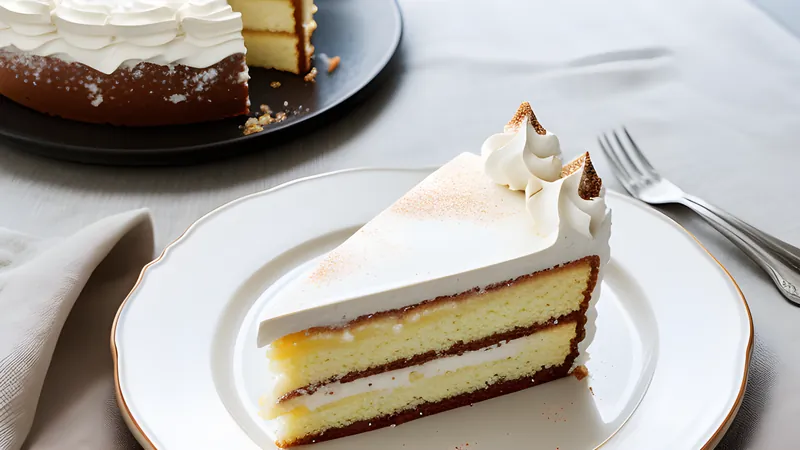
↓ Jump to recipeTres leches is a sponge cake deliberately soaked until it is heavy, cold and almost pudding-like, held together by a trio of milks poured over the top after baking. My twist happens before any of those milks meet the cake: I reduce the whole milk on the stove until it turns pale caramel and smells faintly toasted, then build the soak around it. Plain tres leches is already rich; this version tastes deeper, with a genuine caramel note running underneath the sweetness rather than just sugar for sugar’s sake.
Tres Leches with Toasted-Milk Soak
Ingredients
- 6 large eggs, separated
- 200g caster sugar
- 200g plain flour
- 1 tsp baking powder
- 1/4 tsp fine salt
- 1 tsp vanilla extract
- 500ml whole milk, for toasting
- 397g tin condensed milk
- 410g tin evaporated milk
- 1/2 tsp fine salt, for the soak
- 300ml double cream
- 30g icing sugar
- 1 tsp vanilla extract, for the cream
- Ground cinnamon, to finish
Method
- Heat the oven to 170C fan (190C conventional, gas mark 5). Grease a 33x23cm baking tin and line the base with baking paper.
- Whisk the egg yolks with 150g of the sugar until pale and thick, about 3 minutes, then whisk in the vanilla.
- In a clean bowl, whisk the egg whites to soft peaks, then whisk in the remaining 50g sugar a spoonful at a time until you have a glossy meringue.
- Sift the flour, baking powder and salt over the yolk mixture and fold in gently, then fold in a third of the meringue to loosen the batter, followed by the rest in two more additions, keeping as much air in as you can.
- Pour into the tin, level the top, and bake for 25 to 30 minutes until golden, springy to the touch and coming away slightly from the sides. Cool completely in the tin.
- Meanwhile, pour the 500ml whole milk into a wide, heavy pan and simmer gently over a medium-low heat, stirring often and scraping the base, for 25 to 30 minutes, until reduced by roughly half and pale caramel in colour with a toasted, faintly nutty smell.
- Pour the toasted milk into a jug and whisk in the condensed milk, evaporated milk and 1/2 teaspoon salt until smooth. Cool to room temperature.
- Prick the cooled sponge all over with a skewer, then pour the milk mixture over slowly and evenly, letting it soak in before adding more, until it is fully absorbed.
- Cover and chill for at least 4 hours, or overnight.
- Whip the double cream with the icing sugar and vanilla to soft peaks, spread over the top of the soaked cake, and dust with cinnamon before serving.
A cake built for the fridge
Tres leches — literally “three milks” — is one of the most-loved cakes across Mexico and much of Latin America, and its exact origin is genuinely contested rather than tidy. Nestlé’s marketing in the mid-twentieth century, printing tres leches recipes on the back of condensed and evaporated milk tins across the region, almost certainly helped popularise the dish enormously, but similar soaked-sponge desserts using tinned milk appear earlier across Central America and the Caribbean, and the technique of soaking a plain sponge in sweetened milk or syrup has much older roots in European trifle and rum-baba traditions carried over with colonial-era baking. What is not in dispute is how thoroughly Mexico, Nicaragua and Guatemala in particular have all claimed and shaped the cake into a defining birthday and celebration dessert.
The reason tinned milk became central to the recipe is worth understanding, because it explains the cake’s whole structure. Condensed and evaporated milk were, for much of the twentieth century, shelf-stable, affordable and consistent in a way fresh milk and cream often were not across large parts of Latin America, and a cake that relied on them travelled and kept well, which mattered for a dessert made to serve a crowd at a party. The three milks in the name are usually whole milk, evaporated milk and sweetened condensed milk, each doing a distinct job: the condensed milk brings sugar and thickness, the evaporated milk brings concentrated dairy richness without extra sweetness, and the fresh milk thins the mixture enough that it can actually soak into the cake rather than sitting as a sludge on top.
Nicaragua makes its own strong claim on the cake, particularly around León, where bakeries treat tres leches as a point of civic pride rather than a Mexican import, and home versions there often skip the whipped-cream topping altogether in favour of a simple dusting of cinnamon straight onto the soaked sponge. Peru and Venezuela have their own well-established traditions too, sometimes layering dulce de leche or manjar under the cream instead of leaving the soak to stand alone. In Mexico itself the cake is birthday-party furniture as much as a bakery staple — a proper quinceañera or first-birthday spread is hard to imagine without a tres leches sheet cake cut into small squares, usually finished with piped rosettes of the same cream that tops it.
What toasting the milk actually does
Reducing whole milk slowly on the stove pushes it through the same chemistry that turns milk into dulce de leche, just stopped earlier. As the water in the milk evaporates, its natural sugars — mostly lactose — and its proteins concentrate, and once the mixture gets hot and dense enough, those sugars and proteins begin to brown through the Maillard reaction, the same one responsible for a seared steak or toasted bread crust. Thirty minutes at a gentle simmer is nowhere near long enough to make actual dulce de leche, which typically takes hours of reduction to caramelise fully, but it is plenty of time to nudge the milk from flat and sweet towards genuinely toasted and faintly nutty, with a pale golden-caramel colour you can see happening in the pan.
The reason this matters for the finished cake is that plain tres leches, for all its richness, can taste one-dimensionally sweet — condensed milk sugar with not much underneath it. A toasted milk base adds a savoury-adjacent, roasted depth that plays against that sweetness the way a well-made caramel does against vanilla ice cream, giving the soak more to say once it has fully permeated the sponge.
Two things matter in the reduction itself. Use a wide, heavy-based pan rather than a narrow saucepan, because a wide surface area speeds evaporation and lets you keep the heat gentle rather than needing it aggressively high, which would scorch the milk solids on the base before the whole batch had a chance to reduce evenly. And stir often, scraping the base specifically, because milk proteins and sugars that catch and sit on the bottom of the pan will burn well before the bulk of the milk has taken on colour, leaving bitter black flecks through an otherwise good reduction.
A few things go wrong if you rush this step. Turned up too high, the milk can catch and scorch before it has had time to reduce evenly, leaving those bitter black flecks that no amount of sugar afterwards will mask; if you smell anything acrid rather than toasty, the batch is done for and it’s worth starting again rather than pushing on. Reduced too far past half its original volume, the milk thickens towards a loose caramel that can seize and turn grainy the moment the cold condensed and evaporated milk hit it — whisking in a splash of warm water while everything is still hot usually brings a seized batch back together. Colour is the most reliable guide throughout: you want the pale gold of a runny caramel sauce, not the deep amber of a finished toffee, and it should smell distinctly nutty and toasted rather than merely hot.
The sponge, and why it has to be this kind
Tres leches sponge is deliberately plain and light, built as a separated-egg sponge with no butter or oil in the batter, because the cake’s entire job is to absorb an enormous quantity of liquid without collapsing into mush. A rich, buttery cake is already saturated with fat and cannot take on much more liquid before it turns dense and gluey; a light, airy sponge, full of trapped air from whipped egg whites, has plenty of structural room left to soak up milk and stay tender rather than soggy. Fold the meringue in gently and in stages, because knocking the air back out at this stage is the single most common way to end up with a flat, dense cake that cannot do its one job properly.
Pricking the cooled sponge all over with a skewer before pouring the soak matters more than it looks. Those holes give the milk direct channels down into the crumb rather than relying entirely on slow capillary action from the surface, which is what allows a genuinely full soak — cake that is moist right through to the base, not just damp on top and dry underneath. Pour the milk slowly, in stages, giving each addition time to sink in before you add more; pour the whole quantity at once onto an unabsorbent surface and much of it will simply run off the sides of the tin.
The recipe
Heat the oven to 170C fan (190C conventional, gas mark 5) and prepare a 33x23cm tin. Whisk 6 egg yolks with 150g of 200g total sugar until pale and thick, then whisk in 1 teaspoon vanilla. Whisk the whites to soft peaks in a separate bowl, then whisk in the remaining 50g sugar to a glossy meringue. Fold 200g sifted flour, 1 teaspoon baking powder and 1/4 teaspoon salt into the yolks, then fold in the meringue in three additions. Bake 25 to 30 minutes until golden and springy, then cool completely in the tin.
Simmer 500ml whole milk in a wide pan for 25 to 30 minutes, stirring often, until reduced by half and pale caramel with a toasted smell. Whisk in a 397g tin condensed milk, a 410g tin evaporated milk and 1/2 teaspoon salt, and cool to room temperature. Prick the cooled sponge all over, pour the milk mixture over slowly in stages, then chill for at least 4 hours or overnight. Whip 300ml double cream with 30g icing sugar and 1 teaspoon vanilla to soft peaks, spread over the top, and dust with cinnamon.
Tips, storage and variations
Tres leches genuinely improves with time in the fridge; a cake soaked overnight is noticeably better than one served the same day, because the milk needs real time to travel evenly through the crumb. It keeps well, covered, in the fridge for up to four days, and is, if anything, best on day two. It does not freeze well once soaked — the texture turns watery and separates on thawing — so keep it refrigerated and eat it within the week.
For variations, a shot of dark rum or Kahlúa stirred into the milk soak is a common and very good addition, cutting the sweetness with something bitter and warm. A layer of sliced strawberries or mango under the cream is popular for a birthday presentation. If you like the caramelised-dairy register this cake leans into, my key lime pie with brown-butter graham crust applies the same browning instinct to a completely different dessert, and a glass of horchata with toasted cinnamon and almond alongside keeps the toasted, milky theme running through the whole table.
Related Content