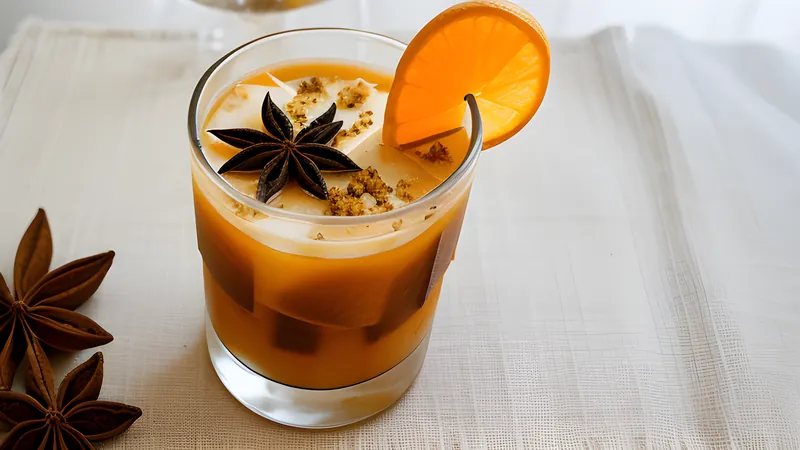
Thai Iced Tea with Star Anise
Orange-red tea steeped hot with star anise and cardamom, then poured cold over condensed milk.
Contents
↓ Jump to recipeThai iced tea is that improbable shade of burnt orange that looks artificial and isn’t — the colour comes from the tea itself, sometimes helped along by a food-safe dye in commercial blends, but mostly from a strong black tea steeped hard and long. Most versions stop at “strong tea, condensed milk, ice.” This one steeps the tea with whole star anise, cardamom and a cinnamon stick, so the underlying tannin gets a warm, liquorice-edged spice note running through it before the condensed milk ever goes in. It’s still a five-minute assembly job; the only patience required is the steep.
Thai Iced Tea with Star Anise
Ingredients
- 4 tablespoons Thai tea mix (loose black tea blend, sometimes labelled 'cha thai' or 'Number One brand')
- 1 litre boiling water
- 2 whole star anise
- 3 green cardamom pods, lightly crushed
- 1 small cinnamon stick
- 3 tablespoons caster sugar
- 120ml sweetened condensed milk, plus extra to taste
- 60ml evaporated milk, or single cream, to finish
- Ice cubes, plenty
Method
- Put the Thai tea mix, star anise, cardamom pods and cinnamon stick into a heatproof jug or teapot.
- Pour over the boiling water, stir once, and leave to steep for 12 minutes — do not stir again or lift the lid, as agitating the leaves during a long steep pulls out excessive tannin.
- Strain the tea through a fine sieve lined with muslin or a coffee filter into a clean jug, pressing gently on the solids to extract the last liquid. Discard the leaves and spices.
- While the tea is still hot, stir in the sugar and 120ml of condensed milk until fully dissolved. Taste and add more condensed milk in tablespoon increments if you want it sweeter.
- Leave the sweetened tea to cool to room temperature, then chill it in the fridge for at least 1 hour — pouring it hot over ice will melt the ice fast and dilute the drink.
- Fill four tall glasses with ice to the brim. Pour the chilled tea over the ice, leaving about 2cm of space at the top.
- Pour a measure of evaporated milk or cream slowly over the back of a spoon so it floats in a pale layer on top. Serve with a straw, stirring the layers together just before drinking.
Where cha yen actually comes from
Cha yen — literally “cold tea” — is a Thailand-wide staple with roots that are more colonial than most people assume. Black tea itself arrived in Southeast Asia largely through British and Chinese trading routes in the 19th and early 20th centuries, and Thailand, never colonised but thoroughly enmeshed in the region’s trade networks, developed its own strong, over-steeped brewing style suited to being cut with sweetened dairy — condensed and evaporated milk, both shelf-stable imports that solved the problem of refrigeration in a tropical climate long before household fridges were common. The tea itself is typically a robust Ceylon-style black tea blend, sometimes bulked with ground tamarind seed or, in the cheapest commercial mixes, artificial orange colouring — which is why home versions made with plain strong tea are noticeably more russet than shocking-orange, and no worse for it.
The drink’s ubiquity owes a lot to Thailand’s street-food economy. A cart selling cha yen is one of the few food businesses that can run on almost no overhead — a thermos of pre-brewed tea, a tin of condensed milk, a bag of ice — and the format spread with Thai restaurants internationally largely unchanged, landing on menus from London to Los Angeles as the fixed, familiar counterpart to a green curry. Star anise isn’t traditional in the strict sense — most commercial Thai tea mixes rely on the tea leaves’ own tannin and colour rather than added whole spice — but it isn’t a stretch either. Star anise, cardamom and cinnamon are all Chinese- and Indian-trade-route spices long present in Thai cooking (the same trio, alongside cloves, forms the backbone of the five-spice blends used in Thai-Chinese braises and the broth for khao soi), and steeping them straight into the tea rather than serving them as garnish gives a drink that tastes rounder and more considered than the syrupy versions most restaurants pour from a pre-mixed concentrate.
The brand most associated with the drink outside Thailand is Cha Tra Mue, easily spotted by its cartoon-cow logo and the orange packaging that gives the tea its instantly recognisable colour on shelves from Bangkok wet markets to Asian grocers in Europe and North America; it was founded in the 1940s and remains the dominant supplier of loose Thai tea mix worldwide, to the point that “the orange one” is shorthand for Thai tea in a lot of diaspora kitchens. Worth placing cha yen alongside its regional cousins, too: the same colonial-era pairing of strong tea or coffee with sweetened tinned dairy produced Hong Kong’s silky milk tea, strained through a cloth “sock” for extra smoothness, and Vietnam’s cà phê sữa đá, built on condensed milk and dark-roast coffee rather than tea. All three came out of the same set of pressures — imported black tea or coffee, imported tinned milk, no reliable refrigeration, and a taste for something sweet and cold in relentless heat.
Why the steep matters more than the milk
Most people who find their homemade Thai tea thin or bitter are making one of two mistakes, and both are about time rather than ingredients.
The first is steeping too briefly. Thai tea wants a genuinely long, hot steep of twelve minutes, roughly triple the time you’d give a delicate green or oolong. Black tea’s tannins extract slowly relative to its caffeine and colour compounds, so a short steep gives you colour and caffeine but not the backbone of tannic grip that lets the tea stand up to a heavy pour of condensed milk without disappearing into sweetness. Twelve minutes at a full boil pulls that grip out properly; less than that and the tea reads as flavoured milk rather than tea with milk in it.
The second is stirring or lifting the lid during the steep. Agitating tea leaves mid-brew exposes fresh surface area to the hot water continuously rather than letting the infusion proceed at an even rate, and with a steep this long that difference compounds — an occasionally-stirred pot of tea steeped for twelve minutes can turn genuinely bitter and astringent, tasting of wet cardboard rather than malt. Pour the water in, stir once to wet all the leaves evenly, then leave it alone.
The spices are doing quieter, simpler work: star anise’s anethole compound (the same one that makes fennel and liquorice taste the way they do) and cardamom’s cineole are both fat- and heat-soluble, so a long hot steep pulls their aromatics out efficiently, and by the time the condensed milk goes in — while the tea is still hot, so the sugars dissolve completely rather than sitting as a separate layer at the bottom of the glass — those aromatics have already integrated into the liquid rather than floating on top as they would in a cold infusion.
Water matters more than people expect, too. Very hard tap water, high in calcium and magnesium, can react with tea’s tannins and leave the finished brew looking slightly dull or scummy on top, and it dampens the aromatic top notes from the star anise and cardamom in the same way it flattens coffee. If your tap water is heavily chlorinated or notably hard, filtered water gives a cleaner, brighter result for very little extra effort. And the straining step is not just for tidiness: fine tea dust and broken leaf fragments left in the liquid keep releasing tannin and bitterness even after you’ve technically stopped the steep by pouring off the leaves, so a genuinely fine strain through muslin or a paper filter, not just a standard tea strainer, is what keeps the tea tasting clean rather than gritty and increasingly bitter as it sits in the fridge.
The recipe
Makes 4 glasses (about 1 litre). Prep 5 minutes, steep 12–15 minutes, then chill.
Ingredients
- 4 tablespoons Thai tea mix (or a strong loose black tea if unavailable)
- 1 litre boiling water
- 2 whole star anise
- 3 green cardamom pods, lightly crushed
- 1 small cinnamon stick
- 3 tablespoons caster sugar
- 120ml sweetened condensed milk, plus extra to taste
- 60ml evaporated milk or single cream, to finish
- Plenty of ice
Method
Combine the tea and whole spices in a heatproof jug. Pour over the boiling water, stir once, and leave undisturbed for 12 minutes. Strain through muslin or a coffee filter, pressing the solids to extract the last of the liquid, and discard the leaves and spices. While still hot, stir in the sugar and condensed milk until fully dissolved, then taste and adjust the sweetness. Cool to room temperature, then chill for at least an hour — this is the step people skip, and pouring warm tea over ice just gives you a watery drink by the time you’ve finished the glass. Fill your glasses with ice, pour the cold tea over, and finish with a slow pour of evaporated milk or cream over the back of a spoon so it sits in a pale layer on top rather than mixing straight in. Stir just before drinking.
Substitutions, make-ahead and storage
If you can’t find a bagged Thai tea mix, a strong Assam or Ceylon black tea works nearly as well — expect a slightly less orange colour and a marginally more straightforward malt flavour, without the tea mix’s characteristic vanilla-tinged sweetness that comes from added flavouring in commercial blends. Star anise substitutes poorly for fennel seed or vice versa despite the flavour overlap; fennel is sharper and greener, star anise rounder and more liquorice-forward, so stick with the real thing if you can.
The sweetened tea base keeps well — up to five days in a sealed jug in the fridge — and actually improves slightly after a day as the spice notes settle in. Make a double batch on a Sunday and you’ve got iced tea on tap all week; just don’t add the ice or the milk topper until you’re serving, or the drink dilutes and separates in storage.
For a lower-sugar version, halve the condensed milk and use unsweetened oat or almond milk for the top layer, adding sugar to taste separately — you lose some of the classic drink’s characteristic silkiness but gain control.
Ice quality is worth a mention, since a drink this dependent on dilution timing lives or dies on it slightly. Standard ice-cube-tray ice, made from tap water, works fine and melts at roughly the rate the drink wants; very large clear ice blocks melt too slowly and leave the tea under-chilled and under-diluted by the time you’ve drunk half the glass, while crushed ice melts so fast it waters the drink down within minutes. If you’re making a big batch for a gathering, err toward standard-size cubes over anything more elaborate.
Variations
A splash of cold-brewed jasmine tea stirred into the finished drink brightens the top note without adding sweetness, and pairs well if you’re already drinking it alongside something spice-forward like pad krapow. For a dessert-adjacent take, pour the tea over a scoop of coconut ice cream instead of the milk float — the two colours don’t need to fully combine, and the coconut fat plays the same role the evaporated milk does, just colder and richer. If you want the drink closer to Vietnamese-style iced coffee territory, swap half the tea for strong brewed coffee; the spice steep works surprisingly well underneath either base, which says more about star anise’s flexibility than anything unique to tea. However you take it, the whole drink lives or dies on that twelve-minute steep — get that right and the rest is just pouring.
Related Content