Takoyaki with Bonito and Kewpie
Molten octopus balls, dancing bonito on top
Contents
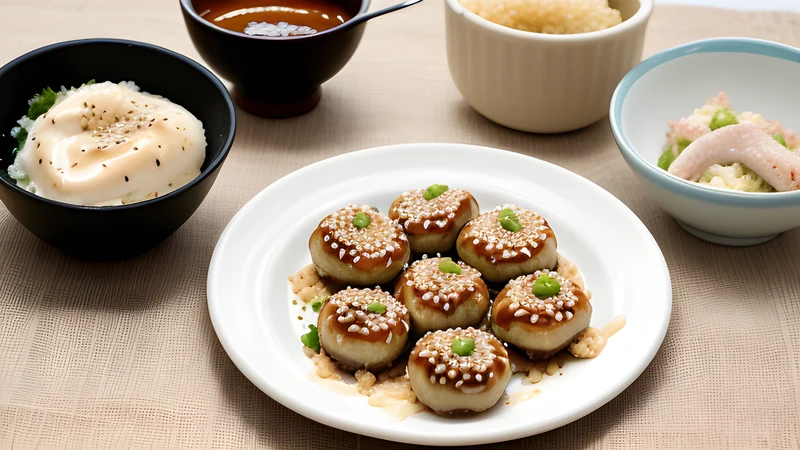
↓ Jump to recipeTakoyaki are the great street snack of Osaka: little spheres of savoury batter with a piece of octopus at the centre, cooked in a special dimpled pan, then crowned with sweet-salty sauce, a lattice of Kewpie mayonnaise and a drift of bonito flakes that curl and dance in the rising heat. The inside stays almost molten, so hot it will catch you out on the first bite. The clever thing is that the batter is loosened with dashi, which is what gives takoyaki their savoury, custardy centre rather than a stodgy one. You need a takoyaki pan, but beyond that they are pure fun to cook.
Takoyaki with Bonito and Kewpie
Ingredients
- 150g plain flour
- 2 large eggs
- 500ml cold dashi (from dashi powder or kombu and bonito)
- 1 tsp soy sauce
- 1/2 tsp fine salt
- 200g cooked octopus, cut into 1.5cm pieces
- 3 spring onions, finely sliced
- 2 tbsp pickled red ginger (beni shoga), chopped
- 2 tbsp tenkasu (tempura scraps), optional
- Neutral oil, for the pan
- Takoyaki or tonkatsu sauce, to serve
- Kewpie mayonnaise, to serve
- Bonito flakes (katsuobushi), to serve
- Dried aonori seaweed, to serve
Method
- Whisk 150g flour, 2 eggs, 500ml cold dashi, 1 tsp soy sauce and 1/2 tsp salt into a thin smooth batter about the consistency of single cream, pour into a jug and rest for 10 minutes.
- Have everything to hand at the pan: the octopus, spring onions, pickled ginger, tenkasu, oil and two skewers for turning.
- Heat the takoyaki pan over a medium-high flame until hot, then brush every hollow generously with oil, up the sides too.
- Pour the batter so the hollows overfill and it runs across the whole surface, drop a piece of octopus into each hollow, then scatter over spring onion, ginger and tenkasu.
- Cook undisturbed for 2-3 minutes until the underside sets and browns, then run a skewer around each ball and turn it a quarter turn, tucking the loose surface batter into the holes.
- Keep turning every minute or so, tucking in stray batter, until each ball builds into a round crisp sphere, about 8-10 minutes per batch.
- When they are round, deep gold and crisp, lift them out onto a plate.
- Brush with takoyaki sauce, zigzag over Kewpie mayonnaise, then scatter with bonito flakes and a pinch of aonori, and eat while blazing hot.
The story
Takoyaki were born in Osaka in 1935, and their inventor has a name: Tomekichi Endo, a street food seller whose stall gave rise to the dish. He was inspired by akashiyaki, an older egg-rich dumpling from the nearby city of Akashi that is dipped in dashi to eat, and by radioyaki, a filled batter ball of his own that used beef and konjac. When a customer told him that in Akashi they put octopus, tako, inside, Endo swapped his filling and takoyaki was set. The dish spread fast through Osaka’s food stalls and became, along with okonomiyaki, one of the twin pillars of the city’s proudly casual, flour-based street cooking known as konamon.
Osaka’s affection for takoyaki runs deep enough to be a point of civic identity. Many households own their own takoyaki pan, and a takoyaki party, where everyone gathers round a tabletop grill and cooks their own, is a common way to entertain friends. The dish travelled out across Japan and then the world, and the little octopus balls are now a fixture of festivals, night markets and food halls far from Osaka, though the locals will tell you, with some justice, that the best ones are still made at home or at a battered corner stall in their own city.
The finishing is half the pleasure. Takoyaki sauce is a thick, sweet, fruity brown sauce in the Worcestershire family; Kewpie is the cult Japanese mayonnaise, richer and tangier than Western versions because it uses only egg yolks and rice vinegar. The bonito flakes on top, shaved from a block of dried, smoked and fermented skipjack tuna, are so thin that the heat rising off the balls makes them writhe and wave, which never stops being a small thrill. Those same bonito flakes and that same dashi are the backbone of a whole style of Japanese cooking; you will meet the dashi again in a bowl of miso soup and the ponzu family, and the balls pair beautifully with a plate of edamame with chilli and sea salt and a citrusy dip of ponzu from scratch.
Getting the batter and the turn right
The two skills that make takoyaki are a thin, dashi-rich batter and the confidence to turn the balls. The batter should be genuinely thin, around the thickness of single cream, because a thin batter cooks into that loose, almost custardy centre that is the whole character of a good takoyaki; a thick batter sets into a dense dumpling. The dashi is doing the heavy lifting on flavour, so make it properly, whether from a good instant powder or from scratch with kombu and bonito.
The turn looks like sorcery the first time and becomes second nature by the third batch. The trick is to overfill deliberately, flooding the whole surface of the pan so there is spare batter to work with. Once the undersides have set, you cut each ball free with a skewer and rotate it a quarter turn, folding the surrounding sheet of batter down into the hollow as you go; that folded-in batter becomes the other half of the sphere. Keep turning and tucking every minute, and each ragged blob gradually rounds itself into a smooth ball. Getting the hollows properly oiled and hot before the batter goes in is what stops them sticking, which is the most common early frustration.
Tips and troubleshooting
If the balls stick and tear when you try to turn them, the pan was not hot enough or not oiled enough, or you tried to turn them before the underside had set. Give them the full 2-3 minutes first, brush oil right up the sides of each hollow, and use a metal skewer to run around the edge and free each one before you rotate it. Cast-iron takoyaki pans give the best browning; if you have a non-stick electric one, keep the heat a touch higher than feels necessary.
If the centres are raw and gluey rather than soft and molten, they simply needed longer over the heat, turning, to set the inside while the shell crisps. If they are dense and heavy, the batter was too thick, so loosen the next batch with a splash more dashi. Cut the octopus small enough, around a centimetre and a half, that a piece fits comfortably in each ball without stopping it rounding off.
Variations and serving
Octopus is traditional and gives that signature springy bite, but the format is generous. Small pieces of prawn, cheese, or cooked sausage all make good fillings if octopus is hard to find, though a takoyaki without tako is really a different snack. A little grated cheese added with the fillings gives an oozing centre that children love.
Serve takoyaki the moment they are dressed, six or eight to a plate, sauce and mayo still glossy and the bonito still moving. They wait for nobody; the crisp shell softens within minutes and the molten centre is at its best straight off the pan. Have cold drinks to hand, warn everyone that the first bite is lava, and cook in a relaxed, sociable batch the way Osaka intended. Leftover batter keeps a day in the fridge, so a second round is easy.
On dashi, and why it matters
It is tempting to skip the dashi and use plain water, and it is the one shortcut that will let a batch of takoyaki down. Dashi is the clear, savoury stock that underpins an enormous amount of Japanese cooking, made in its simplest form by steeping kombu seaweed and then bonito flakes in hot water for a few minutes. It carries the deep, mouth-filling savouriness that the Japanese call umami, and in a takoyaki batter that savour is what makes the soft centre taste of something rather than of wet flour. A good instant dashi powder, stirred into cold water, is entirely respectable and what most Osaka home cooks reach for on a busy day, so do not feel you must simmer kombu from scratch every time. What matters is that the liquid in the batter is dashi and not water. Make it a little stronger than you would for soup, since it is competing with flour, egg and the sauces piled on top, and taste the raw batter before you cook: it should taste pleasantly savoury and lightly salted on its own.
Related Content