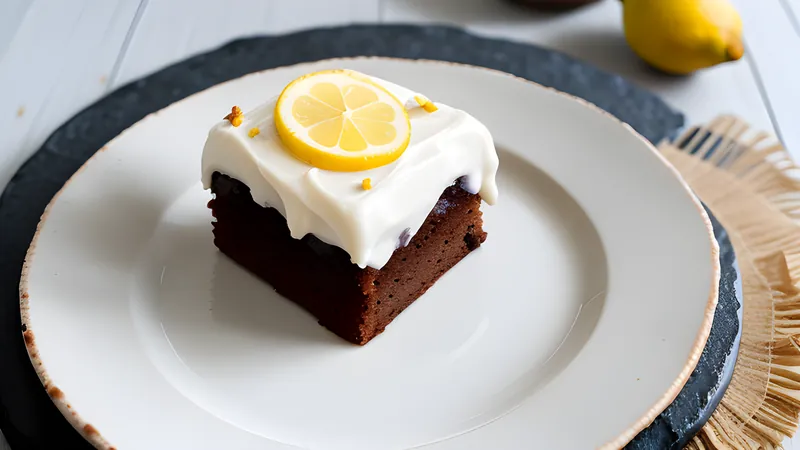
Sticky Ginger Cake with Lemon Icing
A dark treacle cake with three gingers and a crack of pepper
Contents
↓ Jump to recipeA good ginger cake is a dark, dense, sticky thing that improves with keeping, and it is one of the most forgiving cakes you can make. There is no creaming, no folding, no worrying about knocking out air; you melt, you mix, you pour and you bake, and what comes out is a deep brown, treacly, warming cake that gets better every day it sits in the tin. This is my version, spiced with three kinds of ginger and a crack of black pepper, and finished with a sharp lemon icing to cut all that sweetness.
Treacle, keeping and the north of England
Sticky ginger cake belongs to a broad family of British treacle cakes that includes parkin, the oatmeal-and-treacle cake traditionally eaten around Bonfire Night in Yorkshire and Lancashire, and the Jamaican ginger cakes sold in every corner shop. What they share is a reliance on black treacle and golden syrup, which do far more than sweeten. Treacle is the dark, bitter syrup left over from sugar refining, thick with minerals and a faint smokiness, and it is the source of the cake’s colour, its depth and, crucially, its keeping quality.
That last point is the secret of the whole genre. Treacle and syrup are hygroscopic, meaning they attract and hold water from the air, so a treacle cake actually gets moister and stickier as it sits, its flavour deepening and its crumb turning almost fudgy over two or three days. This is why traditional recipes tell you to bake parkin a week before you eat it. It is a cake designed for a time when baking day came once a week and everything had to last, and it rewards patience in a way most cakes do not. The same logic of deep, dark, keeping richness runs through a chocolate Guinness cake, where the stout and treacle do a similar job.
Sticky Ginger Cake with Lemon Icing
Ingredients
- 175g unsalted butter
- 175g dark brown soft sugar
- 175g black treacle
- 100g golden syrup
- 250g plain flour
- 2 tsp ground ginger
- 1 tsp ground cinnamon
- 0.25 tsp fine salt
- 0.25 tsp freshly ground black pepper
- 2 balls of stem ginger, finely chopped, plus 1 tbsp of the syrup
- 1 thumb (25g) fresh ginger, finely grated
- 1 tsp bicarbonate of soda
- 250ml whole milk
- 2 large eggs, beaten
- For the icing: 150g icing sugar, sifted
- 2 to 3 tbsp lemon juice
- Finely grated zest of 1 lemon
Method
- Heat the oven to 150C fan. Butter and line a 20cm square tin.
- Gently melt the butter, sugar, treacle and golden syrup in a pan until smooth, then cool for 10 minutes.
- Whisk the flour, ground ginger, cinnamon, salt and pepper in a large bowl. Stir in the chopped stem ginger and grated fresh ginger.
- Warm the milk to blood temperature, stir in the bicarbonate of soda, and it will froth.
- Pour the melted mixture, the frothy milk, the stem ginger syrup and the beaten eggs into the dry ingredients and whisk to a smooth, loose batter.
- Pour into the tin and bake for 45 to 55 minutes, until risen and firm and a skewer comes out clean.
- Cool completely in the tin. For the icing, mix the icing sugar with enough lemon juice to give a thick but pourable icing, then stir in the zest.
- Drizzle the icing over the cake and leave to set before cutting into squares.
Three gingers, and the pepper
Most ginger cakes rely on ground ginger alone, which gives warmth but not much life. I use three forms, because each does a different job. Ground ginger provides the deep, dusty background heat baked right through the crumb. Chopped stem ginger, the pieces preserved in syrup, gives little pockets of sweet, chewy, intense ginger that you bite into. And a thumb of fresh grated ginger brings a bright, almost lemony heat and a living pungency that dried ginger loses. Together they give the cake a layered warmth that builds rather than sitting flat.
The crack of black pepper is my quiet extra. Pepper and ginger share some of the same pungent compounds, and a quarter-teaspoon of freshly ground pepper in the batter settles into a slow, lingering heat at the back of the throat that makes the ginger feel warmer and more grown-up. It is the kind of thing people taste without being able to name, which is exactly what you want from a twist. Use it freshly ground, since pre-ground pepper has lost most of its aromatic oils. A single dried chilli flake or two, ground fine, does much the same job if you want to push the heat a shade further, though the pepper alone keeps it subtle enough for children who claim not to like ginger.
The low oven, and why the batter is so wet
This is a very loose, pourable batter, wetter than most cakes, and that is deliberate: all that liquid is what gives the finished cake its dense, moist, sticky crumb. The trade-off is that it needs a low oven and a long, slow bake, around 150C fan for the best part of an hour, so the centre cooks through before the sugary edges catch and burn. The high sugar and treacle content means the outside colours fast, so resist the urge to turn the heat up to hurry it along. Stirring the bicarbonate of soda into warm milk just before mixing gives the cake a head start on its rise and helps the treacle’s acidity work with the raising agent.
Storage and making ahead
This is the rare cake that positively demands to be made ahead. Wrap it, un-iced, in foil once completely cool and leave it for at least a day, ideally three, before icing and eating; it becomes stickier, darker and more intensely flavoured as it rests. It keeps for a good week in a tin and freezes well for up to three months. Ice it only once you are ready to serve, since the lemon icing is best fresh and crisp. If you like, you can serve squares warm with custard or cream as a pudding, in which case skip the icing altogether.
Variations
Fold in a handful of sultanas soaked in a little of the stem ginger syrup for extra chew, or a scatter of chopped crystallised ginger on top of the icing for people who want the heat turned up. A spoonful of black treacle swapped for the same amount of molasses makes it darker and more bitter still. For a festive version, add a teaspoon of mixed spice and the zest of an orange, and serve it alongside a spoon of the same lemon-sharp cream you would put on the elderflower cake, so the brightness plays against all that dark, sticky warmth.
Related Content