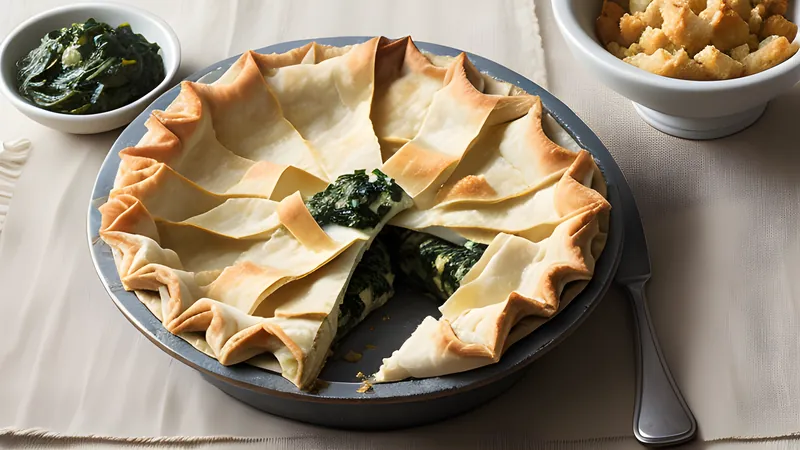
Spanakopita with Charred Spring Onion and Dill
Crisp filo, salty feta and spinach lifted by blistered spring onion and plenty of dill
Contents
↓ Jump to recipeSpanakopita succeeds or fails on one unglamorous step: squeezing every last drop of water out of the spinach before it goes anywhere near the filo. Get that right and the pastry shatters when you cut it; skip it and the whole pie steams itself soft from the inside before it even leaves the oven. This version keeps that discipline and adds one deliberate change — half the spring onion is charred hard in a screaming-hot pan before it joins the filling, so alongside the usual salty feta and grassy dill there is a smoky, faintly bitter note running through the pie that a purely raw allium filling never gets.
Spanakopita with Charred Spring Onion and Dill
Ingredients
- 2 bunches spring onions (about 12), trimmed and cut into 5cm lengths
- 3 tbsp olive oil, divided
- 900g fresh spinach, washed (or 500g frozen, thawed and squeezed dry)
- 200g feta, crumbled
- 100g ricotta
- 3 large eggs, beaten
- 20g fresh dill, chopped
- 0.25 tsp grated nutmeg
- Black pepper
- 0.5 tsp fine salt, plus more for wilting the spinach
- 270g filo pastry (about 12-14 sheets), thawed if frozen
- 120g unsalted butter, melted, for brushing
- 1 tbsp sesame seeds (optional)
Method
- Heat the oven to 190°C fan (210°C conventional / Gas 6-7).
- Heat 2 tablespoons of the olive oil in a wide, heavy frying pan over high heat until just smoking. Add the spring onion and leave undisturbed for 3 to 4 minutes until blackened in patches on one side, then toss and char for a further 2 to 3 minutes. Tip onto a plate to cool.
- In the same pan, wilt the spinach in batches with a pinch of salt over medium-high heat, 3 to 4 minutes per batch, until fully collapsed. Tip into a colander and cool slightly.
- Squeeze the wilted spinach in handfuls, or twist it hard in a clean tea towel, until no more liquid runs out — this can take a genuine 2 to 3 minutes and is the step that determines whether the filo stays crisp.
- Roughly chop the squeezed spinach and the charred spring onion.
- Combine the spinach, spring onion, feta, ricotta, dill, eggs, nutmeg, pepper and the 0.5 tsp salt in a large bowl and mix well.
- Brush a 23x33cm baking tin with melted butter. Lay a sheet of filo into the tin, letting it drape up the sides and over the edge, and brush with butter. Repeat with 6 to 7 more sheets, rotating the direction of the overhang so the whole tin is lined, brushing each sheet as you go.
- Spread the filling evenly over the filo base.
- Layer the remaining filo sheets over the top, brushing each one with butter, then fold the overhanging edges up and over the top layer and scrunch loosely to seal.
- Using a sharp knife, score the top layers of filo into 8 portions, cutting only through the top few sheets, not into the filling. Brush the top generously with the remaining butter and scatter with sesame seeds, if using.
- Bake for 40 to 45 minutes until deep golden brown and audibly crisp when tapped, and the filling is set.
- Rest for 15 minutes before cutting fully through along the scored lines and serving.
A pie that predates the modern pastry drawer
Spanakopita’s two defining ingredients, spinach and feta, have been paired in Greek cooking for a very long time, but the pastry-wrapped pie in its familiar form is really a product of the Byzantine and later Ottoman-era kitchen, where paper-thin stretched dough — the ancestor of modern filo, from the Greek word for “leaf” — was already established technique for both sweet and savoury pies across the Eastern Mediterranean and the Balkans. Village and home versions historically varied enormously by region and by what was growing that week: wild greens (horta) such as nettles, dandelion, sorrel and amaranth often stood in for or joined cultivated spinach, and the resulting pie, sometimes called hortopita, is still common in rural Greece, particularly in Epirus and on Crete, where foraged greens are prized above shop-bought ones.
Feta itself has protected designation of origin status within the EU, meaning only cheese made in specific regions of Greece from sheep’s milk, or a sheep-and-goat blend, from animals grazed on native pasture can legally carry the name — a reflection of how central the cheese is to Greek identity, not just to this one pie. Spanakopita is eaten at almost any time of day in Greece: as a substantial breakfast from a bakery counter, cut into small squares as party food, or as a full dinner alongside a salad, and it travels well cold, which is a large part of why it turns up so often at picnics, on ferries and packed into school bags.
Dill’s presence in the filling is not incidental either. It is one of the most widely used herbs in Greek and wider Eastern Mediterranean cooking, turning up in everything from tzatziki to stuffed vine leaves, and its slightly aniseed, grassy flavour cuts through feta’s salt and richness in a way that flatter herbs such as parsley cannot manage alone. Older regional recipes sometimes add a little mint alongside the dill, particularly in versions from the Peloponnese, though dill on its own, used generously rather than as a token sprinkle, is the more common choice and the one this recipe follows.
Why char the spring onion
Most spanakopita fillings use raw spring onion or a lightly sautéed regular onion for their allium backbone, gently sweated so it softens without taking on any colour. Charring half the spring onion hard, rather than gently cooking it, does something quite different chemically. High, direct, dry-ish heat on the cut surfaces of an allium triggers rapid Maillard browning and a degree of genuine pyrolysis at the blackened edges — the same reaction responsible for the flavour of a well-charred steak or the blistered skin on a good flatbread — which converts some of the onion’s naturally sharp, sulphurous compounds into sweeter, roasted, faintly smoky ones. The result tastes rounder and deeper than a raw or gently sautéed onion, with a bitter, smoky edge at the charred tips that plays beautifully against the salty richness of the feta and the bright, grassy lift of the dill.
It also changes the texture in the filling in a useful way: charred spring onion holds a little bite where a fully softened, sweated onion turns almost invisible once folded through wilted spinach. You get flecks of blackened green and white running through the filling rather than a uniform pale mass, and both the look and the occasional textural contrast make it read, correctly, as a more considered version of a very familiar pie.
Keeping the filo crisp
Filo’s whole appeal is shatteringly thin, crisp layers, and there are exactly two things that ruin that: too much moisture in the filling, and not enough fat between the sheets. Spinach, whether fresh or thawed from frozen, holds an astonishing amount of water — a kilogram of fresh spinach wilts down to a few hundred grams of leaves that still feel deceptively dry to the eye but are saturated with liquid. Squeezing it properly, in batches, twisted hard in a tea towel or pressed firmly in a sieve, is not optional; skip this step and that trapped water will steam the bottom layers of filo from underneath during baking, leaving you with a soggy base under a crisp top, which is the single most common spanakopita failure.
Butter between every sheet matters just as much. Filo sheets are separated by thin layers of air and fat, and it is that fat, rendered crisp in the oven’s heat, that gives each layer its shatter; an unbrushed sheet will stick to its neighbours and bake into a single dense, chewy mass rather than distinct crisp layers. Work reasonably quickly once the filo packet is open, since the sheets dry out and crack if left uncovered for more than a few minutes — keep the stack you are not currently using under a slightly damp tea towel, not directly on the pastry itself, which can make it soggy in patches.
Scoring the top layers of filo before baking, cutting only partway through, is a small trick that pays off twice: it lets steam escape from directly above the filling rather than building up and forcing the top layers to buckle, and it means you can cut the finished pie cleanly along those lines once it is baked, rather than fighting a solid crisp lid that shatters unpredictably under a knife.
How it is actually eaten
In Greece, spanakopita rarely appears as the single centrepiece of a meal in the way this rectangular tray version might suggest to a British table. It turns up cut into small squares alongside olives, a tomato salad and a block of feta drizzled with oil as part of a wider spread, or wrapped whole in paper from a bakery counter and eaten standing up on the way somewhere else. The large tray pie, baked in a rectangular tin the way this recipe does it, is the home and taverna version built for sharing and cutting into portions; village bakers more often shape individual spirals — a long rolled snake of filled filo coiled into a round tin — which bake with even more exposed, crisping surface area per portion, at the cost of being considerably fiddlier to make at home. Either shape rewards being eaten slightly warm rather than straight from the oven, since the filling needs the full 15-minute rest to set enough to hold a clean slice; cut it too soon and the feta and egg mixture will still run.
Tips, substitutions and storage
Frozen spinach works well here and is often more convenient — thaw it fully, then squeeze it exactly as hard as you would fresh, since it holds even more water once frozen and thawed. If ricotta is not to hand, a thick Greek yoghurt or extra crumbled feta both work, though the ricotta’s mildness is what keeps the filling from turning too salty when the feta itself is a strong one. Taste a small piece of your feta before adding the extra 0.5 tsp salt in the filling — some brands, particularly barrel-aged ones, are salty enough on their own that the pie needs none at all.
Spanakopita keeps well in the fridge for up to 3 days, covered loosely rather than tightly wrapped, which lets any residual steam escape rather than softening the crust; reheat squares in a hot oven or air fryer for 8 to 10 minutes rather than a microwave, which will turn the pastry rubbery. Unbaked, assembled spanakopita also freezes well for up to 2 months — freeze it whole in the tin, then bake straight from frozen, adding an extra 15 to 20 minutes to the cooking time. It is also a genuinely good make-ahead dish for entertaining: assemble it fully the morning of the day you plan to serve it, keep it covered and chilled, and bake it fresh that evening — the flavour if anything improves as the dill and charred onion have longer to sit against the feta.
Variations
A version with feta alone and no ricotta, upping the feta to 300g, gives a sharper, saltier pie that some cooks prefer — taste your feta first, since brininess varies a great deal by brand. Individual triangles (spanakopitakia), made by cutting single filo strips, spooning a tablespoon of filling at one end, and folding flag-style, make excellent freezer-friendly party food and bake in half the time. If the technique of layering and brushing thin pastry appeals, the same crisp-sheet discipline turns up in scallion pancakes with ginger-soy dip, where laminated dough rather than filo does the crisping, and in the folded, fried pastry of a vegetable samosa — different doughs, the same underlying rule that thin layers and enough fat between them are what make pastry crackle rather than chew.
Related Content