Spaghetti Puttanesca
Bold, briny and ready in twenty minutes
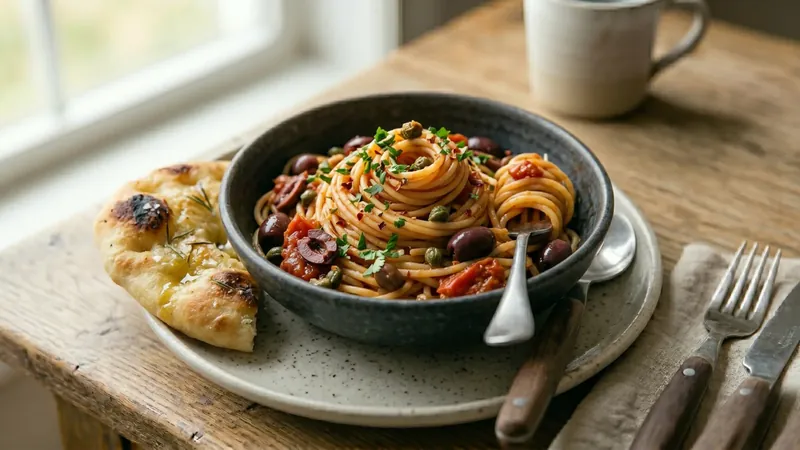
Puttanesca is the pasta sauce for nights when the cupboard looks bare but the appetite is loud. The twist that defines it is the trio of pantry strong-arms — black olives, capers and anchovy — melted with garlic and chilli into a tomato sauce that punches far above its humble ingredients. The anchovies dissolve completely, leaving no fishiness, only a deep savoury hum. No browning of meat, no long simmer; from cold pan to plate in about twenty minutes.
Spaghetti Puttanesca
Ingredients
- 400g spaghetti
- 4 tbsp extra-virgin olive oil
- 4 garlic cloves, thinly sliced
- 6 anchovy fillets in oil
- 0.5 tsp dried chilli flakes
- 2 tbsp capers, drained
- 100g pitted black olives, roughly chopped
- 400g tin chopped tomatoes
- Small bunch flat-leaf parsley, chopped
- Salt and black pepper, to taste
Method
- Bring a large pan of well-salted water to the boil and cook the spaghetti until just shy of al dente.
- Meanwhile, warm the olive oil in a wide frying pan over a medium-low heat.
- Add the sliced garlic, anchovies and chilli flakes, and cook gently, stirring, until the anchovies melt into the oil and the garlic turns pale gold.
- Stir in the capers and olives and cook for 1 minute to warm through.
- Pour in the chopped tomatoes, season with black pepper, and simmer for 8-10 minutes until thickened and glossy.
- Drain the spaghetti, reserving a mugful of pasta water.
- Add the spaghetti to the sauce with a splash of the reserved water and toss vigorously over the heat for 1-2 minutes until coated.
- Stir through most of the parsley, check the seasoning, and serve with the remaining parsley scattered over.
3 The Story
Spaghetti alla puttanesca is a relatively modern classic of southern Italian cooking, strongly associated with Naples and also claimed by the island of Ischia in the Bay of Naples. Most accounts place its rise in the mid-twentieth century, and while it feels timeless, it does not appear in the Italian record nearly as far back as many older regional dishes. The name is famously earthy — puttana is a coarse Italian word for a prostitute — and several colourful stories attach themselves to it, though none can be reliably confirmed and they are best treated as folklore.
What is not in doubt is the character of the dish. Puttanesca belongs to the southern Italian tradition of cucina povera, cooking born of thrift and the store cupboard. Its strength is that almost everything in it keeps for months: tinned tomatoes, olives, capers, anchovies, dried chilli and garlic. There is no need for fresh meat or a long-simmered ragù; the bold, salty, piquant flavours come entirely from preserved ingredients, which is precisely why it can be thrown together at a moment’s notice.
The three key flavourings each pull their weight. Olives, typically the small, dark, oil-cured varieties of the south, bring a meaty saltiness. Capers, the pickled or salt-packed flower buds of the caper bush that grows wild around the Mediterranean, add sharp, floral bursts. Anchovies are the secret engine: cooked gently in oil they dissolve entirely, leaving no recognisable fishiness but a profound savoury depth, the same umami trick that underpins many Italian sauces. A pinch of chilli lifts the whole thing.
A few points of technique make the difference. Cooking the garlic and anchovies low and slow lets the anchovies melt and the garlic sweeten without burning into bitterness. Finishing the pasta in the pan with a splash of starchy cooking water emulsifies the sauce so it clings to every strand rather than sliding off. And the dish needs little or no added salt — between the olives, capers and anchovies, it brings plenty of its own. Cheese is traditionally left off; the sauce is assertive enough to stand alone.
Related Content