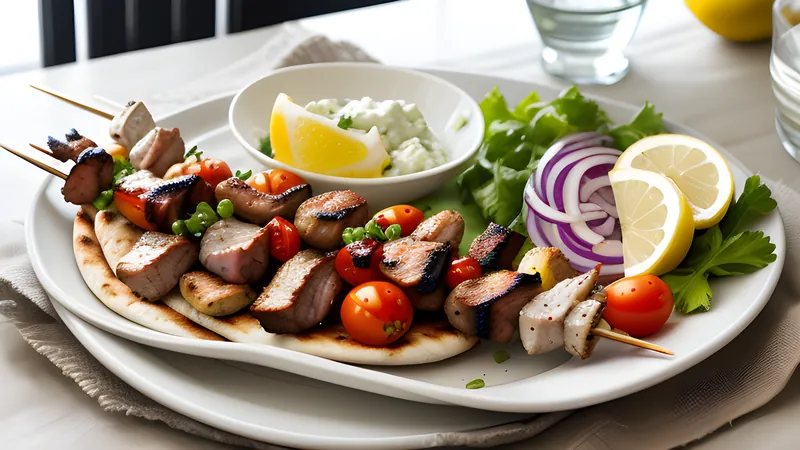
Souvlaki with Tzatziki and Charred Pitta
Marinated pork skewers, cool garlicky yoghurt, blistered bread
Contents
↓ Jump to recipeSouvlaki is Greek street food at its most honest: cubes of marinated meat on a stick, grilled hard over coals, and eaten either straight off the skewer or wrapped in warm pitta with yoghurt and salad. The word simply means “little skewer”, from souvla, a spit. There is nothing clever or precious about it, and that is exactly why getting it right matters — with so few components, every one has to pull its weight.
I ate a lot of this on a trip through the Peloponnese, from tavernas and from a man with a grill cart who wrapped each portion so fast his hands blurred. What struck me was how little the meat was messed about. Good pork, a sharp lemon-and-oregano marinade, fierce heat, and a char that tastes of smoke and caramel. Everything else on the plate is there to keep it company.
Souvlaki with Tzatziki and Charred Pitta
Ingredients
- 800g pork shoulder, cut into 3cm cubes
- 4 tbsp olive oil
- Juice of 1 lemon, plus wedges to serve
- 1 tbsp red wine vinegar
- 2 tbsp dried Greek oregano
- 4 garlic cloves, crushed
- 1 tsp honey
- 1 tsp sweet paprika
- 1.5 tsp sea salt
- 4 pitta breads
- 1 red onion, thinly sliced
- 2 tomatoes, sliced
- 300g Greek yoghurt (10% fat)
- half a cucumber, coarsely grated and squeezed dry
- 1 small garlic clove, grated (for the tzatziki)
- 1 tbsp olive oil and a squeeze of lemon (for the tzatziki)
Method
- Mix the olive oil, lemon juice, vinegar, oregano, crushed garlic, honey, paprika and salt in a bowl. Add the pork cubes, turn to coat, cover and marinate in the fridge for at least 2 hours, ideally overnight. Soak wooden skewers in water if using.
- Make the tzatziki: grate the cucumber, salt it lightly and squeeze out as much water as you can. Stir it into the yoghurt with the grated garlic, olive oil and lemon. Chill until needed.
- Thread the pork onto skewers, packing the cubes snugly but not crushed together. Heat a griddle pan, barbecue or grill to high.
- Grill the skewers for 10 to 12 minutes, turning every few minutes, until charred at the edges and cooked through (75C at the centre). Rest for 5 minutes.
- Warm the pitta on the grill for 30 seconds a side until blistered and pliable, brushing lightly with the marinade-oiled pan juices.
- Slide the pork off the skewers into the pitta, add tzatziki, red onion, tomato and a squeeze of lemon, and wrap.
Pork, chicken or lamb — and why the cut matters
In Greece, souvlaki most often means pork, which is cheap, flavourful and stays juicy over live fire. Chicken thigh and lamb are common too. Whatever you choose, use a cut with some fat and connective tissue running through it: pork shoulder over loin, chicken thigh over breast, lamb from the leg or shoulder. Lean cuts turn to sawdust on a hot grill in the time it takes to char the outside, while a fattier cut bastes itself and forgives a few extra seconds over the flame.
Cut the meat into even 3cm cubes. Too small and they overcook before they colour; too large and the outside chars while the middle stays raw. Even sizing is the unglamorous secret to skewers that cook uniformly.
The marinade, and a spoonful of honey
The classic marinade is olive oil, lemon, oregano and garlic, and you could stop there and eat very well. My twist is a single teaspoon of honey. It does not make the meat sweet; it gives the sugars something extra to caramelise, so the char comes faster and darker and carries a faint smoky-sweet edge that reads as proper grill flavour. A little paprika deepens the colour in the same way. It is the same instinct behind the honey glaze on so many grilled meats — a touch of sugar is a shortcut to browning.
One warning about the lemon: acid is a double-edged tool. A couple of hours to overnight is perfect, and the flavour penetrates and the surface tenderises. Push it to a day and a half and the acid starts to “cook” the surface of the pork and turn the texture mealy. If you want to marinate for longer than a night, hold the lemon back and add it only in the last two hours.
Dried Greek oregano, not fresh, is the right choice here — its concentrated, almost peppery pungency is central to the flavour, and fresh oregano simply burns off on the grill.
Tzatziki that is not watery
Tzatziki is where most home versions fall down, and the fault is always the same: water. Cucumber is mostly water, and if you grate it straight into the yoghurt you get a thin, sloppy sauce within the hour. Salt the grated cucumber, let it sit for a few minutes, then squeeze it hard in a clean cloth or your hands until it is almost dry. Only then fold it into thick, strained Greek yoghurt with grated raw garlic, a little olive oil and lemon. The result should sit up on a spoon, cool and sharp and unapologetically garlicky. Make it ahead — an hour in the fridge lets the garlic mellow and the flavours marry.
Use full-fat Greek yoghurt (10% is ideal). Low-fat versions are looser and sourer and cannot carry the garlic.
Grilling for char without drying out
High heat is the whole game. You want the meat close to the coals or the griddle screaming hot, so the outside chars in the same window that the inside just reaches done. Thread the cubes snugly together but not crushed — a little air between them lets the heat catch the sides. Turn every few minutes to build colour on all faces. Pork is ready at 75C in the centre; if you do not have a thermometer, cut into a cube and look for just-cooked, faintly juicy flesh with no pink.
Rest the skewers for five minutes off the heat. Even little cubes benefit, redistributing their juices so the first bite is not dry.
Then char the pitta. Thirty seconds a side on the hot grill blisters it, makes it pliable, and gives it a toasty edge that a soft warm pitta from the toaster never has. Brush it with a little of the oily pan juices as it toasts.
Building the wrap and what else to serve
Slide the pork off the skewer into the middle of the pitta, add a good stripe of tzatziki, a tangle of thinly sliced red onion, tomato, and a squeeze of lemon. Some cooks add chips inside the wrap, Greek-style, and I am not going to talk you out of it. Roll it tight in paper and eat immediately.
Souvlaki makes a natural centrepiece for a bigger Greek table. Pair it with kleftiko: Greek slow-baked lamb in paper for a slow-and-fast contrast, or with halloumi and vegetable traybake with harissa to keep the vegetarians as happy as everyone else. A sharp tomato-and-feta salad and a bowl of olives finish it.
Souvlaki, gyros and a note on names
It is worth clearing up a confusion, because the two get muddled abroad. Souvlaki is skewered cubes grilled over fire. Gyros is meat stacked on a vertical rotisserie, slow-roasted and shaved off in shards. Both get wrapped in pitta with the same tzatziki, onion and tomato, which is why the wraps look near-identical, but the meat and the method are different animals. In parts of northern Greece “souvlaki” even refers to the wrap itself while the skewers are called kalamaki, “little reed”, after the thin sticks. None of this changes how you cook it; I mention it only so that when a Greek friend corrects your vocabulary, you can nod along knowingly and pass the lemon.
Make-ahead, storage and troubleshooting
- Marinate ahead, up to overnight, but hold the lemon if you want to go longer, or the pork goes mealy.
- Tzatziki watery? You did not squeeze the cucumber. Salt it, wait, wring it out hard. Every time.
- Meat dry? Either too lean a cut or overcooked. Fattier cut, fiercer heat, shorter time, and rest it.
- No grill or barbecue? A cast-iron griddle pan on the hottest burner gets you 90% of the way — get it smoking before the meat goes on.
- Leftovers reheat poorly on the grill but are excellent chopped cold into a rice or grain bowl with the leftover tzatziki thinned into a dressing.
- Chicken version: swap the pork for boned thigh, add a pinch more paprika, and grill a couple of minutes less; it chars beautifully and suits a lighter summer plate.
- Drink it with a cold Greek lager, a chilled Assyrtiko, or an ouzo over ice if the sun is out and nobody is driving.
Souvlaki is proof that a short list of good ingredients, treated with respect and fierce heat, beats a long one every time. Get the char right, get the tzatziki thick, blister the bread, and you have a taverna in your kitchen.
Related Content