Sopa de Lima: Yucatan's Lime-and-Tortilla Soup
A turkey broth built around Seville-orange-sharp lima agria and fried tortilla strips
Contents
↓ Jump to recipeSopa de lima is built around a fruit that doesn’t really exist outside the Yucatan Peninsula: lima agria, a wrinkled, thin-skinned citrus that tastes closer to a bitter, faintly floral Seville orange than to the limes sold in most supermarkets outside Mexico. It’s the defining flavour of the region’s most famous soup, and since lima agria is essentially impossible to find outside Yucatan, every version made elsewhere - this one included - is a workaround using regular limes, sometimes stretched with a little orange juice or zest to approximate that particular bitter-floral note. The soup’s roots reach back to Maya cooking on the peninsula long before Spanish contact, when turkey, chilli and citrus were already staples of the local diet; the version eaten today, thickened with fried wheat- or corn-based garnishes and given its name from the specific lima agria tree that grows almost nowhere else, is a Yucatecan dish through and through, distinct from the tomato-forward soups more familiar from central Mexican cooking.
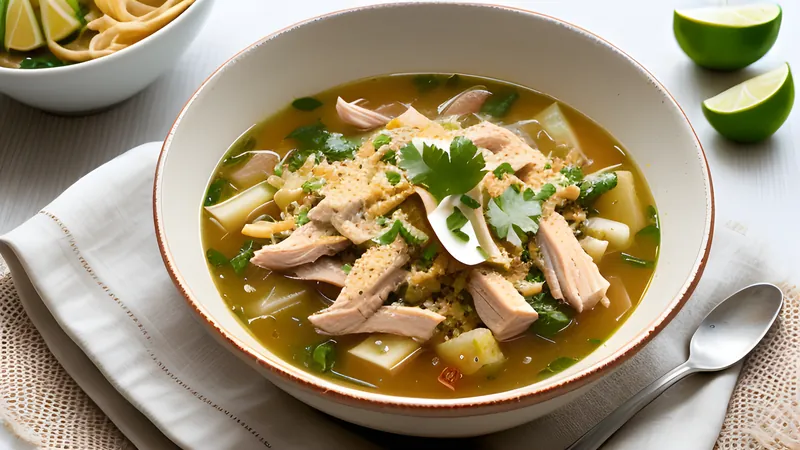
The soup itself is a turkey or chicken broth, spiced simply with garlic, oregano and cumin, given real heat from a whole habanero simmered in rather than chopped through, and finished with a citrus hit strong enough to lift the whole bowl. Crisp fried tortilla strips are stirred in at the table, not cooked into the broth, so they stay crunchy against the hot liquid rather than turning soft the way a dumpling or noodle would.
Sopa de Lima: Yucatan's Lime-and-Tortilla Soup
Ingredients
- 6 corn tortillas, cut into 1 cm strips
- Vegetable oil, for frying (about 300 ml)
- 500 g boneless, skinless chicken thighs
- 1.4 litres chicken stock
- 1 white onion, half sliced thin and half left whole
- 1 green pepper, half diced small and half left whole
- 3 garlic cloves, 2 crushed and 1 whole
- 1 tsp dried oregano (Mexican if available)
- 1/2 tsp ground cumin
- 1 whole habanero or Scotch bonnet chilli, pricked once with a knife
- 2 tbsp olive oil
- 400 g tinned chopped tomatoes
- Juice of 3 limes (about 90 ml), plus 1 extra lime, sliced thin, to serve
- Sea salt, to taste
- 1 ripe avocado, sliced
- 40 g queso fresco or feta, crumbled
- 2 tbsp chopped fresh coriander
Method
- Heat 2 cm of vegetable oil in a frying pan to 180C. Fry the tortilla strips in batches for 1-2 minutes until golden and crisp. Drain on kitchen paper and salt immediately.
- Put the chicken thighs into a pot with the stock, the whole onion half, the whole pepper half, the whole garlic clove and the whole chilli. Bring to the boil, skim, then simmer for 20 minutes until the chicken is cooked through.
- Lift out the chicken, chilli, onion and pepper. Strain the stock and set aside. Shred the chicken once cool enough to handle. Finely chop the cooked chilli if you want more heat in the finished soup, or discard it for a milder result.
- Heat the olive oil in the empty pot over medium heat. Add the sliced onion and diced pepper and cook for 6 minutes until softened. Add the crushed garlic, oregano and cumin and cook for 1 minute until fragrant.
- Add the tinned tomatoes and cook for 5 minutes, breaking them up, until slightly reduced.
- Pour in the reserved stock and bring to a simmer for 10 minutes to let the flavours combine.
- Return the shredded chicken to the pot and warm through for 3-4 minutes. Stir in the lime juice off the heat - don't let it boil again once the lime is in, or the flavour turns dull and bitter.
- Season with salt to taste. Ladle into bowls and top generously with the fried tortilla strips, avocado slices, crumbled cheese, coriander and a slice of fresh lime.
The tortillas are a garnish with a job
Unlike the vermicelli in a Moroccan harira or the rice in avgolemono, the fried tortilla strips in sopa de lima aren’t there to thicken the broth - they’re a textural counterpoint, added at the very last moment so they stay audibly crisp against the hot liquid for as long as it takes to eat the first few spoonfuls. That’s a deliberate structural choice worth understanding before you improvise on the recipe: don’t simmer the tortillas in the soup itself, however tempting it is to save a step, since they’ll turn soft and starchy within minutes and lose the entire point of frying them in the first place.
Fresh corn tortillas fry up better than the thicker, chewier flour tortillas more common outside Mexico - corn tortillas are naturally thinner and drier, which means they crisp quickly in hot oil rather than absorbing it and turning greasy. If corn tortillas aren’t available, tortilla chips from a bag are a genuinely reasonable substitute; many Yucatecan cooks use exactly that shortcut at home rather than frying strips fresh every time.
Building heat without losing the broth’s clarity
Simmering a whole habanero or Scotch bonnet in the stock, rather than chopping it in from the start, gives you control over the final heat level that you don’t get any other way. The chilli releases a background warmth into the broth as it simmers whole, skin intact but pricked once so a little of the capsaicin escapes, without flooding the soup with seeds and membrane that would make the heat unpredictable and hard to dial back once it’s in.
Fishing the chilli out after the initial 20-minute simmer and tasting the broth at that point tells you exactly where you stand. If you want more heat, finely chop a small piece of the cooked chilli - discarding the seeds if you want to keep it milder - and stir it back in during the final stages. If the background warmth is already right, leave it out entirely. This two-stage approach means you’re never stuck with a soup that’s hotter than the table wants, which is a real risk with a chilli this potent chopped in raw from the start.
Habanero and Scotch bonnet are close enough in heat and fruitiness that either works here, and most recipes, including this one, treat them as interchangeable. The real difference is shape and origin rather than flavour: habanero is lantern-shaped and slightly more common in Yucatecan cooking specifically, given the peninsula’s proximity to habanero-growing regions of the Caribbean and southern Mexico, while Scotch bonnet, squatter and slightly sweeter, is the Caribbean’s own version of a very close relative. Either will register somewhere around 100,000 to 350,000 Scoville units, roughly ten times hotter than a jalapeño, which is exactly why simmering it whole rather than chopping it in matters so much for a dish meant to be eaten by a whole table with different heat tolerances.
Where the citrus comes from, if not lima agria
Regular limes, used generously, get you most of the way to the sharp, slightly bitter profile lima agria provides, but a few tricks close the gap further. A little orange zest, added along with the lime juice, mimics some of the floral note lima agria carries that ordinary limes lack entirely. Some cooks outside Yucatan use a small amount of grapefruit juice alongside the lime for a similar bitter edge, a modern stand-in that’s worth trying if you want to chase the specific flavour more closely.
Whatever citrus combination you land on, add it off the heat, right at the end. Boiling lime juice for any length of time cooks out its brightness and can turn faintly bitter and dull in a way that undermines the entire point of the soup - this is the single most common mistake in home versions of sopa de lima, and it’s an easy one to avoid simply by remembering that the lime goes in last, after the pot’s been taken off the stove.
The pot the whole aromatics build
Simmering half an onion, half a pepper and a whole garlic clove directly in the poaching liquid, rather than chopping everything from the start, is a technique worth borrowing for other broths too. Whole or large pieces of aromatic vegetable release their flavour more slowly and cleanly into a poaching liquid than finely chopped ones do, without breaking down into the broth and clouding it — you get a clear, well-flavoured stock to build the second stage of the soup on, rather than one already muddied by softened onion fragments. Discard the spent onion and pepper once you’ve strained the stock; they’ve given up what they had to give and have nothing left worth eating.
This two-stage method — poach whole aromatics for a clean stock, then build a proper sofrito of finely diced vegetables separately for the body of the soup — is common across a lot of Mexican and Central American cooking, and it’s worth remembering any time a recipe asks for stock built from raw chicken or turkey rather than a carton. The extra ten minutes of poaching pays for itself in a broth with genuine depth rather than one that simply tastes of whatever seasoning you dumped in afterwards.
Turkey versus chicken
Traditional Yucatecan sopa de lima is often made with turkey rather than chicken, reflecting the peninsula’s strong culinary connection to turkey more broadly - it appears across the region’s cooking in ways it doesn’t in most of the rest of Mexico. Turkey thigh, simmered the same way as the chicken thighs here, gives a slightly deeper, more savoury broth, and it’s worth trying if you can get hold of turkey thighs or a turkey carcass to build the stock from. Chicken thighs are the easier substitute for most kitchens outside Mexico and give a very good result in their own right; this recipe uses chicken specifically for that reason.
Serving and toppings
The toppings aren’t optional extras so much as part of the dish’s structure - avocado for creaminess against the sharp broth, crumbled cheese for a salty edge, coriander for freshness, and a fresh lime slice on the side for anyone who wants to sharpen their own bowl further at the table. Serve everything separately in small bowls if you’re feeding a group, so people can build their own bowl to taste rather than everyone getting an identical amount of chilli heat and citrus. This build-your-own-bowl approach runs through a lot of Mexican soup cookery — pozole is served exactly the same way, with shredded cabbage, radish, oregano and lime handed round separately rather than stirred in by the cook — and it exists for a practical reason as much as a hospitable one: a soup finished at the table, rather than in the pot, lets every diner control their own final balance of heat, acid and richness without the cook having to guess at everyone’s preference in advance.
Storage and make-ahead
The broth keeps well in the fridge for up to four days and freezes for up to three months - make a double batch of just the soup base and freeze in portions, since it reheats cleanly with none of the egg-based fragility of avgolemono or chikhirtma. Keep the tortilla strips, avocado and cheese separate and add them fresh at serving time regardless of whether the broth is freshly made or reheated from the freezer; none of the three keep or reheat well once combined with hot liquid.
If you want to get ahead for a dinner party, the broth stage through adding the tomatoes can be made up to two days in advance and kept in the fridge, with the shredded chicken stirred back in and warmed through just before serving — the lime, as always, goes in last, off the heat, no matter how far ahead the rest of the pot was made. Frying a large batch of tortilla strips ahead of time and storing them in an airtight container at room temperature, rather than the fridge, keeps them crisp for a day or two; refrigeration introduces moisture that softens them almost immediately.
For another soup where citrus is doing structural, not decorative, work, see Avgolemono: Greece’s Silky Egg-and-Lemon Soup. And for another legume-and-broth soup built to feed a crowd on a modest budget, see Harira: Morocco’s Ramadan Soup, Any Night.
Related Content