Som Tam: Green Papaya Salad
The pestle does the work a knife never could
Contents
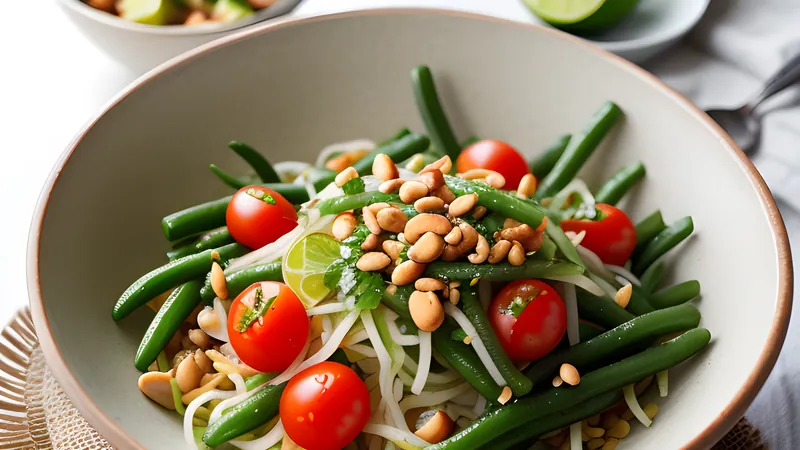
↓ Jump to recipeSom tam is built with a clay mortar and a wooden pestle, and that single fact changes the texture and the flavour of the finished salad more than any ingredient swap could. This version keeps to the pestle technique because it is the whole point of the dish: bruising the shredded papaya so it drinks up a dressing that clings rather than pools at the bottom of the bowl.
Som Tam: Green Papaya Salad
Ingredients
- 300g green (unripe) papaya, peeled and shredded into fine matchsticks
- 2 cloves garlic, peeled
- 2 to 6 bird's eye chillies, to taste
- 8 to 10 yardlong beans (or fine green beans), cut into 4cm lengths
- 8 cherry tomatoes, halved
- 1 tbsp dried shrimp, plus extra to garnish (optional)
- 1 tbsp grated or chopped palm sugar
- 2 tbsp fish sauce
- 2 to 3 tbsp lime juice (about 2 limes)
- 2 tbsp roasted peanuts, roughly crushed
Method
- Peel the green papaya, halve it and scrape out the pale seeds, then shred the flesh into fine, long matchsticks on a mandoline, box grater, or with a knife, and keep it in cold water until needed.
- In a large mortar, pound the garlic and chillies together with the pestle until broken down into a rough, fragrant paste, about 30 seconds.
- Add the beans and bruise them with 6 to 8 firm downward strikes, turning them, until they soften slightly and split; do not pulverise them to mush.
- Add the dried shrimp and lightly pound to break it up, then add the palm sugar and pound and press until it dissolves into the paste.
- Add the fish sauce and lime juice and stir with the pestle to combine into a loose dressing, tasting and adjusting the balance of salty, sour and sweet.
- Add the drained papaya and the halved tomatoes, and use the pestle in one hand and a large spoon in the other to pound and toss together, turning the salad over on itself 15 to 20 times so the dressing coats every strand.
- Taste and adjust with more lime, fish sauce or sugar as needed, then tip into a bowl, scatter with crushed peanuts and extra dried shrimp, and serve immediately with sticky rice.
Isaan’s salad, everywhere now
Som tam comes from Isaan, the vast, dry plateau of northeastern Thailand that borders Laos, and its cooking has a character distinct from the softer, coconut-rounded food of central Thailand: sourer, saltier, hotter, built around sticky rice, grilled meats and fermented fish rather than curry pastes. Som tam is the plateau’s signature dish, and its name is a plain description of what happens to it — som means sour, tam means to pound. It is eaten everywhere in Isaan, from roadside carts with a mortar the size of a bucket to family kitchens, almost always alongside grilled chicken (gai yang) and glutinous rice eaten by hand.
The dish followed Isaan migrants to Bangkok in the twentieth century as the region sent workers to the capital in search of jobs, and it took hold there so completely that most visitors now meet som tam as a Bangkok street-food staple rather than a regional import. Laos claims a close cousin — tam mak hoong — built the same way with the same pestle technique, and the border between the two dishes is more a matter of national pride than real culinary difference; Isaan and Laos share a language, a rice culture and a mortar-and-pestle tradition that long predates the modern border between them.
What travelled less well in translation is the fermented fish. Traditional Isaan versions often include a splash of pla ra, a pungent fermented fish sauce far more assertive than the clear fish sauce sold internationally, along with the dried shrimp. Most versions cooked outside Isaan, including this one, lean on fish sauce and dried shrimp for that savoury backbone, because pla ra is a genuinely challenging ingredient to source and to like on first meeting. If you can find it, a teaspoon stirred in with the fish sauce gets you closer to the version served on plastic stools at a Khon Kaen night market.
Why the mortar matters
A knife slices cleanly through a papaya shred and leaves the surface smooth and sealed. A pestle does something different: it bruises and cracks the fibres of the papaya and beans, opening up thousands of tiny fractures along their length. Dressing poured over knife-cut vegetables mostly sits on top and drips away. Dressing pounded into cracked, bruised vegetables gets forced into those fractures and held there, so every strand carries its share of salt, sour and heat instead of leaving it puddled in the bowl.
The order of operations in the mortar matters as much as the pounding itself. Garlic and chillies go in first and are broken down into a paste on their own, because if they went in with the papaya they would just bounce around loose rather than release their oils properly against the hard walls of the mortar. The beans go in next and get real force — the aim is bruised, split beans that stay in recognisable pieces with a bit of crunch, popping slightly under the teeth. Dried shrimp is pounded gently to open it up and release its savoury depth, and the palm sugar is worked in with pressure rather than sharp strikes, since sugar needs crushing and dissolving more than pounding.
Only once the dressing base is built does the papaya go in, and from that point the technique changes from pounding to tossing. You use the pestle in one hand to press and bruise while a large spoon in the other lifts and turns the salad from the bottom, over and over, so everything moves through the dressing at the base of the mortar. This is closer to a folding motion than a hammering one. Overdo the pounding at this stage and you get mush; underdo it and the dressing never penetrates. Twenty firm turns is usually the right amount for 300g of papaya.
If you do not own a Thai-style clay mortar and wooden pestle, a large, heavy stone or granite mortar will do the job — what matters is weight and a rough interior. A food processor cannot substitute for this step; it slices and shreds when the dish needs bruising and crushing, and the texture difference is obvious in the finished salad.
The recipe
Serves 2 as a light main with sticky rice, or 4 as a side salad.
Peel and halve a 300g wedge of green papaya, scrape out the pale, undeveloped seeds, and shred the flesh into fine, long matchsticks — a mandoline fitted with a julienne blade is the fastest route, though a box grater or a sharp knife works too. Keep the shreds in a bowl of cold water while you prepare everything else, both to stop them browning and to keep them crisp.
In a large mortar, pound 2 peeled garlic cloves with 2 to 6 bird’s eye chillies (start conservative — you can always add more heat, but you cannot take it away) until they break down into a rough, fragrant paste, about 30 seconds of steady pounding. Add 8 to 10 yardlong beans cut into 4cm lengths and bruise them with 6 to 8 firm downward strikes, turning the mortar or the beans between strikes so they bruise evenly and just begin to split.
Add 1 tablespoon of dried shrimp and pound lightly to break it up, then add 1 tablespoon of grated palm sugar and press and pound until it dissolves into the paste at the bottom of the mortar. Pour in 2 tablespoons of fish sauce and 2 to 3 tablespoons of lime juice, and stir everything together with the pestle. Taste the dressing on a spoon: it should hit sour first, then salty, with sweetness rounding it out and chilli heat threading through. Adjust now, before the papaya goes in, because it is much harder to correct once the salad is assembled.
Drain the papaya well, add it to the mortar along with 8 halved cherry tomatoes, and pound and toss with the pestle-and-spoon motion described above, turning the salad 15 to 20 times so the dressing works into every strand. Taste again and adjust with more lime, fish sauce or sugar. Tip the finished salad into a serving bowl, scatter over 2 tablespoons of roughly crushed roasted peanuts and a few more dried shrimp if you like, and serve at once — som tam does not wait, and the papaya softens and weeps liquid if it sits.
Getting the balance right, and what to swap
Som tam runs on four flavours held in tension: sour from the lime, salty from the fish sauce, sweet from the palm sugar and hot from the chillies. There is no fixed ratio, because the sourness of a lime and the saltiness of a fish sauce brand both vary, so taste and adjust at every stage rather than trusting a formula blindly. If you want a reliable starting point, aim for lime and fish sauce in roughly equal measure with about half as much sugar, then push whichever direction your palate wants.
If you cannot find true green papaya, a firm, unripe green mango or a coarsely grated carrot and unripe green tomato mixture gets you a passable stand-in, though the texture is never quite identical — papaya’s fibrous crunch is genuinely its own thing. Palm sugar can be swapped for light brown sugar in a pinch, though it loses a faint caramel note. For a vegetarian version, drop the dried shrimp and use a vegetarian fish sauce or extra soy sauce plus a little extra lime for tartness.
Som tam does not keep. The dressed salad turns watery within an hour as the salt draws liquid out of the papaya, so pound it to order and eat it fresh. The shredded, undressed papaya can sit in cold water in the fridge for a day if you want to prep ahead, and the garlic-chilli-shrimp-sugar base can be pounded a couple of hours in advance and kept covered at room temperature.
Variations worth trying
Som tam Thai is the plain version above, built for balance across all four flavours. Som tam pla ra swaps in fermented fish sauce for a deeper, funkier, more traditionally Isaan result — start with just a teaspoon, since it is powerful. Som tam poo, crab som tam, adds pickled or salted field crab pounded in with the shells for a briny intensity that is an acquired taste even in Thailand, so it is worth a try only once you know you like the base salad.
Serve it the way it is served on its home turf: alongside grilled chicken, sticky rice eaten by hand, and something cooling to counter the chilli. It sits well on a table next to a bowl of larb, another Isaan classic built on balance and crunch, or ahead of a khao soi if you want a full spread of Thai regional cooking that ranges from the sour, punchy northeast to the coconut-rich north.
Related Content