Singapore Noodles with Prawns and Char Siu
Curried vermicelli, wok-tossed and vibrant
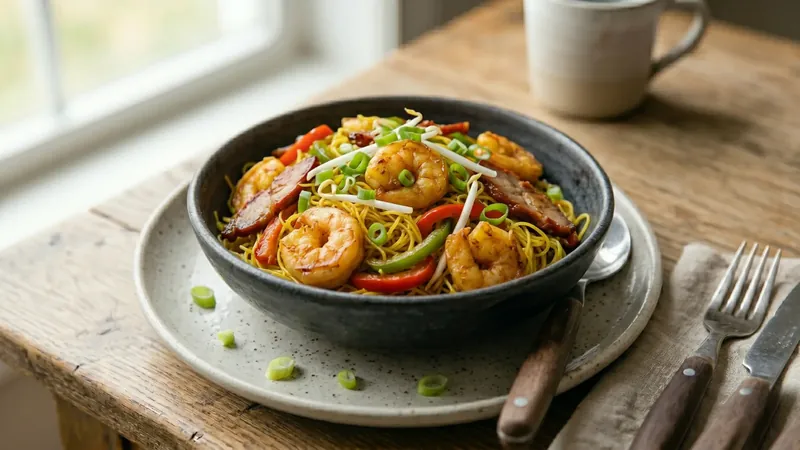
Singapore noodles are a takeaway favourite that rewards a confident wok: springy rice vermicelli stained gold with curry powder, studded with prawns, char siu and crunchy vegetables. The twist is treating the spice properly, toasting the curry powder and turmeric first so they bloom into something warm and rounded rather than dusty. Quick to cook once everything is prepped, this is a bright, vibrant plate of noodles with plenty going on in every forkful.
Singapore Noodles with Prawns and Char Siu
Ingredients
- 200g dried thin rice vermicelli
- 2 tbsp mild curry powder
- 1 tsp ground turmeric
- 3 tbsp neutral oil
- 2 eggs, beaten
- 200g raw king prawns, peeled
- 150g char siu (Chinese barbecue pork), thinly sliced
- 1 onion, thinly sliced
- 1 red pepper, thinly sliced
- 2 garlic cloves, finely chopped
- 1 tbsp grated fresh ginger
- 100g beansprouts
- 3 spring onions, cut into batons
- 2 tbsp soy sauce
- 1 tbsp Shaoxing wine
- 1 tsp caster sugar
- 1 tsp toasted sesame oil
Method
- Soak the rice vermicelli in just-boiled water for 3-4 minutes until pliable, then drain well and set aside.
- Toast the curry powder and turmeric in a dry wok over a low heat for 30 seconds until fragrant, then tip out and reserve.
- Heat 1 tbsp of the oil in the wok over a high heat, pour in the eggs, scramble lightly and remove.
- Add another tbsp of oil and stir-fry the prawns for 1-2 minutes until just pink, then remove.
- Add the last of the oil and stir-fry the onion, pepper, garlic and ginger for 2 minutes.
- Sprinkle in the toasted spices and stir for 30 seconds to coat the vegetables.
- Add the drained noodles, char siu, soy sauce, Shaoxing wine and sugar, tossing constantly to coat everything evenly.
- Return the eggs and prawns to the wok, add the beansprouts and spring onions and toss for 1 minute until hot through.
- Finish with the sesame oil and serve straight away.
3 The Story
Singapore noodles are one of those dishes whose name is more a flag of convenience than a statement of origin. Despite the title, they are not a staple of Singapore’s own hawker centres, where the local noodle dishes go by quite different names. Instead, the dish as most people know it grew up in the Cantonese kitchens of Hong Kong and the wider Chinese diaspora, and it became a fixture on Chinese restaurant and takeaway menus across Britain and beyond. The “Singapore” label seems to have been chosen to evoke something exotic and South-East Asian, gesturing at the curry-spiced character of the dish.
The defining feature is the curry powder, which is unusual in Cantonese cooking and gives the noodles their signature golden colour and gentle warmth. Curry powder itself is a product of cultural exchange, a blended spice mix popularised through trade routes, and its appearance here speaks to the cross-pollination of cuisines that has always run through port cities and migrant kitchens. The vermicelli are fine rice noodles, soaked rather than boiled hard so they stay separate and springy when tossed in the wok.
Toasting the spices before they hit the pan is the small refinement that lifts a home version above a flat, powdery one. A brief dry-toast in the wok wakes up the aromatic oils in the curry powder and turmeric, softening any raw edge and bringing out a deeper, more rounded flavour. It takes only seconds and should be watched closely, as ground spices catch and turn bitter quickly.
The classic combination of ingredients is part of the appeal: prawns for sweetness, char siu, the lacquered Cantonese barbecue pork, for savoury richness, and a tangle of egg, onion, pepper and beansprouts for colour and crunch. Good Singapore noodles are about speed and high heat, so the most important preparation is having everything sliced, soaked and lined up before the wok gets hot. Cooked fast and tossed constantly, the noodles stay light and separate, each strand coated in spice. It is a generous, cheerful plate of food, and once the mise en place is done, it is on the table in minutes.
Related Content