Scotch Eggs with a Runny Yolk
Crisp sausage shell, soft-jammy centre
Contents
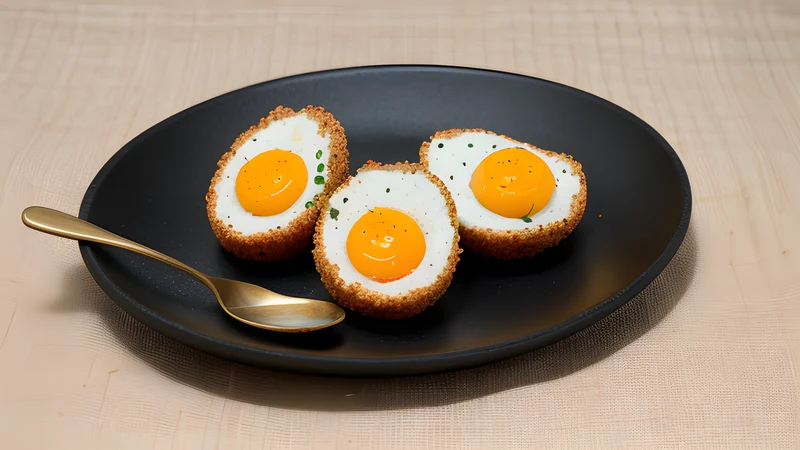
↓ Jump to recipeThe whole point of a homemade Scotch egg is the yolk. The chilled supermarket version, with its chalky, fully set centre, is a different animal from one you cook yourself, where a soft-boiled egg is wrapped in seasoned sausage, crumbed and fried just long enough to heat through while the yolk stays jammy and molten. Break one open warm and the yolk should slump slowly across the plate. It comes down to two things: boiling the eggs to exactly the right point, and frying fast enough that the sausage cooks before the centre sets hard.
Scotch Eggs with a Runny Yolk
Ingredients
- 5 large eggs (4 for wrapping, 1 for the crumb)
- 400g good pork sausagemeat (or skinned sausages)
- 1 tbsp chopped fresh sage
- 1 tsp fresh thyme leaves
- 1/2 tsp English mustard powder
- 1/4 tsp ground mace or nutmeg
- 50g plain flour, for coating
- 100g panko or fine dried breadcrumbs
- Black pepper and a little sea salt
- Sunflower or vegetable oil, for deep-frying
Method
- Bring a pan of water to a rolling boil, lower in 4 fridge-cold eggs and boil for exactly 6 minutes for a soft, jammy yolk.
- Drain and plunge the eggs into iced water for 5 minutes, then peel carefully under a trickle of cold water.
- Mix 400g sausagemeat with 1 tbsp sage, 1 tsp thyme, 1/2 tsp mustard powder, 1/4 tsp mace, black pepper and a small pinch of salt, then divide into 4 equal pieces.
- Set up three shallow bowls: seasoned flour, the remaining egg beaten, and the breadcrumbs.
- On a square of cling film, flatten one piece of sausagemeat into a thin even oval, dust a peeled egg with flour, sit it in the centre and use the film to draw the meat around it into a smooth layer with no gaps.
- Repeat with the rest, then roll each wrapped egg in flour, beaten egg and breadcrumbs, pressing the crumbs on to coat fully.
- Heat the oil to 170C in a deep pan filled no more than a third full.
- Fry the Scotch eggs two at a time for 6-7 minutes, turning, until deep golden brown and the sausage is cooked through.
- Drain on kitchen paper and rest for 3-4 minutes, then serve warm and halved so the runny yolk shows.
The story
The Scotch egg is one of Britain’s great picnic foods, and for all the name, its origins are firmly English and pleasantly murky. The most repeated claim credits the London grocer Fortnum & Mason, who say they invented the Scotch egg around 1738 as a portable snack for wealthy travellers setting off by coach from Piccadilly. It is a good story and the firm has stuck to it for the best part of three centuries, though food historians are more cautious, since no recipe of theirs survives from that date.
Others point across the world to Mughal India, where nargisi kofta wraps a boiled egg in spiced minced meat and simmers it in a rich curry sauce, and suggest the idea travelled home with returning colonial officers who had it re-made in a crisp fried shell. The word “Scotch” here probably has nothing to do with Scotland at all; to “scotch” once meant to score or to crush, and may simply describe the minced, seasoned meat. Whatever the true lineage, by the Victorian era the Scotch egg was a fixture of the cold table, and it never left. It sits comfortably alongside the other portable savouries of British baking, the sausage roll and the cheese and onion pasty, all built on the same idea of a good filling made easy to carry and eat with your hands.
The modern gastropub revival is what rescued the Scotch egg from the sad, rubbery chilled-aisle version. Pubs started serving them warm, split open to show a soft orange yolk, often with a smear of piccalilli or brown sauce alongside, and reminded everyone what the thing is supposed to be: crisp, savoury, still a little warm in the middle. That is the version worth making at home, and it is genuinely straightforward once the timing is in your hands.
Getting the yolk right
Everything hinges on the boil, and the two dangers pull in opposite directions. Under-boil and the white is too loose to peel and wrap; over-boil and you lose the runny yolk that is the entire reason for the exercise. Six minutes in properly rolling water, from fridge-cold, gives a set white and a soft, jammy yolk in a standard large egg. The ice bath immediately afterwards is doing two jobs: it stops the cooking dead so the yolk holds at that soft stage, and it shrinks the egg slightly from the shell so it peels without tearing chunks out of the white.
Then remember that the egg cooks a second time in the fryer. Those 6-7 minutes at 170C bring the sausage up to a safe temperature and firm the yolk a touch further, so a 6-minute boil frying to a warm, soft centre is the aim. If you want the yolk barely set rather than truly liquid, go for 6 minutes 30. Frying colder than 170C means the crumb browns too slowly and the yolk keeps cooking while it waits, ending up firm; frying much hotter burns the crust before the raw sausage is done.
Tips and troubleshooting
Wrapping is where beginners lose eggs, and the fix is cling film. Flattening the sausagemeat on a sheet of film lets you lift it cleanly up and around the egg and seal the join without it sticking to your hands. Aim for an even layer all round, roughly half a centimetre; a thick patch of sausage will still be raw when the crumb is dark. Flouring the peeled egg first gives the meat something to grip so it does not slide off in the oil.
If your coating falls away in the fryer, the crumb layer was rushed. Follow the flour, egg, crumb order without skipping, press the breadcrumbs on firmly, and chill the coated eggs for 20 minutes before frying to set the coating. Panko gives the crunchiest, most rugged crust; fine dried breadcrumbs give a smoother, more traditional one. Either works, so use what you have.
Variations and serving
Once you have the method, the seasoning is yours to play with. Black pudding worked into the sausagemeat, or a version wrapped in haggis, makes a richer, more Scottish-leaning egg. A spoon of wholegrain mustard or a little grated apple in the meat cuts the fat and adds interest. For a lighter take, you can wrap quail’s eggs instead, boiling them for just 2 minutes 15 seconds and frying for a couple of minutes, giving perfect one-bite canapes.
Serve Scotch eggs warm, ideally within an hour of frying, halved so the yolk is on show. They want something sharp alongside to cut the richness: a spoon of piccalilli, some bread-and-butter pickles, or a good dab of brown sauce. They can be eaten cold the next day, kept in the fridge, though the yolk will have set firm by then. If you are making them ahead for a picnic, that is no bad thing, but for the full soft-centred experience, fry them shortly before you want to eat.
Why fresh eggs peel badly
There is one counterintuitive detail worth knowing: very fresh eggs are the hardest to peel. In a newly laid egg the white clings tightly to the inner membrane, and no amount of care will stop it tearing away in ragged patches. As an egg ages over a week or two, its contents lose a little moisture and carbon dioxide, the pH of the white rises, and it releases more cleanly from the shell. For Scotch eggs, where a torn white ruins the wrap, this matters more than usual. Reach for the eggs that have been in the fridge a week rather than the ones you bought yesterday, boil them straight from cold, and give them the full five minutes in iced water before you start peeling. Tap each one all over, roll it gently under your palm to craze the shell, then peel from the fatter end where the air pocket sits, and the shell should lift away in large pieces. If a stubborn one still fights you, peel it fully submerged under a bowl of cold water, which floats the loosened shell free and slips under the membrane to help it release cleanly.
Related Content