Salted Watermelon Agua Fresca with Lime
Blended watermelon and water, sharpened with lime and a pinch of salt that makes the sweetness louder.
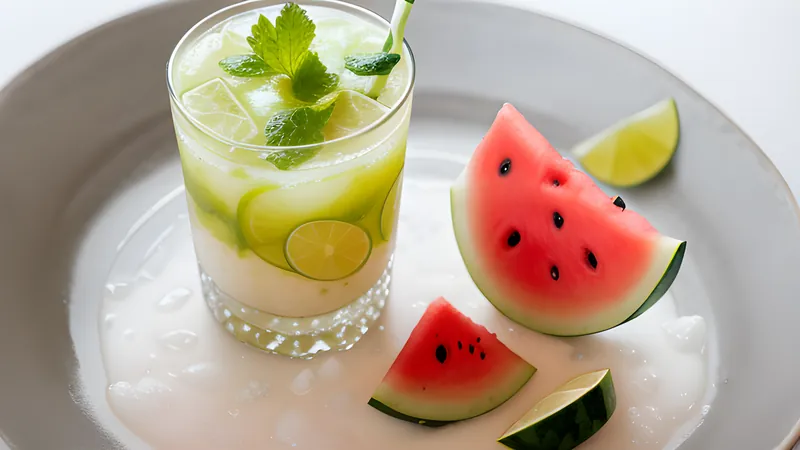
Contents
↓ Jump to recipeWatermelon agua fresca is one of the simplest drinks in the Mexican repertoire, and one of the easiest to get slightly wrong — too thin, too sweet, tasting more of water than melon. This version fixes that with two small moves: a proper squeeze of lime, and a pinch of salt stirred through rather than just sprinkled on top as garnish. Neither addition makes the drink taste of salt or lime specifically. Both make the watermelon taste more like itself.
Salted Watermelon Agua Fresca with Lime
Ingredients
- 1kg watermelon flesh, deseeded and cubed (from about a quarter of a large melon)
- 500ml cold water
- Juice of 2 limes (about 4 tablespoons), plus wedges to serve
- 2 tablespoons caster sugar, or to taste (omit if the melon is very ripe)
- 1/2 teaspoon fine salt, plus a pinch for finishing
- Ice, to serve
- A few mint leaves, torn, to serve (optional)
Method
- Cube the watermelon flesh, discarding any seeds and the tough pale rind. You want deep red, fully ripe flesh — pale or white patches near the rind are underripe and taste faintly bitter blended in bulk.
- Blitz the watermelon in a blender until completely smooth and liquid — this takes less time than you'd expect, as ripe watermelon is over 90% water and breaks down almost instantly.
- Pour the blended watermelon through a fine sieve into a large jug, pressing gently to extract the juice and leaving the pulpy fibre behind. This step is optional if you like a thicker, more textured drink, but it makes for a cleaner-tasting, more refreshing glass.
- Stir in the cold water, lime juice, sugar and the 1/2 teaspoon of salt until fully dissolved. Taste — the salt should register purely as a lift that makes the sweetness and lime taste brighter, well below the threshold where it tastes of salt itself.
- Adjust with more lime for sharpness or more sugar for sweetness, tasting after each small addition, then chill for at least 30 minutes.
- Serve over ice with a final tiny pinch of salt on top of each glass, a lime wedge on the rim, and torn mint if using.
Aguas frescas as a category, and where watermelon sits in it
The aguas frescas tradition — literally “fresh waters” — is one of Mexico’s oldest surviving drink formats, with roots that predate Spanish contact. Pre-Columbian markets, most famously the enormous Aztec market at Tlatelolco that so astonished the conquistador chroniclers, are recorded selling fruit and flower infusions sweetened with agave nectar or honey, served cold from clay vessels. Cane sugar, ice and citrus arrived later with colonisation, and the format simply absorbed them — the giant glass barrels, vitroleros, that line the counters of modern aguas frescas stands are a relatively recent addition too, popularised in the 20th century as a way to display the drinks’ colour and draw customers in.
Watermelon — sandía in Spanish — earns its regular place in that lineup for practical reasons as much as flavour ones. It’s over 90% water by weight, so it blends into a drink almost instantly with minimal added liquid, and it’s cheap and abundant across Mexico’s hot months, making it one of the most economical aguas frescas to produce at scale. The lime is closer to universal than a specific tradition — a squeeze of lime accompanies almost everything sold at a Mexican market stall, from elote to a bag of sliced fruit dusted with chilli-salt — and the pairing of watermelon, lime and a little salt or chilli is common enough as a snack on its own (sandía con chile y limón, watermelon wedges dusted with tajín) that folding the same trio into the blended drink is closer to restoring an existing pairing than inventing one.
Beyond watermelon, the aguas frescas counter is a small universe on its own: jamaica (steeped hibiscus, tart and deep red), horchata (rice and cinnamon, milky and sweet), tamarindo (sour and faintly resinous), and melón or piña depending on what’s in season, all sold from the same ranks of glass barrels with a ladle resting in each one. A proper stand sells them by the cup or, just as often, in a knotted plastic bag with a straw punched through the top — agua en bolsa — a format built for eating on foot around a market rather than sitting down, and one that has migrated with Mexican communities into cities across the US and, increasingly, Europe. Watermelon holds a slightly different place in that lineup to the others, because unlike hibiscus or tamarind it needs no steeping, no separate syrup, no ingredient beyond the fruit itself and a little water — which is also why it’s often the cheapest drink on the counter, and the one improvised at home with the least equipment.
Why salt is doing more work here than it looks like
Salt in a sweet drink sounds like a novelty until you understand what it’s actually doing on the tongue, and it isn’t adding a salty flavour at the concentrations used here.
Sweetness and saltiness interact on the palate through a genuine perceptual effect that goes well beyond simple contrast: a very small amount of salt suppresses some of the bitter and vegetal notes that sit underneath watermelon’s sweetness (present in all melons to some degree, more noticeable the closer to the rind you cut), while simultaneously making the sugar receptors on the tongue fire more readily. The half teaspoon used across a full jug here is well below the threshold where salt registers as its own flavour — if you can taste “salt” specifically when you sip this, you’ve added too much. The test is simple: taste the drink both with and without the salt side by side. The salted version should taste more watermelon-like and noticeably sweeter.
Lime does two separate jobs alongside the salt. Its acidity brightens the drink in the way citrus brightens most fruit-forward preparations — cutting the cloying flatness that a purely sweet blended fruit can have — and it also chemically brings the watermelon’s aroma compounds forward; citric acid lowers the perceived pH on the palate just enough to make volatile aromatics read as sharper and more present. The two together, salt and lime, are doing complementary versions of the same trick: making a naturally sweet, naturally mild fruit taste more vivid without changing what it fundamentally is.
The recipe
Makes 1.5 litres (about 6 glasses). Prep 15 minutes. No cooking.
Ingredients
- 1kg watermelon flesh, cubed (about a quarter of a large melon)
- 500ml cold water
- Juice of 2 limes
- 2 tablespoons caster sugar, or to taste
- 1/2 teaspoon fine salt, plus a pinch to finish
- Ice and mint leaves, to serve
Method
Cube the watermelon flesh, cutting away any pale rind and discarding seeds — deep red flesh only, as pale patches taste faintly bitter once concentrated in a blend. Blitz until completely smooth; ripe watermelon liquefies almost instantly given how much water it already holds. Pour through a fine sieve into a jug, pressing to extract the juice and leaving the fibre behind, for a cleaner drink (skip this if you prefer more texture). Stir in the cold water, lime juice, sugar and salt until fully dissolved, then taste — the salt should register purely as brightness. Adjust lime or sugar to taste in small increments and chill for at least 30 minutes. Serve over ice with a final light pinch of salt on top, a lime wedge on the rim and torn mint if using.
Tips, substitutions and storage
Judge sweetness by the melon rather than the recipe: a genuinely ripe, height-of-summer watermelon needs little to no added sugar, while an early-season or supermarket melon out of peak ripeness may need the full quantity or slightly more. A quick way to check ripeness before you buy: a ripe watermelon sounds hollow and low-pitched when thumped, and has a pale yellow “field spot” where it sat on the ground rather than a white one. Weight is another useful check that has nothing to do with size — pick up two melons of similar dimensions and go with the heavier one, since that extra weight is water content, and a watermelon that feels light for its size has likely dried out somewhat in storage and will taste correspondingly less juicy blended.
Seedless watermelon, now the dominant variety in most supermarkets, works just as well here and saves the deseeding step, though it isn’t genuinely seedless — look for the small, soft white seed coats scattered through the flesh and pick out any fully black ones you find, since a stray hard seed left in is the one unpleasant surprise in an otherwise silky drink. If you can only find seeded melon, running a knife down the flesh in strips before cubing makes the black seeds far easier to spot and remove than trying to pick them out of already-cubed pieces.
This drink is best drunk the day it’s made — watermelon’s high water content means it separates and the flavour dulls within about 24 hours in the fridge, even covered, as the fibre and liquid settle apart. If you need to make it ahead, blend and sieve the watermelon and store the plain juice; add the water, lime, sugar and salt only when you’re ready to serve.
For a version with more staying power, swap a quarter of the water for coconut water — it adds its own faint sweetness and a slightly thicker mouthfeel that helps the drink hold together longer, in the same way a splash of dairy anchors horchata.
Freeze any leftovers rather than fridging them past the first day. Poured into ice-lolly moulds or a shallow tray, the sieved drink turns into a genuinely good watermelon granita once scraped with a fork, and the salt and lime carry through the freeze without dulling, which they wouldn’t in a plain, unsalted watermelon puree.
Variations
Serving this alongside food, it plays the same palate-cleansing role a good agua fresca always does at a Mexican table — something cold and only lightly sweet to cut through grilled or fried food rather than compete with it, in the same way a glass of horchata sits next to a plate of tacos without ever trying to be the main event. A few slices of cucumber blended in with the watermelon give the drink a cooler, more vegetal edge that suits a genuinely hot day — cucumber and watermelon share enough textural DNA (both mostly water, both mild) that they blend seamlessly rather than fighting each other. For a version with a little heat, muddle a thin slice of jalapeño with the lime juice before adding it, in the same spirit as a michelada’s chilli-salt rim — strain it back out before serving if you don’t want visible seeds, or leave it in for a slow, steady warmth. Basil or Thai basil, torn in at the end instead of mint, pushes the drink in a slightly more savoury, herbal direction that pairs well alongside grilled food. Whichever way you take it, taste as you go — a ripe watermelon needs almost nothing added to taste extraordinary, and the salt and lime here are meant to be felt rather than noticed.
Related Content