Sachertorte with Apricot and Dark Chocolate Glaze
The Viennese chocolate cake, split with apricot, poured with a mirror glaze, deepened with espresso
Contents
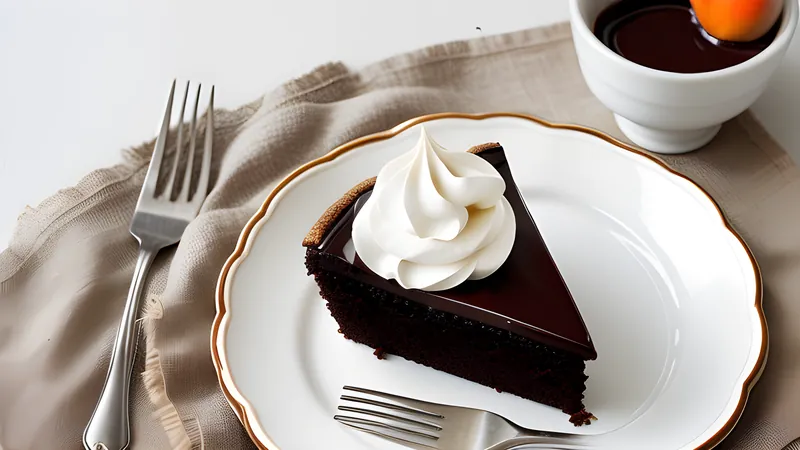
↓ Jump to recipeThere are cakes you make to eat and cakes you make to prove something to yourself, and the Sachertorte is quietly both. It is a dark, dense chocolate cake, split and sealed with tart apricot jam, and poured over with a glossy chocolate glaze that sets to a smooth, faintly crisp shell. In Vienna it is served in a slab with a mound of unsweetened whipped cream on the side, and no fork ever leaves the plate disappointed. It is a serious cake, and making a good one is one of the more satisfying afternoons a home baker can spend.
It also comes with more baggage than almost any other cake in Europe, having been the subject of a seven-year court case. But we will come to that. First, know that this is achievable at home, that the technique is classic and teachable, and that the two things people fear most — the poured glaze and the risk of a dry crumb — both come down to a couple of temperatures and a bit of nerve.
Sachertorte with Apricot and Dark Chocolate Glaze
Ingredients
- 130g dark chocolate (60-70%), finely chopped
- 130g unsalted butter, softened
- 100g icing sugar
- 6 large eggs, separated, at room temperature
- 1 tsp vanilla bean paste
- 1 tsp instant espresso powder
- 1/2 tsp fine salt
- 100g caster sugar (for the whites)
- 130g plain flour, sifted
- 200g apricot jam, plus 2 tbsp for the crumb coat
- 1 tbsp dark rum (optional)
- 200g dark chocolate (55-60%), for the glaze
- 200g caster sugar (for the glaze)
- 125ml water (for the glaze)
Method
- Heat the oven to 160C fan. Grease and line a 22cm springform tin. Melt the 130g chocolate gently and let it cool to just warm.
- Beat the butter and icing sugar until pale and fluffy. Beat in the egg yolks one at a time, then the vanilla, espresso powder and salt, then the melted chocolate.
- In a clean bowl, whisk the egg whites to soft peaks, then add the 100g caster sugar a spoon at a time, whisking to a firm, glossy meringue.
- Fold a third of the meringue into the chocolate base to loosen it, then fold in the rest in two additions, alternating with the sifted flour, keeping as much air as you can.
- Scrape into the tin and bake for 40-45 minutes, until a skewer comes out with a few moist crumbs. Cool 15 minutes in the tin, then turn out and cool completely.
- Warm the 200g apricot jam with the rum until loose, then sieve. Level the cake, slice it horizontally into two layers, and sandwich with a third of the jam. Brush the remaining jam all over the top and sides as a thin crumb coat and leave to set for 30 minutes.
- Make the glaze: dissolve the 200g caster sugar in the water and boil to 108-112C (a syrup that threads). Off the heat, stir in the 200g chopped chocolate until smooth and glossy. Let it cool to a coating consistency, about 35C.
- Set the cake on a rack over a tray. Pour the glaze over the centre in one go and let it flow down and over the sides, coaxing it with a palette knife in as few strokes as possible. Leave to set at room temperature rather than in the fridge, so it stays glossy.
A cake, a hotel and a lawsuit
The Sachertorte was invented in 1832 by Franz Sacher, a sixteen-year-old apprentice cook standing in for his sick head chef in the kitchen of Prince Wenzel von Metternich, the Austrian statesman. Asked to produce a dessert for important guests, the boy improvised a chocolate cake, and it was good enough to outlive everyone at the table. Franz’s son Eduard refined the recipe while training at the pastry shop Demel, and later opened the Hotel Sacher, which is where the cake became a Viennese institution.
Then it got complicated. Both the Hotel Sacher and Demel claimed the right to the “original”, and from 1954 they fought a legal battle that dragged on for seven years over, among other things, whether the layer of apricot jam belongs in the middle of the cake or only under the glaze on top. The hotel won the name Original Sacher-Torte, with its round chocolate seal, and puts jam in the middle and beneath the glaze; Demel calls its version the Eduard-Sacher-Torte and puts a single layer of jam directly under the glaze. The lesson for a home cook is liberating: the “correct” Sachertorte was never really settled, so make it the way it tastes best, which in my kitchen means jam through the middle and a thin coat over the whole thing before glazing.
The sponge: separated eggs and a careful fold
This is not a fudgy, molten American chocolate cake. The Sachertorte crumb is drier and closer, built like a genoise-adjacent sponge leavened almost entirely by whipped egg whites rather than raising agents. That structure is what lets it stand up to the jam and glaze without turning to mud, and it is also where people go wrong, because a Sachertorte baked carelessly can be genuinely dry.
The method is the classic separation. You cream butter and icing sugar, beat in yolks and melted chocolate for richness, and then fold in a firm meringue for lift, alternating with the flour so the batter does not deflate. Fold with a light hand and a large spoon or spatula, cutting down and turning over, stopping the moment the streaks disappear. Overfold and you knock out the air the cake depends on; underfold and you get pockets of unmixed meringue. Bake it at a moderate temperature so it cooks through gently, and pull it when a skewer comes out with a few moist crumbs clinging on rather than a dry skewer. The apricot jam and glaze then top up the moisture, which is precisely why the two elements exist together.
The clever bit: espresso in the batter
My one departure from the Vienna line is a teaspoon of instant espresso powder folded into the chocolate base. It is a small thing and, done gently, an invisible one; nobody eats the cake and tastes coffee.
What the espresso does is deepen the chocolate. Coffee and cocoa share a family of roasted, bitter aromatic compounds, and a little coffee against dark chocolate reads on the palate as more chocolate — richer, darker, longer on the finish — rather than as a coffee flavour in its own right. It is the oldest trick in the chocolate-cake book and it earns its place in a Sachertorte, where the sponge itself is fairly restrained in sugar and can take all the depth it can get. Keep it to a level teaspoon of instant espresso so it stays under the radar. If you would rather taste the coffee outright, that is a different and also excellent cake, closer in spirit to opera cake with coffee and chocolate, where coffee and chocolate share the billing equally.
Apricot: the tart bridge
The apricot jam is not decoration; it is what makes a Sachertorte a Sachertorte. Its job is to cut the richness of two layers of dark chocolate with a bright, slightly tart fruit note, and to add moisture and a faint stickiness that helps the glaze grip. Warm it, loosen it with a little water or a spoon of dark rum, and push it through a sieve so it goes on smooth. A splash of rum sharpens the apricot and plays beautifully with the chocolate; leave it out for a family cake if you prefer.
Brushing a thin crumb coat of jam over the whole cake and letting it set is the step novices skip and then regret. That tacky, sealed surface is what gives the poured glaze a clean, glassy finish; pour glaze straight onto bare sponge and you drag crumbs into it and lose the mirror. The same principle sits behind the marzipan-and-jam wrapping on a Battenberg with marzipan and apricot jam: apricot glaze is the great sealer of the European cake kitchen.
The glaze, which is all about temperature
The traditional Sacher glaze is not a ganache. It is a sugar syrup boiled to the thread stage, around 108 to 112C, into which chopped chocolate is stirred off the heat. Done right, it sets to a smooth shell with a faint snap and a deep shine, quite unlike the soft matte of a cream ganache.
Two temperatures decide everything. Boil the syrup too little and the glaze stays sticky and never sets; boil it too far and it seizes grainy. A sugar thermometer removes the guesswork. Then let the finished glaze cool to around 35C, coating consistency, before you pour — too hot and it runs off thin and streaky, too cool and it sets before it has covered the sides. Pour it all onto the centre of the chilled, crumb-coated cake in one confident go and let gravity carry it down, nudging it over any bare patches with the fewest strokes you can manage. Every extra pass with the palette knife dulls the shine. Then leave it to set at room temperature; the fridge will fog the surface and kill the gloss.
Serving, storage and a note on cream
A Sachertorte is at its best a day after it is made, once the flavours have settled and the crumb has relaxed. It keeps for four or five days in a tin at cool room temperature; do not refrigerate the glazed cake if you can help it. Serve it in slim wedges with a generous spoon of schlagobers, softly whipped and completely unsweetened cream, which is the correct counterweight to a cake that is deliberately not very sweet. A cup of strong black coffee alongside completes the Viennese picture. It is a lot of care for one cake, and every slice tells you it was worth it.
Related Content