Rosemary Sea-Salt Focaccia
Dimpled, golden and drenched in good olive oil
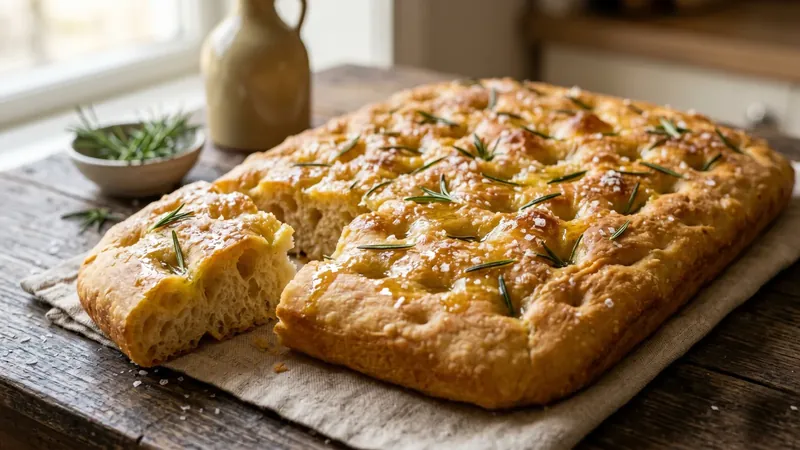
Few breads reward patience like focaccia. The twist here is time: a long, cold overnight rise that develops a deep, almost savoury flavour and a wonderfully open, bubbly crumb, finished with a fragrant rosemary and flaky-salt top. The result is golden and crisp where it meets the oiled tin, soft and airy within, and unapologetically rich with good olive oil. It is best eaten warm, torn straight from the tray.
Rosemary Sea-Salt Focaccia
Ingredients
- 500g strong white bread flour
- 7g (1 sachet) fast-action dried yeast
- 10g fine salt
- 400ml lukewarm water
- 6 tbsp extra-virgin olive oil, plus extra for the tin
- Leaves from 3-4 sprigs of fresh rosemary
- Flaky sea salt, for the top
Method
- Whisk the flour, yeast and fine salt together in a large bowl.
- Add the lukewarm water and 2 tablespoons of the olive oil, and mix to a wet, shaggy dough with no dry flour remaining.
- Cover the bowl and leave at room temperature for 1 hour, giving the dough a few folds in the bowl every 20 minutes if you can.
- Cover and refrigerate overnight, or for at least 8 hours, for a slow rise and better flavour.
- Generously oil a large rectangular baking tin. Tip in the dough and gently stretch it towards the corners, then leave to rise for 1.5 to 2 hours until puffy.
- Heat the oven to 220C (fan 200C). Drizzle the dough with 2 tablespoons of olive oil.
- Oil your fingers and press them firmly all over the dough to make deep dimples right down to the base.
- Scatter over the rosemary leaves and flaky sea salt, and drizzle with the last of the olive oil.
- Bake for 22-25 minutes until deep golden and crisp at the edges.
- Drizzle with a little more oil if you like, cool slightly in the tin, then lift out and cut into squares.
3 The Story
Focaccia is one of Italy’s oldest breads, a flat, oil-rich loaf whose roots reach back to the ovens of antiquity. Its very name points to that age: it derives from the Latin focus, meaning hearth, and describes a bread baked in the heat of the fire. Long before domestic ovens were common, simple flatbreads of this kind were cooked on hot stones or under the ashes, and focaccia is one of their direct descendants.
The dish is most closely tied to Liguria, the coastal region in north-west Italy around the port city of Genoa, where focaccia is woven into daily life. The Ligurian style is generously oiled, dimpled and often eaten plain or simply with rosemary, sometimes at breakfast dipped into coffee, more often through the day as a snack or alongside a meal. The region’s prized olive oil is central to its character, and a good focaccia is unashamedly rich with it; the oil is not a garnish but a defining ingredient.
What makes focaccia so forgiving for the home baker is its very wet dough. A high proportion of water relative to flour produces a slack, sticky mass that needs no real kneading, only gentle folding and time. That high hydration is also what gives the finished bread its characteristic open, irregular crumb, full of large and small holes. The long, cold rise in the refrigerator is the quiet hero of the method: the slow, cool fermentation lets the dough develop flavour while staying easy to handle, and it can be stretched conveniently across an evening and the following day.
The dimpling is more than decoration. Pressing deep wells into the dough before baking holds pools of olive oil and salt, which season the bread and help create that signature texture, soft beneath a lightly crisped surface. Rosemary and coarse sea salt are the classic Ligurian topping, the resinous, piney herb playing beautifully against the richness of the oil. From there the possibilities are endless, with cherry tomatoes, olives, thinly sliced onion or grapes all finding their way onto trays across Italy. But the plain rosemary version remains the benchmark, and it is hard to improve upon. Eaten warm from the tray it needs nothing at all, though split and filled it makes a fine sandwich, and a day-old slab toasts beautifully. However it is served, the same simple pleasures define it: good oil, good salt, and a fragrant herb scattered over a soft, golden crumb.
Related Content