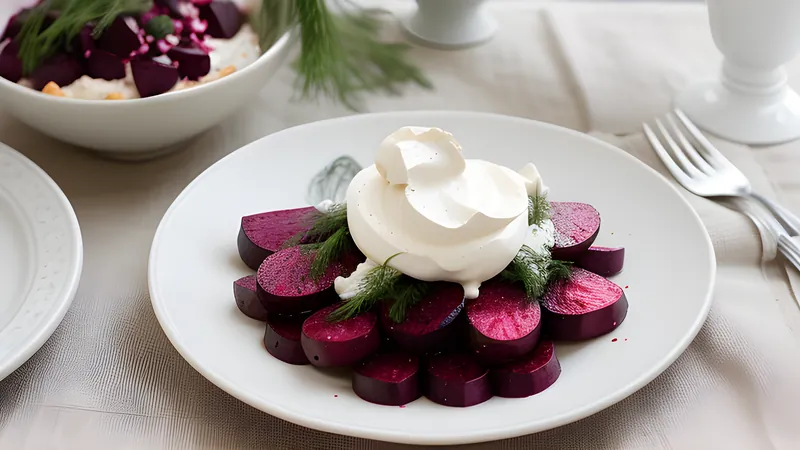
Roasted Beetroot with Horseradish Crème Fraîche
Slow-roasted beets, earthy and sweet, cut through with a fierce horseradish cream
Contents
↓ Jump to recipeBeetroot has spent decades being unfairly maligned, and I blame the jar. A whole generation grew up on beetroot that came pickled and sliced in harsh malt vinegar, staining everything it touched and tasting mostly of acid, and understandably concluded they did not like it. Roast a fresh beetroot whole in its skin, though, and you meet an entirely different vegetable: dense, sweet, earthy and almost meaty, with a flavour that has concentrated rather than leached away. Pair that with a cold, fierce horseradish cream, and you have a side dish with real backbone, the sweetness of the beets and the burn of the horseradish playing off each other on every forkful.
An honest root with deep roots
Beetroot is a cultivated descendant of the wild sea beet, a scrappy coastal plant of the Mediterranean and Atlantic shores, and its swollen red root is a relatively recent development in culinary terms. The Romans mostly ate the leaves and used the root medicinally; the fat, sweet round beetroot we roast today was largely bred in central and eastern Europe from around the sixteenth century onward. Its sugar content is no accident of flavour but the whole point of its most industrious relative, the sugar beet, developed in Prussia in the late eighteenth century and now a major source of the world’s sugar. That sweetness is exactly what roasting brings forward.
Beetroot and horseradish are an old central and eastern European partnership, most famously bottled as chrain, the fiercely pungent beetroot-and-horseradish relish that appears on Jewish and Polish tables at Passover and Easter alongside cold meats and fish. The logic is sound: horseradish’s volatile, sinus-clearing heat is the perfect foil for beetroot’s deep, cloying sweetness, each pulling the other into balance. This dish takes that classic pairing and loosens it, keeping the beetroot in generous roasted wedges and turning the horseradish into a cool, creamy base rather than a sharp relish.
The clever bit: horseradish in cold cream, added at the end
The trick to keeping the horseradish’s fire alive is temperature and timing. Horseradish gets its heat from allyl isothiocyanate, the same volatile compound family that gives mustard and wasabi their kick, and that compound is fragile: it breaks down with heat and fades with time once the root is grated and exposed to air. So the horseradish goes into cold crème fraîche, never anything warm, and the cream is mixed shortly before serving so the heat is at its sharpest. Grating the horseradish fresh, if you can find the root, gives a cleaner, more electric burn than the jarred sauce, though a good hot horseradish sauce is a perfectly respectable shortcut. The contrast of warm, sweet beetroot against the cold, sharp cream is the whole pleasure of the plate, so keep the two elements separate until the moment you serve.
Roasted Beetroot with Horseradish Crème Fraîche
Ingredients
- 800g medium beetroot, similar in size, leaves trimmed
- 2 tbsp olive oil
- 0.5 tsp flaky sea salt, plus more to season
- 2 tbsp water
- 1 tbsp sherry vinegar
- 1 tsp runny honey
- 150g crème fraîche
- 2 to 3 tsp finely grated fresh horseradish (or 1.5 tbsp hot horseradish sauce)
- 1 tsp Dijon mustard
- Zest of 0.5 lemon
- 2 tbsp chopped dill, plus sprigs to finish
- 30g toasted walnuts, roughly chopped
Method
- Heat the oven to 190C fan. Put the beetroot in a roasting tin, add the water, drizzle with 1 tbsp olive oil and the salt, and cover tightly with foil.
- Roast for 60 to 90 minutes, until a knife slides into the centre with no resistance. Timing depends on size.
- Uncover and cool until you can handle them, then rub off the skins with kitchen paper or a gloved hand.
- Cut the beetroot into wedges and dress at once with the remaining olive oil, sherry vinegar, honey and a little salt.
- Mix the crème fraîche with the horseradish, Dijon, lemon zest and a pinch of salt. Taste and add more horseradish for more heat.
- Fold the chopped dill through the beetroot.
- Spread the horseradish crème fraîche over a platter, pile the dressed beetroot on top, scatter with walnuts and dill sprigs and serve.
Why roast whole, in the skin
Roasting beetroot whole and unpeeled, wrapped under foil with a splash of water, is really a hybrid of roasting and steaming, and it does two things at once. The skin traps the beetroot’s moisture and sugars so nothing bleeds out into the pan, which is exactly what happens when you boil them; boiled beetroot loses colour, flavour and a fair amount of its earthy sweetness to the water. Meanwhile the gentle, contained heat slowly softens the dense flesh and concentrates its sugars, deepening both colour and taste. When you slip the skins off afterwards, the flesh underneath is a vivid, saturated red and tastes emphatically of beetroot.
The one thing to watch is size. Beetroot vary enormously, and a tin holding both golf-ball and tennis-ball sized roots will give you some overcooked and some raw in the middle. Choose beets of similar size, or cut the giants in half, and start testing at the hour mark. Undercooked beetroot has a woody, unpleasant crunch at the centre, so err towards longer; a beetroot that yields completely to a knife is where you want to be.
Substitutions, make-ahead and variations
If you cannot find fresh horseradish, a good jarred hot horseradish sauce works well; start with a tablespoon and a half and add more to taste, bearing in mind jarred sauces are already softened with vinegar and cream. Greek yoghurt or soured cream can stand in for the crème fraîche, and for a vegan version use a thick coconut or cashew yoghurt with the horseradish, mustard and lemon. Walnuts can be swapped for toasted hazelnuts or pumpkin seeds, and a handful of crumbled goat’s cheese or feta over the top turns this into a more substantial starter or lunch.
This is a genuinely good make-ahead dish. Roast and peel the beetroot up to three days in advance and keep them in the fridge; the horseradish cream can be made a few hours ahead but is at its fiercest fresh, so mix it close to serving. Assemble only when you are ready to eat, so the warm-cold contrast holds. If you like this earthy, sweet-and-sharp register, it is a close relation of my beetroot, goat’s cheese and candied walnut salad, and it sits happily on the same table as roasted carrots with honey, cumin and yoghurt, where roasted roots meet a cool, spiced dressing in much the same spirit.
Related Content