Ratatouille with Herbes de Provence
Sun-ripened vegetables, slowly coaxed
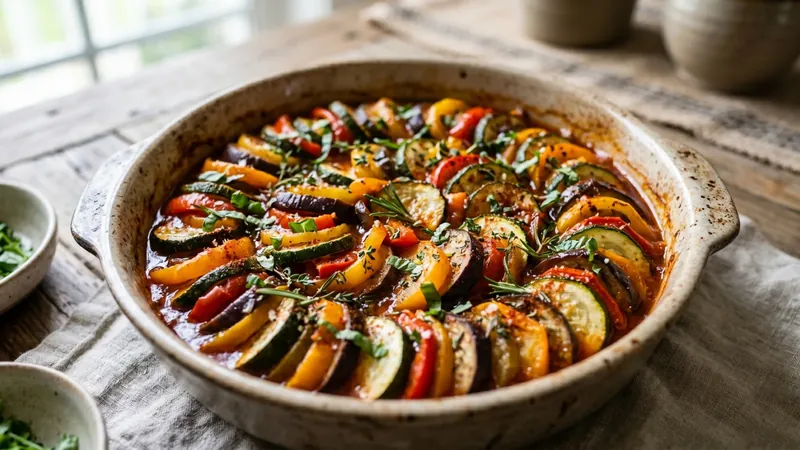
Ratatouille is the taste of a Provencal summer in a single pan: aubergine, courgette, peppers and tomato simmered until soft and fragrant. The twist here is method rather than ingredient, frying each vegetable separately before bringing them together, so every element keeps its character instead of collapsing into mush. A scattering of herbes de Provence lends that unmistakable scent of the south. It is wonderful warm, but arguably even better the next day, eaten at room temperature.
Ratatouille with Herbes de Provence
Ingredients
- 1 large aubergine, cut into 2cm chunks
- 2 courgettes, cut into 2cm chunks
- 1 red pepper, deseeded and chopped
- 1 yellow pepper, deseeded and chopped
- 1 large onion, sliced
- 4 ripe tomatoes, chopped (or 400g tin chopped tomatoes)
- 3 garlic cloves, sliced
- 5 tbsp olive oil
- 1 tbsp tomato puree
- 2 tsp herbes de Provence
- 1 bay leaf
- A handful of fresh basil, torn
- Salt and black pepper
Method
- Heat 1 tbsp olive oil in a large pan and fry the aubergine over a medium-high heat until golden on all sides. Remove and set aside.
- Add another tablespoon of oil and fry the courgettes until lightly coloured. Remove and set aside.
- Fry the peppers in a little more oil until softened and beginning to char at the edges. Remove and set aside.
- Lower the heat, add the remaining oil and soften the onion gently for 8 minutes.
- Stir in the garlic and cook for a minute, then add the tomato puree and cook for a further minute.
- Add the chopped tomatoes, herbes de Provence and bay leaf, and simmer for 10 minutes until thickened.
- Return all the cooked vegetables to the pan and stir gently to combine.
- Season, cover and simmer very gently for 20-25 minutes, stirring occasionally, until everything is tender and melded.
- Remove the bay leaf and check the seasoning.
- Stir through the torn basil and serve warm or at room temperature.
3 The Story
Ratatouille is the great vegetable stew of Provence, the sun-soaked region of south-eastern France whose markets overflow in summer with aubergines, courgettes, peppers and tomatoes. The dish is a celebration of exactly those ingredients at their peak, and its name is thought to derive from the French verb touiller, meaning to stir or toss. It began as humble, thrifty country cooking, a way for farmers and labourers to make a satisfying meal from whatever the garden was producing in abundance.
It is worth remembering that several of ratatouille’s defining vegetables are not native to France at all. Tomatoes, peppers and aubergines all arrived in Europe from the Americas and beyond over the centuries, and were gradually embraced by Mediterranean cooks who found they thrived in the warm southern climate. By the time ratatouille took its recognisable modern shape, these once-exotic vegetables had become utterly at home in the region, and the dish stands as a quiet testament to how thoroughly they were adopted.
The twist in this recipe is a matter of technique, and it is one that divides cooks. The simplest, most traditional approach throws everything into a single pot to stew together. The trouble is that the vegetables cook at very different rates: aubergine soaks up oil and turns silky, courgette softens quickly, peppers want longer, and tomatoes break down into sauce. Cooked all at once, the quicker vegetables disintegrate before the slower ones are ready. By frying each vegetable separately first, then combining them, each retains its own texture and flavour, and the aubergine in particular develops a golden, almost caramelised edge it never achieves when simmered from raw.
Herbes de Provence ties the dish to its homeland. This is a dried blend traditionally associated with the region, typically including herbs such as thyme, rosemary, oregano and savory, sometimes with a little lavender or fennel. Their warm, resinous aroma is the scent of the Provencal hillsides, and a couple of teaspoons stirred through the tomato base lifts the whole pan. Finished with fresh basil and good olive oil, ratatouille is endlessly versatile: a side dish, a light main with crusty bread, a topping for eggs, or a filling for an omelette the morning after.
Related Content