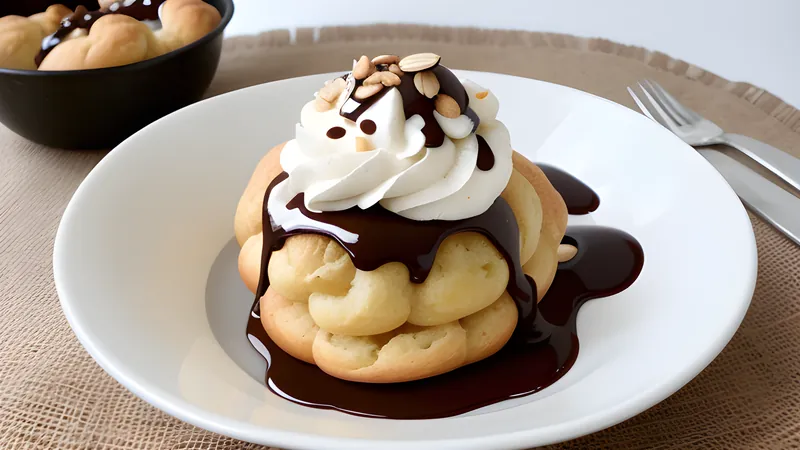
Profiteroles with Warm Chocolate Sauce
Crisp choux, cold cream, a dark sauce poured at the table
Contents
↓ Jump to recipeProfiteroles have a reputation as a restaurant flourish, the sort of thing that arrives under a silver jug and a waiter’s practised pour. In truth they are one of the cheapest desserts you can make: flour, butter, water and eggs turned into little hollow shells, filled with softly whipped cream, drowned in warm chocolate. The whole magic is in a technique, choux pastry, that frightens people far more than it should.
My one quiet twist is half a teaspoon of instant espresso stirred into the chocolate sauce. You will not taste coffee. What you will taste is a chocolate that seems darker, rounder and more grown-up, the bitterness pulled into focus the way a pinch of salt sharpens caramel. It is the single easiest upgrade in this whole recipe, and nobody ever guesses it is there.
Profiteroles with Warm Chocolate Sauce
Ingredients
- 75g plain flour
- 60g unsalted butter, cubed
- 150ml water
- 1/2 tsp caster sugar
- 1/4 tsp fine salt
- 2 large eggs, beaten (plus a little extra if needed)
- 300ml double cream
- 1 tbsp icing sugar
- 1 tsp vanilla bean paste
- 150g dark chocolate (about 60% cocoa), chopped
- 100ml double cream, for the sauce
- 30g unsalted butter, for the sauce
- 1 tbsp golden syrup
- 1/2 tsp instant espresso powder
Method
- Sift the 75g flour onto paper. Heat the water, 60g butter, sugar and salt in a pan until the butter melts, then bring to a rolling boil.
- Off the heat, tip in all the flour at once and beat with a wooden spoon to a smooth ball that leaves the pan sides clean.
- Return to low heat and beat for 1 minute until a film forms on the pan base. Cool for 5 minutes until just warm.
- Beat in the eggs a little at a time until the paste is glossy and drops in a thick, reluctant V. Add more egg only if stiff.
- Pipe walnut-sized mounds onto a lined tray, spaced apart, and smooth peaks with a wet finger.
- Bake at 200C fan for 20 minutes until deep gold and risen. Pierce each with a skewer and return to the oven for 5 to 8 minutes to dry the insides. Cool on a rack.
- Whip the 300ml cream with the icing sugar and vanilla to soft peaks. Fill the cold buns through the skewer hole or by splitting them.
- Melt the chocolate, 100ml cream, 30g butter, golden syrup and espresso powder in a pan over the lowest heat, stirring until glossy and pourable. Do not boil.
- Pile the filled profiteroles into a bowl and pour the warm sauce over them at the table.
A pastry built on steam
Choux is the odd one out in the pastry family because it is cooked twice, once on the hob and once in the oven, and it rises with no raising agent at all. The lift comes entirely from water turning to steam inside a batter elastic enough to trap it. Get the science right and each bun inflates into a crisp shell around a hollow centre, ready to hold cream. Get it wrong and you have dense little rocks.
The pastry is old. It is usually credited to a sixteenth-century Italian cook, Panterelli, who came to France in the retinue of Catherine de’ Medici and made a dried paste called pâte à Panterelli. Over two centuries it was refined by successive pastry chefs, the great Antonin Carême among them, into the pâte à choux we know, so named because the little buns piped for gougères and cream puffs resembled tiny cabbages, choux in French. The profiterole itself, filled and sauced, became a fixture of the classic French dessert trolley, and the tower of them glued with caramel, the croquembouche, is still the traditional French wedding cake.
Understanding that the whole thing runs on steam tells you everything about how to treat it. You want plenty of water in the dough to become steam, then a hot oven to drive that steam hard, then time to dry the shells out so they hold their shape once they cool.
Making the choux
Start by sifting the flour onto a sheet of paper so you can add it in one clean shot. Put the water, butter, sugar and salt in a saucepan and heat gently until the butter has fully melted, then bring it to a rolling boil. The order matters: if you boil before the butter melts, water evaporates and your ratios drift.
The moment it boils, take it off the heat and tip in all the flour at once. Beat hard with a wooden spoon until it comes together into a smooth ball that leaves the sides of the pan clean. Now return it to a low heat and keep beating for a minute or so to cook out the raw flour and drive off a little moisture; you want a thin film forming on the base of the pan. This step is what stops a claggy, eggy interior later.
Let the paste cool for five minutes, until it is warm rather than hot, or it will scramble the eggs. Then add the beaten egg a little at a time, beating well between each addition. This is the one judgement call in the recipe. You are looking for a paste that is glossy and drops from the spoon in a thick, reluctant V. Two eggs is usually right, but flours vary, so hold a little back and add more only if it seems stiff. Too much egg and it will spread flat; too little and it will not rise.
Pipe walnut-sized mounds onto a lined tray, spaced well apart, and pat down any peaks with a wet finger so they do not scorch. Bake at 200C fan for about 20 minutes until well risen and deep gold, then, and this is non-negotiable, pierce each one with a skewer to let the steam out and return them to the oven for a further five to eight minutes to dry the insides. A shell that looks done but is still damp within will collapse on the cooling rack.
Cream and sauce
Whip the 300ml of double cream with the icing sugar and vanilla paste to soft, barely-holding peaks. Stop early: over-whipped cream turns grainy and the buns pipe better with a slightly slack filling. When the shells are completely cold, either split them and spoon the cream in, or use the skewer hole and a piping bag with a plain nozzle to fill them from underneath, which looks neater and keeps them crisp.
For the sauce, put the chopped dark chocolate, the 100ml of cream, the butter, golden syrup and espresso powder in a small pan over the lowest heat. Stir gently and constantly until everything melts into a glossy, pourable sauce. Do not let it boil or the chocolate can seize and turn grainy. If it thickens too much as it stands, loosen it with a splash of warm milk. It should coat the back of a spoon and fall in a smooth ribbon. Golden syrup is the quiet workhorse here: its glucose keeps the sauce glossy and pourable rather than letting it set hard as it cools on the cream.
What goes wrong, and why
Flat buns almost always mean too much egg, or an oven door opened too early: for the first fifteen minutes the steam is doing its work and a blast of cool air will deflate everything, so keep it shut. Soggy buns mean they were not dried out enough, so give them the full extra oven time and cool them on a rack, never a plate. A greasy paste means the butter and water boiled too long before the flour went in and the emulsion broke. And a seized, grainy sauce means the heat was too high, so go slow and low.
The buns can be made a day ahead and re-crisped for a few minutes in a hot oven before filling. Unfilled, they also freeze beautifully; refresh them straight from frozen in a 180C oven for five minutes. Once filled with cream, though, they are best eaten within a couple of hours, before the moisture softens the shells.
Serving, and where to take it next
Pile the filled profiteroles into a bowl or a shallow-sided dish, carry them to the table, and pour the warm sauce over them in front of everyone. The contrast is the whole point: cold cream, crisp pastry, hot bittersweet chocolate running into the cracks. A scatter of toasted flaked almonds or a little grated chocolate is welcome; anything more is gilding.
Once you are comfortable with choux you have unlocked a whole shelf of French pastry. The same paste, piped into fingers and dried the same way, becomes the éclairs with coffee crème pâtissière worth learning next, and the crème pâtissière skill behind them carries you straight to a proper millefeuille with vanilla crème pâtissière. Learn to trust the steam and dry your shells out fully, and these desserts stop being restaurant tricks and start being things you make on a Tuesday.
Related Content