Pork Belly Bao Buns with Pickled Daikon
Cloud-soft buns folded around sticky braised pork
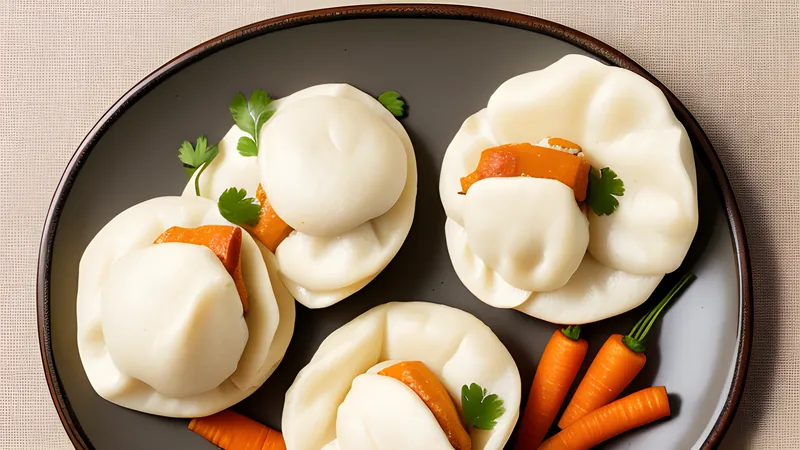
Pork Belly Bao Buns with Pickled Daikon
Ingredients
- 300g plain flour
- 1 tsp instant yeast
- 1 tbsp caster sugar
- 0.5 tsp baking powder
- 0.5 tsp fine salt
- 150ml warm milk
- 1 tbsp neutral oil, plus extra for brushing
- 800g pork belly, skin removed, cut into thick strips
- 2 tbsp dark soy sauce
- 2 tbsp light soy sauce
- 2 tbsp Shaoxing wine
- 2 tbsp brown sugar
- 1 star anise
- 3 slices fresh ginger
- 2 garlic cloves, crushed
- 1 cinnamon stick
- 300ml water
- 100g daikon, julienned
- 1 carrot, julienned
- 4 tbsp rice vinegar
- 1 tsp caster sugar (for the pickle)
- Hoisin sauce, fresh coriander, sliced chilli and crushed roasted peanuts, to serve
Method
- Make the dough: mix the flour, yeast, sugar, baking powder and salt, then add the warm milk and oil and bring together into a dough.
- Knead for 8 to 10 minutes until smooth and elastic, then cover and prove in a warm place for about an hour until doubled.
- Meanwhile, braise the pork: sear the pork belly strips in a hot pan until browned all over, then add the soy sauces, Shaoxing wine, brown sugar, star anise, ginger, garlic, cinnamon and water.
- Bring to a simmer, cover and cook gently for 1.5 to 2 hours until the pork is meltingly tender, then reduce the liquid to a sticky glaze.
- Make the pickle: combine the daikon and carrot with the rice vinegar, sugar and a pinch of salt and set aside for at least 30 minutes.
- Knock back the dough, roll into a sausage and divide into 10 pieces. Roll each into an oval, brush with oil, fold in half over a chopstick or strip of paper, and place on squares of greaseproof paper.
- Prove the folded buns for 20 to 30 minutes until puffy.
- Steam the buns in batches in a covered steamer for 10 minutes, then turn off the heat and leave for 2 minutes before lifting the lid.
- Open each warm bun and spread with a little hoisin, fill with sliced braised pork, drained pickle, coriander, chilli and crushed peanuts.
There is a specific joy to a freshly steamed bao bun: that pillowy, slightly sweet dough giving way to something sticky and savoury inside, eaten with your hands and almost certainly down your chin. These are the folded gua bao made famous by street stalls and, more recently, by half the restaurants on every high street, filled here with soy-braised pork belly and a sharp daikon pickle. They take an afternoon, but most of it is hands-off, and very little compares to handing someone a bun they fold around the filling themselves. The clever twist is the pickle, a quick, bright tangle of daikon and carrot that cuts the richness of the pork so cleanly that you reach for another bun before you have finished the first.
1 From Taiwanese night markets to everywhere
Gua bao, sometimes affectionately nicknamed the Taiwanese hamburger, has its home in the night markets of Taiwan, where the folded steamed bun is filled traditionally with braised pork belly, pickled mustard greens, crushed peanuts and coriander. Its roots reach back to mainland Chinese mantou, the plain steamed bread of the north, which travelled and adapted across regions and centuries. The half-moon fold, created by steaming the dough over a strip so it does not seal shut, makes the bun a natural pocket, and it is that shape that lets you stuff it at the table.
In the last decade or so gua bao has gone global, championed by a wave of modern Taiwanese and pan-Asian restaurants, and the bun has become a canvas for all sorts of fillings, from fried chicken to mushrooms. The braised pork version remains the original and, to my mind, the best, a balance of fatty, sweet, salty and sour that is hard to improve on.
2 Making the buns and the pork
Two things happen in parallel here, and neither is hard. The dough is an enriched, slightly sweet steamed dough leavened with yeast and a little baking powder, which gives it that cloud-like, faintly springy texture. Knead it properly until smooth, prove it until doubled, then shape, fold over an oiled chopstick or strip of paper, and prove again before steaming. The fold and the second prove are what give you a light, openable bun rather than a dense lump.
The pork is a straightforward soy braise. Sear the belly strips for colour, then simmer them low and slow in soy, Shaoxing wine, sugar and warm spices until the meat is spoonably tender and the liquid has reduced to a glossy, sticky glaze. Steaming the buns is the only fiddly moment: keep them on squares of paper so they do not stick, do not crowd the steamer, and let the steam settle for a couple of minutes after the heat goes off before lifting the lid, or a sudden draught of cool air can wrinkle their surface.
3 Tips and getting ahead
This is a brilliant make-ahead project. The braised pork is better the next day, once the flavours have settled and you can lift off any set fat, so cook it in advance and reheat gently. Steamed buns freeze beautifully too: steam them plain, cool, freeze, then re-steam from frozen for a few minutes to bring them back to softness. That means you can do all the work on a quiet day and assemble fresh buns in minutes when you want them.
If you cannot find daikon, mooli is the same thing under a different name, and at a pinch you can use extra carrot or even thinly sliced radishes for the pickle. Shaoxing wine gives the braise its characteristic depth, but a dry sherry stands in well if you have none.
A few notes on the buns, since the dough is where people most often come unstuck. Steam over a gentle, steady heat rather than a furious one, because violent boiling can collapse the delicate surface. Lining the steamer with squares of greaseproof under each bun stops them sticking and tearing as you lift them out. If your buns come out a little dense, the dough probably needed longer to prove or a touch more kneading to develop its structure; both are easily fixed next time, and even a slightly heavy bun tastes wonderful filled and warm. Set everything out in bowls and let people build their own, going heavy on the pickle, peanuts and coriander, because the contrast of hot sticky pork against cold sharp crunch is the entire reason these buns are so good.
Related Content