Plain pasta
Fresh egg pasta from four ingredients
Contents
↓ Jump to recipe<p>Fresh pasta has a reputation for being fiddly and precious, the preserve of nonnas with marble tables and forearms like a stevedore. It is not. It is flour and eggs, worked together and rested, and once you have made it twice the whole thing takes less active time than waiting for a jar of sauce to warm through. What you get in return is a noodle with real character: tender but with a gentle chew, faintly eggy, and porous in a way that grabs sauce instead of shedding it. This is the plain, unflavoured version, the foundation everything else is built on. There is no clever twist here on purpose. Learn this and you can add the twists yourself.</p>
<div class="recipe-card" id="recipe">
<div class="recipe-card-head"><p class="recipe-card-title">Plain pasta</p>
<div class="recipe-card-actions"><a class="recipe-pin" href="https://www.pinterest.com/pin/create/button/?description%3dPlain%2bpasta%26media%3dhttps%253A%252F%252Fmedia.vo.rs%252Fbackground-906135_1280.jpg%26url%3dhttps%253A%252F%252Fvo.rs%252Fstory%252Fplain-pasta%252F" target="_blank" rel="nofollow noopener" aria-label="Save to Pinterest"><i class="fab fa-pinterest-p fa-fw"></i> Save</a><button type="button" class="recipe-print" onclick="window.print()" aria-label="Print recipe"><i class="fas fa-print fa-fw"></i> Print</button>
</div>
</div>
<div class="recipe-meta"><span class="recipe-meta-item"><span class="recipe-meta-label">Serves</span>4 servings</span><span class="recipe-meta-item"><span class="recipe-meta-label">Prep</span>90 min</span><span class="recipe-meta-item"><span class="recipe-meta-label">Cook</span>3 min</span><span class="recipe-meta-item"><span class="recipe-meta-label">Cuisine</span>Italian</span><span class="recipe-meta-item"><span class="recipe-meta-label">Course</span>Main course</span></div>
<div class="recipe-cols">
<div class="recipe-ingredients">
<h3>Ingredients</h3>
<ul><li>450 g tipo 00 flour, plus extra for dusting</li><li>50 g plain white flour</li><li>1/2 teaspoon fine salt</li><li>4 large eggs (about 220 g without shells)</li><li>1 tablespoon water, if needed</li></ul>
</div>
<div class="recipe-method">
<h3>Method</h3>
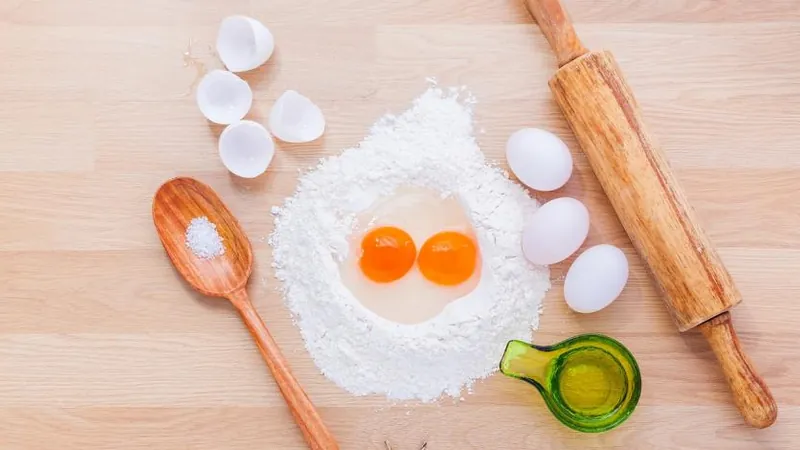
<ol><li>Mix the 450 g tipo 00 flour, 50 g plain flour and 1/2 teaspoon salt into a mound on a clean work surface and make a wide well in the centre.</li><li>Crack the 4 eggs into the well and beat them with a fork, gradually drawing in flour from the inner walls until a shaggy dough forms.</li><li>Knead by hand for 10 minutes until smooth and elastic, adding the tablespoon of water only if the dough feels dry and cracked.</li><li>Wrap the dough tightly and rest at room temperature for 30 minutes, or refrigerate for up to 1 hour, then return to room temperature before rolling.</li><li>Cut the dough into four pieces and roll each into a thin sheet with a rolling pin or pasta machine, dusting with flour to prevent sticking.</li><li>Cut into your chosen shape and lay the strands out on a floured tray to dry for 30 to 60 minutes before cooking.</li><li>Cook in a large pan of well-salted boiling water for 2 to 3 minutes, until it floats and is just tender.</li></ol>
</div>
</div>
</div><h2 id="where-egg-pasta-comes-from">Where egg pasta comes from</h2><div class="ad-unit ad-in-article" aria-label="Advertisement">
<span class="ad-label">Advertisement</span>
<ins class="adsbygoogle" style="display:block;text-align:center"
data-ad-client="ca-pub-3726833845844946"
data-ad-slot="3291553914"
data-ad-format="auto"
data-full-width-responsive="true"></ins>
<script>(adsbygoogle = window.adsbygoogle || []).push({});</script>
</div>
<p>Dried pasta and fresh egg pasta are two different traditions, and it helps to know which one you are making. Dried pasta, made from durum wheat semolina and water and shaped in factories, is the pasta of the Italian south, where the hard wheat grows and the dry climate let cooks store it through the year. Fresh egg pasta, the <em>pasta all’uovo</em> you are making today, belongs to the north, above all to Emilia-Romagna, the region around Bologna that gave the world tagliatelle, tortellini and lasagne. There, soft wheat and plentiful eggs made a richer, more golden dough, traditionally rolled paper-thin by hand with a long wooden pin called a <em>mattarello</em> by women known as <em>sfogline</em>, after <em>sfoglia</em>, the sheet of pasta itself.</p>
<p>The distinction is not snobbery, it is chemistry. Eggs bring fat and protein that make the dough supple and give the cooked pasta its silkiness and its rich colour, while the semolina in dried pasta gives that firmer, springier bite. Tagliatelle in Bologna and pappardelle in Tuscany were dishes for feast days and Sundays precisely because eggs and the labour of rolling were not everyday luxuries. Making it yourself at home is a small inheritance of that tradition.</p>
<h2 id="the-flour-and-why-the-mix">The flour, and why the mix</h2>
<p>Tipo 00 is Italian soft-wheat flour milled to a very fine, talcum-soft powder, and it makes a dough that is smooth and easy to roll thin. On its own, though, some cooks find it a touch slack, so I cut it with a small proportion of ordinary plain flour, which has a little more protein and lends the dough structure and a firmer bite once cooked. The 450 g to 50 g ratio gives you the silk of 00 with just enough backbone. If you only have plain flour, the pasta will still be very good, just slightly less delicate.</p>
<p>Eggs are the other half of the equation, and their size matters more than people expect. Four large eggs should weigh roughly 220 g out of the shell; if your eggs are on the small side you may need the extra tablespoon of water, and if they are enormous you may need a dusting more flour. Pasta dough is a feel, not a fixed formula, which is exactly why it rewards practice.</p>
<h2 id="making-the-dough">Making the dough</h2><div class="ad-unit ad-in-article" aria-label="Advertisement">
<span class="ad-label">Advertisement</span>
<ins class="adsbygoogle" style="display:block;text-align:center"
data-ad-client="ca-pub-3726833845844946"
data-ad-slot="3291553914"
data-ad-format="auto"
data-full-width-responsive="true"></ins>
<script>(adsbygoogle = window.adsbygoogle || []).push({});</script>
</div>
<p>Tip the flours and salt onto a clean work surface and mix them together, then shape the pile into a mound and hollow out a wide well in the centre, keeping the walls high enough to hold the eggs. Crack the eggs into the well and beat them with a fork as though making an omelette, then begin drawing flour down from the inner walls of the well a little at a time. Go slowly; if you breach the walls too early the eggs run everywhere and you end up chasing them across the counter. Once the mixture is too stiff to work with a fork, abandon it and bring the dough together with your hands.</p>
<p>Now knead. This is the part that cannot be rushed, because kneading develops the gluten network that gives fresh pasta its structure and stops it turning to paste in the pot. Push the dough away with the heel of your hand, fold it back, turn it a quarter and repeat, for a full 10 minutes. It starts out shaggy and ragged and slowly becomes smooth, tight and elastic, springing back when you press it. Add the tablespoon of water only if it stays dry and cracked; a slightly firm dough is correct, because a wet one is a nightmare to roll.</p>
<p>If the whole well-on-the-counter business makes you nervous the first time, there is no shame in mixing the eggs and flour in a wide bowl instead, or even pulsing them briefly in a food processor until they form crumbs, then tipping out to knead by hand. The traditional well is elegant and it warms you up to the feel of the dough, but the pasta does not know or care how it was brought together. What it does care about is the kneading and the rest, so do not shortcut either. You can tell the dough is properly kneaded when you press a thumb into it and the dent springs most of the way back, and when the surface has gone from ragged and matte to smooth and faintly satiny.</p>
<h2 id="resting-and-rolling">Resting and rolling</h2>
<p>Wrap the dough tightly in cling film and let it rest for at least 30 minutes, and up to an hour in the fridge. Do not skip this. Kneading leaves the gluten tense and springy, and resting lets it relax so the dough rolls out thin without fighting back and pinging into holes. If you refrigerate it, let it come back to room temperature first, or it will be stiff and brittle.</p>
<p>Cut the rested dough into four pieces, keeping the ones you are not working on covered with an upturned bowl or a damp cloth so they do not form a dry skin. Flatten a piece and roll it, either with a rolling pin on a well-floured surface or through a pasta machine, going down one setting at a time. If you rush straight to the thinnest setting the dough tears; the gradual progression stretches the gluten in stages and gives you an even sheet. You are aiming for a sheet thin enough to see the shadow of your hand through it, or to read newsprint through if you hold it up. Dust with flour whenever it feels tacky, and use a coarse semolina or plain flour for dusting rather than anything damp. Then cut it: wide ribbons for pappardelle, narrower ones for tagliatelle, or squares for lasagne. To cut ribbons neatly, dust the sheet well, fold it loosely into a flat roll, slice across it at your chosen width, then lift and shake the coils apart. Lay the cut pasta on a floured tray, tossed with a little flour to stop it clumping, and leave it to dry for 30 to 60 minutes while you make your sauce. A short dry firms the strands just enough that they hold their shape in the pot without becoming brittle.</p>
<h2 id="cooking-and-what-goes-wrong">Cooking, and what goes wrong</h2>
<p>Fresh pasta cooks astonishingly fast. Drop it into a large pan of well-salted, fast-boiling water and it is done in 2 to 3 minutes, as soon as it floats and tastes just tender. Use plenty of water, at least four litres for this quantity, so the temperature does not crash when the pasta goes in and the strands have room to move rather than clumping. The commonest mistake is treating it like dried pasta and boiling it for 10 minutes, which turns it to mush. The second commonest is under-salting the water: it should taste like the sea, because this is the pasta’s only chance to season from within. Reserve a mugful of the starchy cooking water before you drain, to loosen and emulsify your sauce, and finish the pasta by tossing it in the sauce over the heat for a few seconds so the two marry rather than sitting apart on the plate.</p>
<h2 id="storage-freezing-and-where-to-take-it">Storage, freezing and where to take it</h2>
<p>Fresh pasta keeps in the fridge for up to 2 days, well dusted with flour in an airtight container so it does not stick into a solid lump. For longer keeping, arrange the cut strands in loose nests on a tray, freeze until firm, then bag them; they cook straight from frozen with just an extra minute in the water. Do not skip the initial firm-freeze, or the strands weld together.</p>
<p>Because these noodles are delicate and eggy, they suit sauces that cling rather than drown. Melted butter and sage, a scrape of nutmeg and a shower of Parmigiano-Reggiano is the classic minimalist treatment. For something heartier, this is the pasta to roll for a proper <a href="/story/lasagne-bolognese/">lasagne bolognese</a>, where the tender sheets soak up the ragù, or to cut into the strands you want for <a href="/story/spaghetti-carbonara/">spaghetti carbonara</a> if you fancy making both halves of the dish from scratch. Once you are comfortable with the plain dough, try folding chopped herbs, a little spinach purée or a spoonful of squid ink into it for colour and flavour, using exactly the same method throughout.</p>
Advertisement
Related Content
Advertisement
