Patatas bravas
Viva el potato
Contents
↓ Jump to recipe<p>Patatas bravas is the tapas dish I judge a bar by. Get it right and it is one of the great small plates: potatoes fried until the corners crackle, blanketed in a warm, brick-red paprika sauce with just enough kick to make you reach for a cold drink. Get it wrong and it is soggy chips with ketchup. The gap between the two is almost entirely technique, and every bit of that technique is doable in a home kitchen. My version keeps the sauce the way I first met it in Madrid: a smooth, roux-thickened paprika sauce rather than a chunky tomato one, all smoky depth and gentle fire.</p>
<div class="recipe-card" id="recipe">
<div class="recipe-card-head"><p class="recipe-card-title">Patatas bravas</p>
<div class="recipe-card-actions"><a class="recipe-pin" href="https://www.pinterest.com/pin/create/button/?description%3dPatatas%2bbravas%26media%3dhttps%253A%252F%252Fmedia.vo.rs%252Faround-679209_1280.jpg%26url%3dhttps%253A%252F%252Fvo.rs%252Fstory%252Fpatatas-bravas%252F" target="_blank" rel="nofollow noopener" aria-label="Save to Pinterest"><i class="fab fa-pinterest-p fa-fw"></i> Save</a><button type="button" class="recipe-print" onclick="window.print()" aria-label="Print recipe"><i class="fas fa-print fa-fw"></i> Print</button>
</div>
</div>
<div class="recipe-meta"><span class="recipe-meta-item"><span class="recipe-meta-label">Serves</span>4 servings</span><span class="recipe-meta-item"><span class="recipe-meta-label">Prep</span>15 min</span><span class="recipe-meta-item"><span class="recipe-meta-label">Cook</span>30 min</span><span class="recipe-meta-item"><span class="recipe-meta-label">Cuisine</span>Spanish</span><span class="recipe-meta-item"><span class="recipe-meta-label">Course</span>Appetiser</span></div>
<div class="recipe-cols">
<div class="recipe-ingredients">
<h3>Ingredients</h3>
<ul><li>3 large floury potatoes (about 700g)</li><li>1 medium onion, finely chopped</li><li>2 tsp hot or smoked paprika</li><li>4 tbsp olive oil, plus extra for frying</li><li>30 g plain flour</li><li>300 ml chicken or vegetable stock</li><li>Salt</li><li>White pepper</li><li>A splash of red wine vinegar (optional)</li></ul>
</div>
<div class="recipe-method">
<h3>Method</h3>
<ol><li>Gently fry the finely chopped onion in olive oil over medium-low heat for 6 to 8 minutes until soft and translucent but not coloured.</li><li>Add a pinch of salt, white pepper and the paprika and cook, stirring, for 1 minute to bloom the paprika without scorching it.</li><li>Stir in the flour and fry for 30 seconds, then add the stock gradually, stirring until smooth.</li><li>Simmer on medium heat for 4 to 5 minutes until it thickens to a coating sauce, then adjust the seasoning and add a splash of vinegar if you like.</li><li>Peel and cut the potatoes into roughly 1.5 cm cubes and boil in well-salted water for 8 to 12 minutes until almost tender, then drain and steam-dry for at least 10 minutes.</li><li>Fry the cooled potatoes in olive oil over medium-high heat for 8 to 10 minutes until deeply golden and crisp, working in batches if needed.</li><li>Drain on kitchen paper, season with salt, pile into bowls and spoon the warm paprika sauce over the top. Serve at once.</li></ol>
</div>
</div>
</div><h2 id="bravas-angry-potatoes-from-madrid">Bravas, angry potatoes from Madrid</h2><div class="ad-unit ad-in-article" aria-label="Advertisement">
<span class="ad-label">Advertisement</span>
<ins class="adsbygoogle" style="display:block;text-align:center"
data-ad-client="ca-pub-3726833845844946"
data-ad-slot="3291553914"
data-ad-format="auto"
data-full-width-responsive="true"></ins>
<script>(adsbygoogle = window.adsbygoogle || []).push({});</script>
</div>
<p><em>Patatas bravas</em> means, roughly, “fierce” or “angry potatoes”, a name that points at the sauce rather than the spud. The dish is Madrid’s own, and it grew up in the city’s bars through the middle of the twentieth century, one of a family of cheap, satisfying plates that a tavern could turn out fast for people drinking cañas of beer and glasses of vermouth. Several old Madrid establishments claim to have popularised it; the bar Casa Pellico and the district around La Latina are often named, though as with most bar food the true first cook is lost.</p>
<p>What is worth knowing is that authentic Madrid bravas sauce is frequently <em>not</em> tomato-based at all. The purist version is built on olive oil, flour, stock and paprika, sometimes sharpened with a splash of vinegar — a smooth, russet sauce with a savoury, smoky warmth. The tomato-heavy versions you meet across much of Spain and abroad are a later and perfectly good variation, but the Madrid original leans on paprika for both colour and flavour. That is the version below, because it is the one that made me fall for the dish.</p>
<p>Paprika, <em>pimentón</em>, is the soul of it. Spanish pimentón comes sweet (<em>dulce</em>), bittersweet (<em>agridulce</em>) and hot (<em>picante</em>), and the smoked varieties from La Vera in Extremadura are dried over oak fires for a deep, almost bacon-like aroma. A good hot or smoked paprika is what separates a memorable bravas sauce from a dull one, so buy the best tin you can and keep it somewhere dark, because paprika stales and fades fast.</p>
<h2 id="what-you-need">What you need</h2>
<p><em>Serves 4 as a tapa.</em></p>
<p>For the potatoes:</p>
<ul>
<li>3 large floury potatoes (Maris Piper or similar), about 700g</li>
<li>Olive oil for frying, roughly 4 tablespoons</li>
<li>Salt</li>
</ul>
<p>For the sauce:</p>
<ul>
<li>1 medium onion, finely chopped</li>
<li>4 tablespoons olive oil</li>
<li>2 teaspoons hot or smoked paprika (or a mix)</li>
<li>30g plain flour</li>
<li>300ml (3 dl) chicken or vegetable stock</li>
<li>Salt and white pepper</li>
<li>A splash of red wine vinegar (optional, to sharpen)</li>
</ul>
<h2 id="how-to-make-it">How to make it</h2><div class="ad-unit ad-in-article" aria-label="Advertisement">
<span class="ad-label">Advertisement</span>
<ins class="adsbygoogle" style="display:block;text-align:center"
data-ad-client="ca-pub-3726833845844946"
data-ad-slot="3291553914"
data-ad-format="auto"
data-full-width-responsive="true"></ins>
<script>(adsbygoogle = window.adsbygoogle || []).push({});</script>
</div>
<p>Start with the sauce so it can sit while you fry. Warm the olive oil in a small pan over a medium-low heat and cook the finely chopped onion gently for 6 to 8 minutes until soft and translucent but not coloured; you want sweetness, not browning. Add a pinch of salt, a little white pepper and the paprika, and stir for a full minute — this blooms the paprika in the oil and wakes up its flavour, but keep the heat gentle because paprika scorches and turns bitter in seconds if the pan is too hot.</p>
<p>Scatter in the flour and stir constantly for about 30 seconds to cook out the raw taste, then pour in the stock a little at a time, stirring until smooth. Simmer on a medium heat for 4 to 5 minutes until it thickens to a coating sauce that just clings to the back of a spoon. Taste and adjust the salt, and add a small splash of vinegar if you want it sharper. If you like it smoother still, blitz it with a stick blender.</p>
<p>Now the potatoes. Peel them and cut into rough 1.5cm cubes, keeping them even so they cook at the same rate. Put them into a large pot of well-salted cold water, bring to the boil and simmer for 8 to 12 minutes until almost tender — a knife should meet only slight resistance. Drain them well and let them steam-dry and cool for at least 10 minutes; this step is the secret to crunch. Frying wet potatoes gives you soft ones.</p>
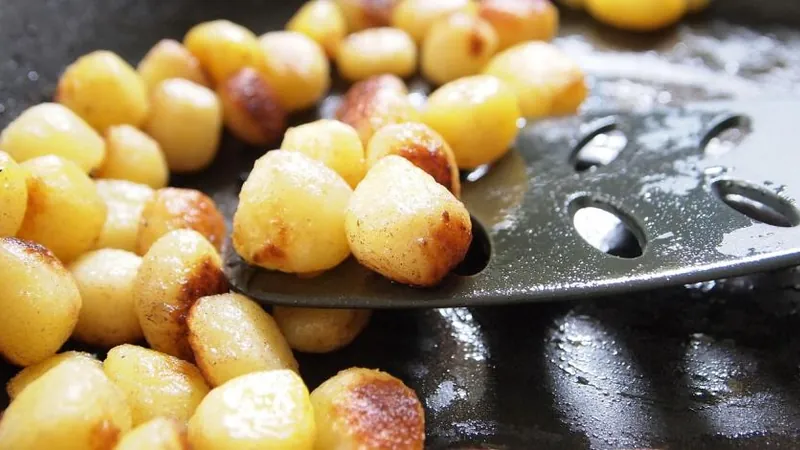
<p>Heat 4 tablespoons of olive oil in a large frying pan over a medium-high heat and fry the cooled potatoes in a single layer, turning occasionally, for 8 to 10 minutes until deeply golden and crisp on all sides. Work in two batches if your pan is crowded — piling them in steams rather than fries. Drain on kitchen paper, season with salt, pile into bowls and spoon the warm paprika sauce over the top. Serve at once.</p>
<h2 id="the-two-stage-trick-and-why-it-works">The two-stage trick, and why it works</h2>
<p>The single most important thing in patatas bravas is that you parboil the potatoes before you fry them. It feels like a faff, but the reasoning is straightforward: boiling gelatinises the starch and cooks the inside soft, so that when the cubes hit the hot oil, the outside can dry out and crisp into a shell without the middle still being raw and chalky. Fry raw potato cubes and you are forced to choose between a burnt outside or a hard centre. Parboil first and you get both a fluffy interior and a shatteringly crisp crust.</p>
<p>The cooling step matters just as much. Warm, damp potatoes throw off steam in the pan, and steam is the enemy of crispness. Letting them dry on a tray for ten minutes — or even chilling them uncovered in the fridge for an hour — drives off surface moisture so the oil can do its work. If you want to go further, a light dusting of flour or cornflour on the dry cubes before frying gives an extra-crunchy coat, a trick I borrow from roast potatoes.</p>
<p>For the sauce, the two hazards are burnt paprika and lumps. Bloom the paprika off a fierce heat, and add the stock gradually to the flour so it disperses rather than seizing into pockets. If it does go lumpy, a quick whizz with a stick blender rescues it completely.</p>
<p>There is also the question of the fry itself. Olive oil is traditional and gives the right flavour, but it does not need to be your best extra-virgin — a workaday olive oil, or even a neutral oil cut with a little olive oil, fries perfectly well and costs less. Keep the oil hot enough that a cube sizzles on contact; too cool and the potatoes drink oil and go greasy rather than crisp. If you would rather not shallow-fry, the parboiled, dried cubes roast beautifully in a very hot oven, 220°C, tossed in a couple of tablespoons of oil for 30 to 35 minutes until golden, turning once. It is a lighter route to almost the same crunch, and a good option if you are cooking a lot at once.</p>
<p>One more thing on cutting: keep the cubes on the larger side, around 1.5cm to 2cm. Small dice fry faster but end up all crust and no fluffy middle, which is half the pleasure of a good bravas. You want that contrast of a crackling shell around a soft, steamy interior in every mouthful.</p>
<h2 id="substitutions-storage-and-the-aioli-question">Substitutions, storage and the aioli question</h2>
<p>Floury potatoes crisp best, but waxy ones hold their shape and are worth using if you prefer neat cubes over maximum fluff. Vegetable stock keeps the dish vegetarian; smoked paprika alone (no fresh chilli) gives plenty of warmth if you want depth without much heat. A pinch of cayenne or a crumbled dried chilli pushes it properly <em>brava</em> for those who want to sweat a little.</p>
<p>Fry the potatoes to order — they lose their crunch within minutes of sitting under sauce — but the sauce itself keeps happily in the fridge for three days and reheats gently with a splash of water to loosen it. If you are feeding a crowd, parboil and dry the potatoes hours ahead, then do the final fry just before serving.</p>
<p>There is real room to play with the sauce once you trust the method. A spoonful of tomato purée or a couple of tinned tomatoes blitzed in nudges it towards the tomato-based version you meet outside Madrid, giving a slightly sweeter, redder result. A crushed clove of garlic softened with the onion deepens it; a pinch of ground cumin lends an earthy, faintly North African note that suits the paprika. Some cooks finish with a knob of butter for gloss, others with a squeeze of lemon for lift. The frame stays the same: soft onion, bloomed paprika, a roux, good stock, and enough seasoning to make it sing.</p>
<p>Do resist the temptation to serve the sauce fridge-cold over hot potatoes, which cools everything to a lukewarm middle. Warm it through gently so both elements arrive hot, and get it to the table fast, because the whole joy of the dish is that first bite where the crust still crackles under the sauce.</p>
<p>In many bars, bravas arrive with a second sauce alongside: a garlicky white one. That is where my <a href="/story/aioli/">aioli</a> comes in, and the combination of fiery red sauce and cool garlic emulsion, the <em>mixta</em> style, is how a lot of Spaniards actually order it. Serve the potatoes as part of a proper spread with a <a href="/story/spanish-omelette-a-ten-step-guide/">Spanish omelette</a>, some good bread and a plate of olives, and you have a tapas table worth lingering over.</p>
Advertisement
Related Content
Advertisement
