Panettone: The Long Proof Worth the Patience
Milan's towering Christmas bread, from a rested biga to a hanging cool
Contents
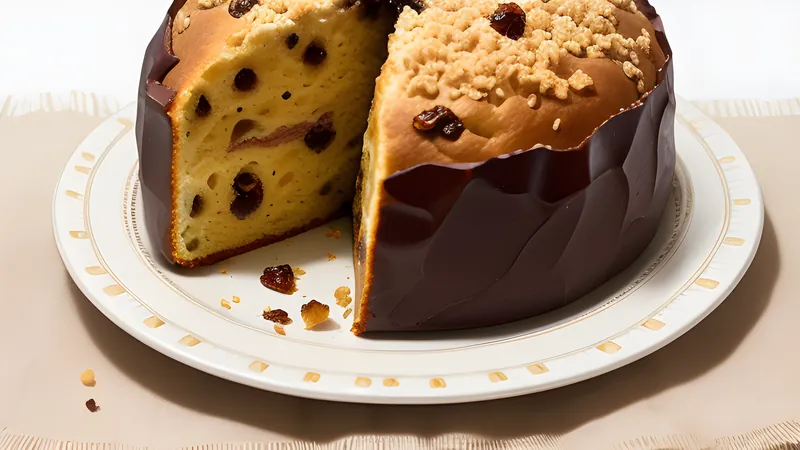
↓ Jump to recipeThere are bakes you make on a whim and bakes you commit to, and panettone is firmly the second kind. It takes two days, a small mountain of egg yolks and butter, a patience that borders on the meditative, and a slightly absurd final step in which you skewer the finished loaf and hang it upside down like a cooling bat. What you get in return is a tall, domed, cloud-light bread with a crumb so tender and open it seems to defy the amount of fruit and richness it carries. Buy a good one and it costs a fortune; bake your own and you will understand exactly why.
Milan’s bread of luxury
Panettone comes from Milan, and like most beloved foods it has more origin legends than any one loaf could earn. The most charming tells of a fifteenth-century nobleman’s kitchen boy named Toni, who saved a collapsed Christmas dessert by improvising a rich, fruited bread; it became pan de Toni, Toni’s bread. Whether or not Toni existed, the word panettone simply means a large loaf, and the enriched Milanese version was a luxury item, sweetened and fruited at a time when sugar and candied peel were expensive.
The airy, towering panettone we recognise today is largely a twentieth-century industrial achievement. In the 1920s the Milanese baker Angelo Motta gave it its now-standard tall domed shape by proving the dough inside a paper collar, and he and his rival Gioacchino Alemagna turned it into a mass-produced Christmas institution sold across Italy and, eventually, the world. Traditional artisan panettone is leavened with a natural sourdough starter, the lievito madre, refreshed obsessively over days, which gives it both its lift and its long keeping. That is a serious commitment, so this recipe uses a compromise that home bakers can actually manage: an overnight biga, a stiff pre-ferment, combined with commercial yeast. It won’t match a Milanese master’s, though it produces a genuinely tall, fragrant, feathery loaf without a pet starter to feed for a week.
Panettone: The Long Proof Worth the Patience
Ingredients
- For the biga: 100g strong white bread flour
- For the biga: 60g water
- For the biga: 3g fast-action dried yeast
- 400g strong white bread flour (ideally high-protein)
- 120g caster sugar
- 6g fine salt
- 7g fast-action dried yeast
- 120ml whole milk, lukewarm
- 4 large egg yolks, plus 1 whole egg
- 150g unsalted butter, softened
- 2 tsp vanilla bean paste
- Finely grated zest of 1 orange and 1 lemon
- 1 tbsp honey
- 120g raisins soaked in 3 tbsp Marsala or orange juice
- 100g candied orange peel, chopped
Method
- The night before, mix the biga flour, water and yeast to a stiff dough, cover and leave at room temperature for 12 to 16 hours until risen and bubbly.
- Combine the main flour, sugar, salt and yeast. Add the biga, milk, yolks, whole egg, vanilla, zests and honey, and mix to a dough.
- Knead 12 to 15 minutes until very elastic, then work in the softened butter a little at a time until glossy and passing a windowpane test.
- Prove until doubled, 2 to 3 hours.
- Gently work in the drained soaked raisins and candied peel.
- Shape into a tight ball and drop into a 1kg paper panettone mould. Prove until the dough crests the rim, 3 to 5 hours.
- Score a cross in the top, place a knob of butter in the centre, and bake at 160C fan for 45 to 50 minutes, tenting with foil once dark.
- Skewer two long metal rods through the base and hang the panettone upside down until completely cold, several hours.
The one clever twist: honey in the crumb
A spoonful of honey in the dough is my quiet addition, and it does more than sweeten. Honey is hygroscopic, meaning it draws and holds moisture, so it keeps the crumb soft for longer and mimics, in a small way, the long-keeping character that a natural starter gives a traditional panettone. It also adds a floral depth behind the citrus and vanilla that reads as complexity rather than sweetness. Use a mild honey, acacia or orange blossom, so it supports the other flavours instead of shouting over them.
Why you hang it upside down
The upside-down cool is the step everyone finds ridiculous and everyone should do. Panettone’s crumb is extraordinarily light and delicate, weak and full of hot, moist air the moment it leaves the oven. If you cool it upright, the tall dome will sink and compress under its own weight while the structure is still soft, giving you a collapsed, dense loaf. Hanging it inverted lets gravity stretch the crumb gently downward as it sets, locking in that towering, open structure. This is why panettone moulds and skewers exist at all. Make sure your skewers pass right through the sturdy base of the paper case, not the fragile crumb near the top.
Troubleshooting the long doughs
The two things that go wrong are underdeveloped gluten and impatient proving. If your dough will not come together after the butter and stays soupy, it was not kneaded enough beforehand; a stand mixer really helps here, as this is a punishing dough to knead by hand. If the loaf bakes short and heavy, the final prove was cut short, so wait until the dough genuinely crests the rim before baking. Because the dough is so enriched, it proves slowly; a warm spot around 26 to 28C is ideal, and a turned-off oven with the light on works well.
Keeping, serving and using the last of it
Well made and honey-softened, panettone keeps in an airtight bag for a week or more and only improves for the first day or two. Serve it in tall wedges with coffee, or with a glass of sweet spumante or vin santo in the Italian way. Slightly stale panettone is a gift: it makes the most luxurious bread-and-butter pudding imaginable, or French toast, or the base of a trifle. Toasted and buttered, a day-old slice is breakfast worth getting up for.
If you have caught the enriched-bread bug
Panettone sits at the demanding end of a family of celebration breads that all reward patience. Its German counterpart is the dense, marzipan-cored stollen, rested for a fortnight under a coat of sugar, while for an easier introduction to soft, rich doughs the tangzhong method behind these cloud-soft milk rolls teaches the same lessons about hydration and tenderness with far less commitment. If it is the long weekend project you enjoyed rather than the fruit, the lamination of croissants from scratch scratches exactly the same itch. Panettone is a bake to grow into, and the first time your own loaf stands tall and light on the board, hung upside down like a slightly mad experiment, you will forgive it the two days entirely.
Related Content